

Momentum-Space Feynman Rules
Momentum-space Feynman rules are the Fourier transform of the quadratic kernel and interaction monomials in a declared action. In the all-momenta-incoming convention, invert the regulated quadratic kernel for each internal line, multiply each interaction coefficient by and by the momentum factors generated by derivatives, impose a momentum-conserving delta distribution at every vertex, integrate each independent internal momentum with , and divide by the graph symmetry factor. This procedure fixes signs and normalizations without relying on a memorized model catalog.
Required background. Diagrammatics and Symmetry Factors supplies the decorated graphs and their residual factors.
Helpful background. Fourier Series, Fourier Transforms, and Plancherel Theory supplies the transform and convolution rules; Scalar Propagators, Ordered Correlators, and Sources fixes the Feynman boundary value.
Quadratic kernels become propagators
Section titled “Quadratic kernels become propagators”Write a bosonic quadratic action in momentum space as
The internal-line rule is the regulated inverse
where abbreviates the state and boundary prescription needed for the particular kernel. For a canonically normalized real scalar,
This is not merely algebraic matrix inversion at a pole: the boundary value is part of the propagator. Constrained or gauge-degenerate quadratic forms must be gauge fixed or reduced before they can be inverted.
For a Dirac field with
the same Fourier convention gives the inverse kernel and
Multiplication by returns away from the prescribed pole, providing an immediate numerator and sign check.
Local interactions become vertices
Section titled “Local interactions become vertices”With
the spacetime integral of a local product produces
Thus a conventionally normalized interaction
gives the vertex
The has already been canceled by the identical field attachments. If the action does not contain that factorial, the vertex rule must retain the corresponding combinatorial multiplicity. Momentum-space conversion and the vertex delta functions are worked explicitly in Schwartz 2014, § 7.3, pp. 93–96 and Weinberg 1995, § 6.3, pp. 281–285.
Exact vertex momentum conservation uses translation invariance. If a coupling is switched, , the spacetime integral instead gives
Thus the switched vertex is with the inherited forward Fourier phase . The delta is recovered only when the constant-coupling or infinite-volume limit exists; it should not be imposed prematurely in finite-time calculations. Constant switching conceals the sign of the argument because .
Derivatives act on the field immediately following them and produce for an incoming momentum . For example,
gives, with both identical momenta incoming,
The sign follows mechanically: each derivative gives , the action contributes , and the two identical attachments cancel the explicit . Derivative Interactions and Contact Terms treats the integration-by-parts and time-derivative qualifications.
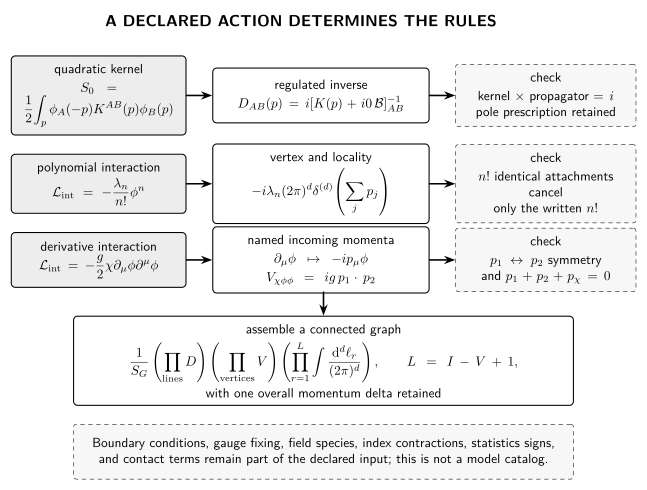
The action-to-rule map is summarized below. Inspect which data are algebraic and which remain prescriptions.
On a narrow screen, swipe the diagram or focus it and use the left/right arrow keys; Home and End move to its edges. Open the full-size diagram.
From action terms to momentum-space ingredients in the site Fourier convention. The quadratic kernel is inverted only after its boundary or gauge prescription is fixed; polynomial factorials determine identical-field combinatorics; each derivative supplies on its own incoming field. The diagram is schematic and does not replace model-specific index contractions.
| Action datum | Momentum-space rule | Independent check |
|---|---|---|
| multiplying by gives as a distributional inverse | ||
| direct Wick counting cancels | ||
| one local spacetime integral | translation invariance conserves momentum | |
| a total derivative gives at the vertex | ||
| closed independent momentum cycle | for a connected graph |
Assemble a connected graph
Section titled “Assemble a connected graph”For a connected graph with internal lines and vertices:
- assign an incoming momentum to every half-edge;
- put one propagator on each internal line;
- put the complete tensor and coupling factor on each vertex;
- include one delta distribution per vertex;
- integrate one momentum per internal line;
- use independent vertex deltas to perform integrals, retaining one overall delta; and
- multiply by and all statistics signs.
The number of remaining integrals is
the number of independent loops in a connected graph. After stripping the overall delta, a tree has and therefore no unconstrained loop integration. Weinberg derives this counting directly from the vertex delta functions Weinberg 1995, § 6.3, pp. 282–283.
In compressed notation the contribution therefore has the structure
with a declared routing . A change of loop routing is a change of integration variables only when the regulator respects that shift; superficially divergent integrals require care before such manipulations are used.
As a minimal check, the one-vertex connected four-point function contributes
before amputation. There is one vertex delta, no internal line, and no loop integral. The external propagators belong to the correlator; LSZ later removes them under stable-particle pole assumptions.
Overall factors and convention checks
Section titled “Overall factors and convention checks”Several conventions can change the appearance of intermediate rules:
- choosing all momenta outgoing replaces every displayed incoming momentum by its negative;
- defining a propagator without its numerator factor moves powers of elsewhere;
- changing the sign of changes the vertex sign; and
- reversing an oriented fermion or ghost line changes which momentum is named incoming, not the final invariant amplitude.
A reliable translation reconstructs a simple correlator from the action and checks its pole, residue, momentum delta, and mass dimension. “Up to conventions” is not enough when an amplitude sign or phase is at stake.
Common pitfalls
Section titled “Common pitfalls”Inverting a singular gauge kernel. A gauge-invariant quadratic form has null directions. Declare the gauge-fixed action first; its inverse is gauge dependent and is not itself an observable.
Adding an extra factorial at the vertex. The factorial in a normalized interaction monomial is designed to cancel identical attachments. Count from the written action once.
Integrating every internal momentum after using deltas. Start with one integral per internal line, then use independent vertex deltas. A connected graph retains exactly loop variables.
Check your understanding
Section titled “Check your understanding”Starting from , derive the three-point vertex, including its momentum delta and identical-field factor.
Solution
Fourier transforming the three fields gives one spacetime exponential , hence . The perturbative expansion contributes , while the two identical fields can be attached in ways. The factors cancel, leaving
Replace the constant coupling by a time window , with . For total incoming energy , compute the time integral at the vertex. Which feature detects the sign of the Fourier argument?
Solution
Set and evaluate the Gaussian Fourier integral:
This is . A nonzero displacement supplies the phase ; using would conjugate that phase. The centered window cannot detect this error. Its finite width also shows why an exactly energy-conserving delta is inappropriate before the constant-window limit is taken.
Where to continue
Section titled “Where to continue”- Track graded signs: Fermion Signs and Closed Loops fixes open-line ordering and loop signs.
- Handle momentum-dependent vertices carefully: Derivative Interactions and Contact Terms separates spatial derivatives from time-ordering contact terms.
- Convert correlators into stable-particle amplitudes: Asymptotic States, LSZ, and Scattering Observables supplies external residues, amputation, and state normalization.