

LSZ for Spinor and Vector External States
Spin does not change the logic of LSZ: isolate a stable one-particle pole, divide by the square root of its residue, amputate the external propagator, and take the positive-energy on-shell limit. What changes is the pole numerator. A Dirac leg ends in an on-shell or spinor; a spin-one leg ends in a physical polarization vector. Gauge-fixed vector components that do not represent positive-norm asymptotic states are never promoted to external particles.
The common pole-factorization logic for arbitrary spin is developed in Weinberg 1995, §§ 10.2–10.3, pp. 430–441.
Required background. LSZ Reduction: Poles, Residues, and Stable External States supplies the scalar residue argument. The Fermion Propagator fixes the Dirac pole numerator. Massive and Massless Spin-One Polarizations fixes the physical polarization spaces.
Helpful background. Covariant Free-Photon Quantization and Propagator distinguishes gauge-fixed propagator components from physical photon states.
Dirac poles and external spinors
Section titled “Dirac poles and external spinors”Use
For a stable Dirac particle of mass , choose phases and normalization so that
Near the physical pole, the exact propagator has the form
The numerator is the positive-energy spin projector because
We use and , with analogous antiparticle relations. The on-shell equations
ensure that the inverse Dirac operator amputates the pole and leaves the corresponding wave function. Srednicki derives the fermionic asymptotic overlaps and reduction factors in Srednicki 2006 draft, § 41, pp. 263–267, PDF.
For a connected amputated object with its open Dirac indices displayed, the four familiar endpoints are
| External particle | State direction | Endpoint contracted with |
|---|---|---|
| fermion | incoming | |
| fermion | outgoing | |
| antifermion | incoming | |
| antifermion | outgoing |
The placement is not mnemonic decoration: it follows from whether or has the nonzero vacuum-to-particle matrix element and from the ordering of the open spinor index. Reversing a fermion line or crossing a particle requires the statistics and phase convention of the amplitude, not only replacing by .
Massive spin-one poles
Section titled “Massive spin-one poles”For a stable massive vector state,
where
There are three physical polarizations, and their completeness relation is
After amputating the vector pole and multiplying by , an incoming leg is contracted with and an outgoing leg with . The completeness tensor provides an independent check: it is transverse and has trace with both indices lowered in the convention.
An unstable massive vector does not satisfy the premise. A complex resonance pole or narrow line shape can be treated inside a larger stable-particle amplitude, but there is no exact asymptotic to reduce.
Massless vectors and the physical-state restriction
Section titled “Massless vectors and the physical-state restriction”For a stable massless gauge boson, only the two transverse helicities are physical external states. Choose a reference vector with . A useful polarization sum is
Changing changes the representatives by terms proportional to . A complete physical amplitude must therefore satisfy the on-shell Ward check
so that leaves unchanged. The gauge-fixed propagator may contain longitudinal or scalar components, but LSZ contracts its physical pole residue with transverse external polarizations. Srednicki gives the photon reduction and normalization condition in Srednicki 2006 draft, § 56, pp. 339–342, PDF.
This page uses the Ward identity as a necessary amplitude check. The general BRST proof that gauge-parameter dependence cancels between physical states belongs to the gauge-structure treatment, and Vector External States and Ward Checks performs the perturbative complete-amplitude test.
One reduction pipeline, different pole numerators
Section titled “One reduction pipeline, different pole numerators”The scalar LSZ map remains valid after replacing its scalar endpoint by a spin projector. In the figure, inspect the final stage: the inverse pole removes propagation, while the spinor or polarization selects a state inside the pole residue.
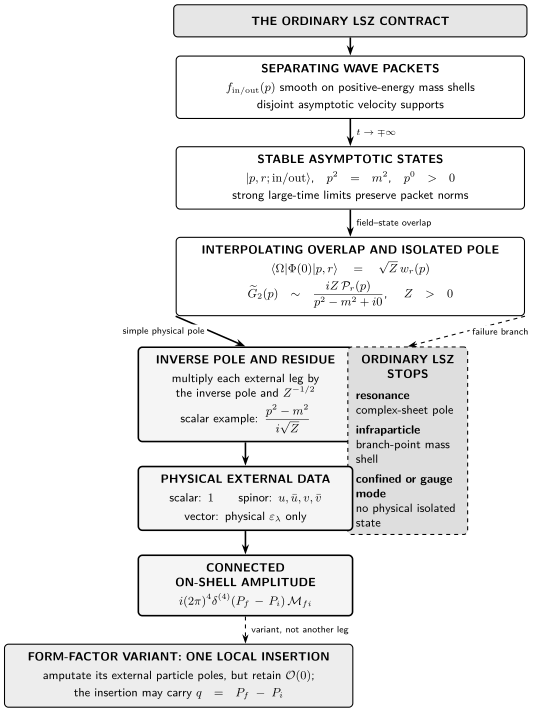
On a narrow screen, swipe the diagram or focus it and use the left/right arrow keys; Home and End move to its edges. Open the full-size diagram.
For a Dirac leg, or in the pole residue is resolved by or wave functions. For a stable vector leg, the residue is resolved by physical polarizations; gauge-fixed auxiliary directions are excluded. The same isolated-pole, packet, and stability assumptions as scalar LSZ remain in force. Schematic and not to scale.
| Field pole | Physical residue data | External contraction | Failure to exclude |
|---|---|---|---|
| scalar | non-simple or nonphysical pole | ||
| Dirac | or antiparticle projector | unstable or infraparticle charged state | |
| massive vector | three | unstable vector resonance | |
| massless gauge vector | transverse physical residue | two helicity polarizations | longitudinal gauge modes or confined gauge quanta |
A residue and spin-sum check
Section titled “A residue and spin-sum check”For a real coupling , suppose an amputated scalar source creates a fermion pair through
Summing over final spins gives
The first line checks the external-state normalization: each spin sum reproduces the numerator of the corresponding on-shell pole. A rate for unobserved final spins sums this expression; it does not divide by the number of final polarizations. Initial-state averaging is a separate specification of the prepared beam ensemble.
Boundaries that survive the formal similarity
Section titled “Boundaries that survive the formal similarity”- A photon can be a sharp stable external particle while a charged excitation in the same theory fails ordinary Fock-state LSZ because of soft radiation.
- A perturbative gluon polarization is useful inside a partonic calculation, but confinement prevents an exact colored asymptotic S-matrix state.
- A massive Proca field has three physical polarizations; a massless gauge field has two after quotienting gauge directions. Setting in the massive projector is singular and is not a derivation of the massless state space.
- Mixing fields require a matrix residue. One must identify and normalize the physical pole eigenvectors before attaching external wave functions.
For the last point, suppose several Dirac interpolators overlap stable states of the same mass through
State insertion factorizes the pole residue:
Choose a dual on the residue image, , and contract with to select the normalized physical state before applying the Dirac inverse. Left-null field combinations have zero overlap and cannot create that particle. This factorized prescription is invariant under changes of interpolating-field basis; taking square roots of individual matrix entries is not.
Common pitfalls
Section titled “Common pitfalls”“The numerator of a fermion propagator is amputated and discarded.” Amputation removes the inverse propagator; its on-shell residue is resolved into the external spinor. Dropping that wave function loses spin information.
“Use for every external vector sum.” For a massive vector the longitudinal physical polarization contributes . For a massless vector, reference-dependent terms disappear only after contraction with a Ward-consistent amplitude.
“Any pole in a gauge-fixed propagator is an external particle.” Physical-state conditions and positive norm are indispensable. Auxiliary, ghost, and confined excitations do not become external states through LSZ notation.
Check your understanding
Section titled “Check your understanding”-
Verify that is annihilated by on shell.
Answer
Multiply: . Thus the spin sum lies in the kernel of the on-shell inverse Dirac operator, as a physical pole residue must.
-
Why may a reference vector appear in a massless polarization sum but not in a physical rate?
Answer
The reference selects representatives of the two-dimensional gauge quotient. Changing it adds momentum-proportional terms. Contracting with a complete amplitude satisfying removes those terms, so the rate is reference independent.
Continue
Section titled “Continue”Vector External States and Ward Checks tests the physical-polarization rule in complete amplitudes. Cross Sections and Decay Rates explains spin sums and initial averages. On-Shell States and Little-Group Scaling repackages the same physical state data without gauge-redundant fields.
References
Section titled “References”- Srednicki, Mark. Quantum Field Theory. Prepublication draft, 2006. Author’s draft and published-edition errata. Open PDF.
- Weinberg, Steven. The Quantum Theory of Fields. Volume I: Foundations. Cambridge: Cambridge University Press, 1995. DOI.