

Form Factors and Local Operator Insertions
A scattering form factor is a matrix element of one declared local operator between stable asymptotic states. LSZ amputates and residue-normalizes only the external particle legs of a correlator containing that insertion; the operator itself remains inserted. Translation symmetry assigns a momentum transfer to the insertion rather than forcing the ordinary S-matrix condition , and Lorentz symmetry, discrete symmetries, and Ward identities organize the remaining tensor structures.
Required background. LSZ Reduction supplies external-leg reduction. Operators, Observables, and Matrix Elements fixes the state–operator distinction. Local and Composite Operator Insertions explains source insertions before an interacting renormalized definition is chosen.
Helpful background. LSZ for Spinor and Vector External States supplies spinning external factors. Relativistic Scattering Kinematics supplies momentum-transfer variables. Mandelstam Channels and Tree-Level Crossing and Free-Field OPE Preview clarify two nearby but distinct uses of operator data.
What a form factor is
Section titled “What a form factor is”For one local operator , define the connected matrix element
Translation covariance gives
Set . A fixed insertion at can transfer this momentum and therefore carries no . Using an injection-momentum convention, define
so under the site’s global Fourier convention. Then
An ordinary S-matrix amplitude differs in two ways: its interaction is integrated over spacetime with no externally prescribed injected momentum, and its connected matrix element carries . A vacuum-to-many-particle quantity is also called a form factor; it is a special state choice, not the definition of every form factor.
LSZ with one insertion
Section titled “LSZ with one insertion”For scalar external particles, start from
Apply to every and the same Fourier phase, Klein–Gordon operator, and factor as in ordinary LSZ. Do not apply to . The result is
where the compact notation means the simultaneous on-shell residue limit with the appropriate incoming and outgoing phases. Schwartz emphasizes that any interpolating operator with a one-particle overlap can be used in reduction Schwartz 2014, § 6.1.2, pp. 73–74. Here plays a different role: it is the retained observable insertion, while the surrounding fields interpolate the external particles.
Connectedness needs care. Subtract a vacuum expectation when it factors from the external overlap, and separate spectator delta functions from the genuinely connected insertion matrix element. The exact subtraction depends on the states and operator quantum numbers.
The LSZ pipeline therefore ends differently for a form factor. Inspect the figure’s final note: external poles are removed, but the local insertion remains as the source of momentum and tensor structure.
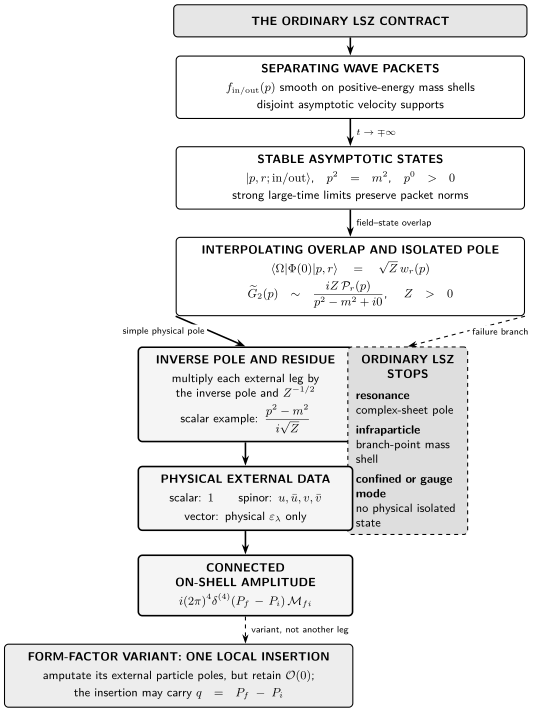
On a narrow screen, swipe the diagram or focus it and use the left/right arrow keys; Home and End move to its edges. Open the full-size diagram.
LSZ with one local insertion uses the same stable-state, wave-packet, pole, and residue assumptions as ordinary scattering. Scalar, spinor, or vector external legs are amputated and contracted with physical wave functions; is retained and may inject . Resonances, infraparticles, and confined fields remain invalid ordinary external legs. Schematic and not to scale.
Spin-zero current form factor
Section titled “Spin-zero current form factor”Let be a conserved Hermitian current and let the external particle be a stable spin-zero state of mass . Lorentz covariance permits
Current conservation gives
For equal on-shell masses and generic , . If the matrix element has no longitudinal massless pole at , continuity extends the same one-form-factor decomposition to zero transfer:
With the charge operator normalized by , a particle of charge satisfies . This is an invariant normalization check, not a perturbative approximation. Weinberg derives the scalar decomposition, conservation constraint, and zero-transfer normalization in Weinberg 1995, § 10.6, pp. 452–454.
Spin-one-half current form factors
Section titled “Spin-one-half current form factors”For equal-mass stable spin-one-half states and a conserved parity-even vector current,
where
The on-shell Dirac equations and antisymmetry of ensure current conservation. In the standard electromagnetic normalization, , while is the Pauli form factor and supplies the anomalous magnetic coupling. If one factors an elementary charge from the current, the static magnetic moment is ; this statement also allows a neutral particle to have a nonzero Pauli moment. Different communities use spacelike instead of ; translating the argument must not change or a measured cross section. The decomposition and its normalization are derived in Weinberg 1995, § 10.6, pp. 454–457.
Operator renormalization is separate from external-leg reduction
Section titled “Operator renormalization is separate from external-leg reduction”LSZ factors remove external propagation and field-overlap residues. They do not make a composite insertion finite. In an interacting theory, a set of operators with the same quantum numbers can mix,
possibly with equation-of-motion, total-derivative, or lower-dimensional terms allowed by the regulator and symmetries. The form factor inherits the chosen renormalization scheme, scale, and operator basis. Renormalized Composite-Operator Insertions develops that construction, mixing, and scale evolution.
This separation supplies a useful check: changing the normalization of an external interpolating field cancels against its LSZ and leaves the form factor invariant. Changing the renormalized operator basis transforms the components of the form-factor vector and is not supposed to cancel.
If is a finite change of operator basis, then the form factors transform covariantly,
Only a contraction with coefficients transforming inversely is basis independent. By contrast, a conserved current with exactly normalized charge may be protected from multiplicative renormalization; that is a Ward-identity statement about the declared current, not a generic property of local insertions.
Nearby objects that are not interchangeable
Section titled “Nearby objects that are not interchangeable”| Object | External states | Momentum delta | Where to continue |
|---|---|---|---|
| ordinary S-matrix amplitude | stable in/out particles | this volume’s amplitude chapters | |
| local-operator form factor | stable in/out particles plus one retained insertion | after Fourier transforming the insertion | this page and model-specific current applications |
| correlator/OPE data | local operator insertions, not asymptotic particle states | translation constraints among all insertions | From the Local OPE to Conformal Data |
| exact integrable form-factor bootstrap | exact asymptotic states in special -dimensional integrable theories | model-specific axioms and crossing equations | Form-Factor Bootstrap and Correlator Expansions |
Crossing can sometimes relate a matrix element between particles to a vacuum-to-many-particle form factor by analytic continuation. That relation is not mere relabeling and is not assumed without its analyticity, phase, and singularity conditions.
Common pitfalls
Section titled “Common pitfalls”“The operator insertion is another external particle leg.” It is retained, not amputated. It can carry off-shell momentum and need not correspond to any asymptotic state.
“A fixed insertion conserves the external particle momentum.” Translation covariance allows . A delta distribution appears only after Fourier transforming the insertion and states that the insertion supplies .
“LSZ renormalizes a composite operator.” LSZ normalizes external pole residues. Composite-operator renormalization and mixing are separate ultraviolet data.
“Every object called a form factor obeys the same bootstrap axioms.” Perturbative current matrix elements, hadronic form factors, and exact integrable form factors share vocabulary but have different assumptions and definitions.
Check your understanding
Section titled “Check your understanding”-
Show directly that the scalar current form factor is conserved on shell.
Answer
Contract with : . Thus any scalar function multiplying this vector respects current conservation.
-
Why does not produce an overall momentum-conservation delta function?
Answer
Fixing the insertion at one point breaks the spacetime integration that would generate a delta distribution. Translation covariance records the mismatch as the phase . Fourier integrating restores a delta function with the insertion momentum included.
-
In a free complex-scalar theory with current , what is the one-particle form factor in the unit-charge convention?
Answer
Direct contraction of the bilinear with normalized one-particle states gives
Thus at tree level, in particular . The result checks the derivative sign, external-state normalization, and charge normalization simultaneously.
Continue
Section titled “Continue”Use Renormalized Composite-Operator Insertions when scale dependence or mixing matters. Use Mandelstam Channels and Tree-Level Crossing for analytic crossing, Form-Factor Bootstrap and Correlator Expansions for exact integrable theories, and the relevant application volume for a model-specific current.