

Forward Scattering Sum Rules
In a gapped forward amplitude, crossing combines the two cuts and the optical theorem turns the right-cut discontinuity into inclusive production data. Even low-energy Taylor coefficients then become inverse-energy moments of a physical absorptive part; crossing-odd combinations instead give generally signed sum rules unless extra structure supplies a sign.
Required background. Subtracted dispersion relations supplies the contour formula and subtraction count. The optical theorem and cut interpretation supplies the inclusive state sum and its normalization.
The crossing-even forward moment expansion
Section titled “The crossing-even forward moment expansion”Consider identical massive scalars and first remove all stable one-particle poles below the two-particle threshold. At define
so the cuts begin at . Assume real analyticity, no other first-sheet singularities, and on the large complex arc. The twice-subtracted relation about is
The factor of two is the combined right- and left-cut contribution. Its sign can be checked by expanding both kernels and before combining them. This forward crossing construction and its subtraction dependence are developed in Weinberg 1995, § 10.8, pp. 465–469.
For , expand the denominator geometrically:
Thus is an inverse-energy moment. The first undetermined subtraction constant is ; crossing has removed the linear one. More subtractions would leave more Taylor data outside the integral.
Inclusive data and convergence
Section titled “Inclusive data and convergence”With the common relativistic normalization in four dimensions, the forward optical theorem reads
Other amplitude normalizations change the positive kinematic factor, not the sign. The moment therefore sums every on-shell final state accessible from the chosen initial state. It is not just the elastic cross section and is not a tree-level identity. Adams and collaborators use exactly this inclusive input to turn a forward contour integral into a positive coefficient Adams et al. 2006, § 4, pp. 14–19, PDF.
Convergence is checked twice:
- Near threshold, phase space and any threshold singularity must make the weighted integral locally integrable.
- At infinity, the power must beat the absorptive growth. The same growth estimate must also justify discarding the original large arc.
A convergent moment does not retroactively justify the contour step: an amplitude could have acceptable real-axis data but uncontrolled growth in other complex directions.
The contour figure can now be read as a sum rule. The right and left lips become the same inclusive spectrum only after crossing; the small pole circles must be removed before a Taylor coefficient is identified.
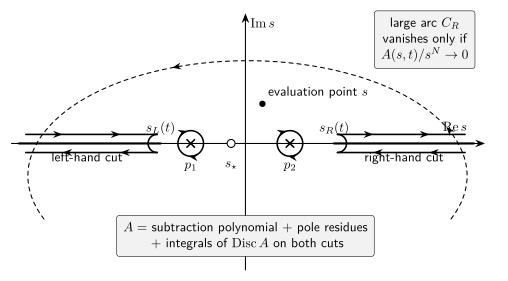
Schematic forward contour, not to scale. Crossing maps the left cut to a physical crossed-channel cut, the optical theorem supplies its inclusive absorptive data, and two subtractions leave while determining the even coefficients for . The dashed arc still requires the stated high-energy bound.
| Contour contribution | Forward sum-rule meaning |
|---|---|
| right cut | inclusive -channel production |
| left cut | crossed-channel production, with crossing matrix or parity retained |
| pole circles | known stable exchange terms, removed explicitly |
| subtraction point | low-energy constants not fixed at the chosen subtraction order |
Crossing-odd sum rules
Section titled “Crossing-odd sum rules”For particles with charge, flavor, or spin, crossing acts on a vector of amplitudes. In a crossing eigenchannel write
has the even moment expansion above. For , the ratio is even, but its right-cut absorptive part is a crossing-weighted combination of physical processes. In ordinary particle–antiparticle examples the resulting integrand contains a difference of inclusive cross sections. Unitarity makes each cross section nonnegative, not their difference. Consequently an odd sum rule can be predictive without being a positivity bound.
If the odd amplitude decreases unusually fast, an otherwise free odd subtraction constant may obey a superconvergent sum rule. That statement requires the stronger falloff explicitly; it must not be inferred from crossing alone.
Moment checks
Section titled “Moment checks”Write . Because ,
whenever the chosen channel has nonzero absorptive weight. Cauchy–Schwarz supplies a stronger internal check,
and support on gives
Indeed, with
the three entries are , , and . Cauchy–Schwarz gives the first inequality, while gives the second. They are consequences of the positive measure and its support, not additional assumptions. The systematic moment formulation and its finite Hankel constraints are given in Bellazzini et al. 2021, § I.A–B, pp. 2–5, PDF.
Exercises
Section titled “Exercises”Put all spectral weight at one narrow scale . Show that and that the Cauchy–Schwarz inequality is saturated.
Check
For with ,
so . A mixture of distinct scales generally moves the sequence into the interior of the moment region.
Continue to the sign theorem: Forward-Limit Positivity Bounds. For nonzero momentum transfer: Fixed-t and Partial-Wave Dispersion.
References
Section titled “References”- Adams, Allan, Nima Arkani-Hamed, Sergei Dubovsky, Alberto Nicolis, and Riccardo Rattazzi. “Causality, Analyticity and an IR Obstruction to UV Completion.” Journal of High Energy Physics 10 (2006): 014. DOI. Open PDF.
- Bellazzini, Brando, Joan Elias Miró, Riccardo Rattazzi, Marc Riembau, and Francesco Riva. “Positive Moments for Scattering Amplitudes.” Physical Review D 104 (2021): 036006. DOI. Open PDF.
- Weinberg, Steven. The Quantum Theory of Fields. Volume I: Foundations. Cambridge: Cambridge University Press, 1995. DOI.