

Causality, Growth, and Analytic Domains
Relativistic microcausality, the spectrum condition, locality, and suitable asymptotic states support analyticity of scattering amplitudes in qualified complex-momentum domains. Fixed- dispersion relations and polynomial bounds need additional mass-gap, domain, and growth assumptions; Froissart– Martin behavior is therefore a theorem under a specific hypothesis set, not a consequence of “causality” alone.
Required background. Analyticity and Crossing of Amplitudes supplies cuts, sheets, and boundary values. Microcausality and Relativistic Compatibility supplies the local commutativity statement and its scope. Partial-Wave Unitarity supplies the angular-momentum bound.
From causal support to complex momentum
Section titled “From causal support to complex momentum”A retarded distribution vanishes outside the future causal domain. Its Fourier–Laplace transform is analytic when the imaginary momentum lies in a corresponding forward tube. For scattering, LSZ reduction, spectral support, and edge-of-the-wedge arguments can connect such tube analyticity to domains of complex external momenta and, for amplitudes, to domains in and .
For example, let be an LSZ current and define between stable one-particle states
Microcausality implies . With the site Fourier sign, complexify momentum as and consider
If , then damps the transform throughout the future-cone support; the properly smeared Fourier–Laplace transform is holomorphic in the future tube. The advanced commutator gives the opposite tube. This is an off-shell several-variable statement. Spectral gaps, stable LSZ poles, and edge-of-the-wedge continuation are the additional steps needed before it becomes a statement about an on-shell Mandelstam amplitude Dyson 1958, pp. 1460–1464.
Each step has hypotheses: local fields as distributions, a stable vacuum, the spectrum condition, appropriate mass shells, and existence of the scattering limits. A mass gap makes the separation between one-particle poles and multiparticle thresholds particularly useful. Massless exchange brings singularities toward and can remove the fixed- neighborhood used in standard bounds.
At fixed physical , locality and the gap can yield analyticity in the scattering angle inside a Lehmann ellipse rather than the whole complex plane. Unitarity can enlarge particular domains—the Martin extension—but the result is not the unrestricted Mandelstam representation. Martin’s original theorem states its axiomatic setting in Il Nuovo Cimento A 42 (1966), pp. 930–953.
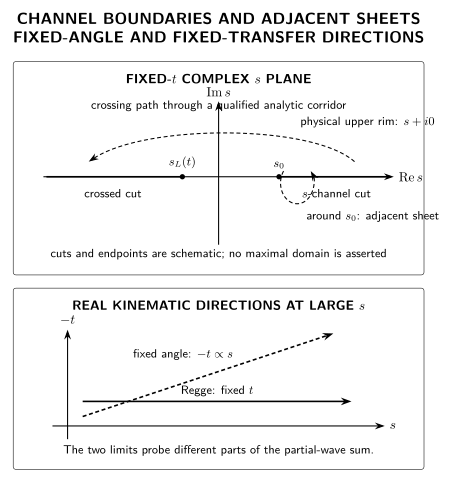
Microcausality and spectral support motivate analytic domains, while mass gaps, unitarity, and growth assumptions control their useful extension. The schematic crossing corridor is not a claim of maximal analyticity, and its fixed- high-energy arrow is distinct from the fixed-angle direction.
Growth and the number of subtractions
Section titled “Growth and the number of subtractions”Suppose that for fixed the amplitude is analytic in the cut -plane and obeys a polynomial bound
on the large contour in the relevant domain. Choosing subtractions makes the contour contribution vanish and gives the schematic relation
The polynomial contains subtraction data not fixed by the discontinuity. More subtractions improve convergence but introduce more such data. If no growth bound has been established, writing an unsubtracted dispersion relation is an additional assumption.
For equal-mass self-conjugate scalars it is often cleaner to use the crossing variable
and a pole-subtracted crossing-even amplitude . If on the contour, choose an integer with ; then
Crossing combines the two cuts and removes odd subtraction powers. For distinguishable particles or a non-eigenstate of crossing, the left- and right-cut integrals and the general subtraction polynomial must be retained separately.
Mizera derives the elementary causal-transform mechanism and its subtraction logic in Mizera 2023, open lecture-note PDF, §§ 1.2–1.3, pp. 13–19, then discusses the QFT and Froissart qualifications in Mizera 2023, open lecture-note PDF, § 5.3, pp. 141–148.
What a Froissart-type statement assumes
Section titled “What a Froissart-type statement assumes”For a local, unitary relativistic theory with the required analyticity, polynomial boundedness, and a nonzero nearest -channel singularity , the high-energy total cross section is bounded asymptotically by a constant times
The coefficient and scale depend on the precise theorem and conventions; the important structural inputs are the angular analyticity domain, partial-wave unitarity, and a mass gap in the crossed channel. Froissart’s original result assumed the Mandelstam representation and obtained logarithmic-squared growth for total cross sections Physical Review 123 (1961), pp. 1053–1057. Martin’s later axiomatic extension sharpened the analyticity input.
The standard conclusion does not transfer unchanged to theories with massless exchange, long-range forces, finite temperature, curved spacetime, or observables without an ordinary -matrix. Nor does it determine the actual asymptotic behavior; it is an upper bound.
This page supplies the bounded physical argument, not a proof of the maximal domain. Rigorous scattering analyticity and crossing bounds develops the theorem-level hypotheses, while subtracted dispersion relations show how a declared growth bound fixes the allowed contour construction.
Check your understanding
Section titled “Check your understanding”Given on the large fixed- contour, determine a sufficient number of subtractions and count the independent subtraction coefficients. Then remove the -channel mass gap and identify which step of the Froissart–Martin argument loses its standard domain. A successful answer labels both changes as hypothesis changes, not algebraic corrections.
Solution
In a general -plane representation, any integer number of subtractions strictly greater than the growth exponent is sufficient, so four subtractions leave a cubic polynomial with four independent coefficient functions of . For a crossing-even amplitude organized in paired powers of , choose ; the smallest choice is , leaving . These are two parametrizations of different symmetry input, not contradictory counts. If the nearest crossed-channel singularity moves to , the nonzero Lehmann–Martin angular domain used to suppress high partial waves collapses; the standard Froissart–Martin derivation and coefficient no longer follow.
References
Section titled “References”- Dyson, Freeman J. “Integral Representations of Causal Commutators.” Physical Review 110 (1958): 1460–1464. DOI.
- Froissart, Marcel. “Asymptotic Behavior and Subtractions in the Mandelstam Representation.” Physical Review 123 (1961): 1053–1057. doi:10.1103/PhysRev.123.1053.
- Martin, André. “Extension of the Axiomatic Analyticity Domain of Scattering Amplitudes by Unitarity—I.” Il Nuovo Cimento A 42 (1966): 930–953. doi:10.1007/BF02720568.
- Mizera, Sebastian. “Physics of the Analytic S-Matrix.” Physics Reports 1047 (2024): 1–92. DOI. Open PDF, §§ 1.2–1.3 and 5.3, pp. 13–19 and 141–148.