

Lorentzian Correlators and Causal Orderings
A Euclidean correlator does not determine a usable Lorentzian formula until one specifies how every insertion approaches real time. The infinitesimal imaginary times fix the Wightman ordering, the continuation path fixes the sheet in cross-ratio space, and the two boundary values of a cut determine the commutator or double discontinuity used by analytic bootstrap methods.
Required background. Cross ratios and four-point kinematics fix , , , and . Lorentzian boundary conditions and the prescription explain how operator order is encoded by complex time.
Helpful background. Wick rotation and analytic continuation reviews the relation between Euclidean and real-time boundary values.
Lorentzian boundary values of a Euclidean correlator
Section titled “Lorentzian boundary values of a Euclidean correlator”Use the site’s Lorentzian metric. Starting from Euclidean times , continue
Then the Euclidean ordering becomes the Wightman product
For a scalar two-point denominator,
Exchanging two operators reverses the sign of the corresponding . Their difference is a commutator boundary value. Spacelike separated local operators commute, so the two continuations agree there; timelike separation can place them on different sides of a branch cut. This tube-domain viewpoint, and not the shorthand instruction “send to ,” is what keeps the ordering unambiguous Caron-Huot 2017, §2.2, pp. 6–9.
Time ordering is a sum of Wightman boundary values selected by step functions. Retarded correlators add a commutator and causal support. These are different distributions; one cannot change from one to another by relabeling a single analytic expression after the hierarchy has been discarded.
Cross-ratio sheets and causal orderings
Section titled “Cross-ratio sheets and causal orderings”For identical real scalars, use
In a Euclidean configuration , and the correlator is single-valued even though individual conformal blocks need not be. The OPE converges in finite radial domains with an exponentially controlled high-dimension tail Pappadopulo et al. 2012, §§3–5. In Lorentzian signature and are independent. The branch points , , and correspond to pairwise null configurations in the three OPE channels. A path winding or changes the sheet; a path winding or changes the sheet associated with a different channel.
It is therefore insufficient to state only a final pair of real numbers . Two paths can end at the same point and represent different operator orderings. A complete specification gives:
- the initial Euclidean point;
- the hierarchy of ;
- the path of and relative to , , and ;
- the final boundary value, such as ;
- the OPE channel and causal region in which a subsequent expansion is used.
The figure below is a visual guide to these data. Inspect the distinction between a permutation, which changes the cross-ratio coordinates, and a monodromy, which changes the analytic sheet.
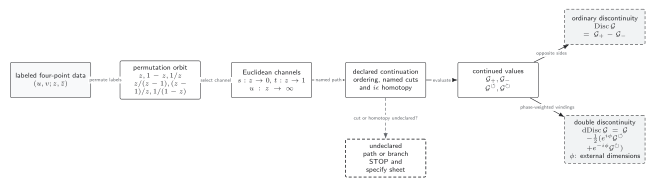
Cross ratios, OPE channels, Euclidean regions, Lorentzian orderings, and analytic sheets. The diagram separates from the phase-weighted clockwise/counterclockwise combination defining . It is schematic: arrows represent specified homotopy classes, not continuous motion through an everywhere-analytic region.
The same content can be read without the figure:
| Operation | Cross-ratio effect | Physical datum that must remain fixed |
|---|---|---|
| Permute points | Relabeled external operators and prefactor | |
| Continue around | Wightman ordering and direction of winding | |
| Approach a cut | Upper or lower boundary value | |
| Take a lightcone limit | with a declared behavior of | Order of limits, sheet, and OPE channel |
| Take a Regge limit | Continue to a Regge sheet, then scale both variables | Boost parameter, impact parameter, and smearing |
The six basic permutations generated by exchanging four points act on by
and similarly on . The prefactor in the full correlator transforms too. Checking only the reduced function without its prefactor can therefore create a false sign or power mismatch.
Discontinuities and double discontinuities
Section titled “Discontinuities and double discontinuities”For a cut in , define the oriented discontinuity
Reversing this definition reverses every later commutator sign, so the convention must be carried into inversion and dispersion formulas. For identical external scalars, the double discontinuity around is
where the two superscripts denote counterclockwise and clockwise continuation around while is held on its declared branch. For unequal external dimensions the two continued terms carry phases; omitting those phases changes the inversion kernel’s input. In the reflection-positive identical-scalar configuration used by the Lorentzian inversion formula, the double discontinuity is related to a product of commutators and has a positivity property Caron-Huot 2017, eqs. (2.14)–(2.16), pp. 8–9. The spacetime derivation makes the causal diamonds and commutator ordering explicit Simmons-Duffin, Stanford, and Witten 2018, §§2–3. That positivity statement does not extend automatically to mixed, charged, or nonunitary correlators.
Solvable check: generalized free field
Section titled “Solvable check: generalized free field”For
the crossed contraction contains . Away from contact distributions, its two monodromies are
Consequently,
This check fixes the factor of two and the direction-independent double discontinuity. If is an integer, the pointwise expression vanishes, but endpoint or contact distributions may still matter. A pointwise zero must not be used to discard such terms before the integration prescription is specified.
Failure modes
Section titled “Failure modes”Endpoint without path. Reporting only real and loses the homotopy class of the continuation. Record which branch point was wound and in which direction.
Euclidean OPE on a Lorentzian sheet. Euclidean convergence does not follow a correlator through a cut. Re-establish the applicable expansion or use a Lorentzian representation designed for that sheet.
Commutator sign by memory. The sign depends on the definition of Disc and on the ordering. Derive it from the two boundary values.
Positivity outside its domain. Double-discontinuity positivity uses unitarity, reflection positivity, operator reality, and a specific ordering. Mixed or nonunitary systems require a separate argument.
Exercises
Section titled “Exercises”For , compute its discontinuity and double discontinuity around .
Solution
The two monodromies are and . Hence
On the principal branch and with the declared upper-minus-lower convention,
Reversing the discontinuity convention reverses this sign.
References
Section titled “References”- Caron-Huot, Simon. “Analyticity in Spin in Conformal Theories.” Journal of High Energy Physics 2017, 078 (2017). doi:10.1007/JHEP09(2017)078.
- Pappadopulo, Duccio, Slava Rychkov, Johnny Espin, and Riccardo Rattazzi. “OPE Convergence in Conformal Field Theory.” Physical Review D 86, 105043 (2012). doi:10.1103/PhysRevD.86.105043.
- Simmons-Duffin, David, Douglas Stanford, and Edward Witten. “A Spacetime Derivation of the Lorentzian OPE Inversion Formula.” Journal of High Energy Physics 2018, 085 (2018). doi:10.1007/JHEP07(2018)085.