

Extremal Functionals, Navigators, and Spectrum Reconstruction
Extremal functionals, primal solutions, and navigator objectives turn exclusion boundaries into candidate CFT data and efficient searches. They are inference tools, not existence theorems: reconstructed dimensions and OPE coefficients depend on extremality, degeneracies, basis choices, finite cutoffs, and the selected objective.
Required background. Mixed-Correlator Islands supply the conditional allowed region. Solver Certificates and Independent Verification supply primal-dual checks. Helpful background. Linear Functionals and Positivity supply the functional zeros used below.
Literature cutoff: 2026-08-09. Navigator implementations and reconstructed spectra are research-sensitive. This page states method-level checks and exact synthetic fixtures; it does not assert a current spectrum estimate for a named interacting CFT.
Extremal zeros and primal data
Section titled “Extremal zeros and primal data”At a smooth boundary point, an extremal functional often obeys
on operators that enter a candidate boundary solution. Interior zeros in a continuous dimension sector are typically tangent zeros, so the derivative with respect to also vanishes when the zero is nondegenerate. Endpoint zeros obey different conditions. The zero pattern depends on functional normalization and finite basis.
Given candidate locations, solve the truncated primal equation
and report the residual in the original unscaled crossing basis. Mixed systems reconstruct PSD OPE matrices or vectors up to signs and rotations in degenerate subspaces. A small residual with an unstable operator list indicates overfitting to the finite basis rather than a stable spectrum.
The extremal functional method relates boundary zeros to candidate low-lying data and must be tested as cutoffs increase El-Showk and Paulos 2013, §§2–4.
Navigator functions
Section titled “Navigator functions”A navigator replaces a binary feasibility query by a continuous objective on parameter space. In one common convention,
The sign and normalization belong to the chosen deformation of crossing; record them. is not a metric distance to the set of exact CFTs. Gradients can guide optimization and trace boundaries, but local minima, nonsmooth changes of active constraints, and objective dependence require multiple starts and direct certificate checks Reehorst et al. 2021, §§2–4.
Stability protocol
Section titled “Stability protocol”Track each candidate operator across derivative order, block order, spin coverage, precision, and nearby parameter points. Match operators by quantum numbers and a continuity criterion declared before looking at the result. Report zero multiplicity, singular values of the truncated primal system, positivity margins, and rotations within near-degenerate subspaces. Disappearing high operators are expected; a claimed low-lying datum must be stable within a stated envelope. The relationship among extremal, primal, and navigator methods is reviewed in Rychkov and Su 2024, §§III.C–III.D.
For a generalized-free-field fixture, exact exchanged dimensions and OPE coefficients provide a target. Deliberately truncate the tower, reconstruct low states, and verify that the residual decreases with the declared tail treatment. This tests reconstruction mechanics without asserting an interacting model.
The shared figure places navigator searches, extremal reconstructions, and benchmark reproductions in separate evidence classes. Compare their supported-claim boxes with the common boundary against model identity, existence, and uniqueness.
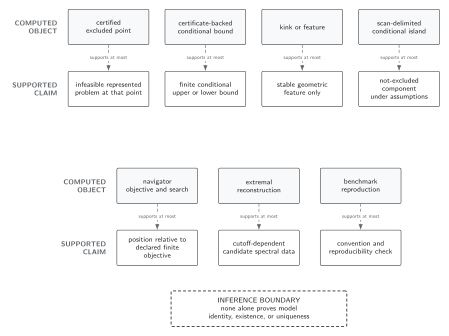
Schematic evidence classification for navigator and extremal methods. A navigator locates points relative to a chosen deformed feasibility problem; extremal and primal data reconstruct a cutoff-dependent candidate spectrum; benchmark reproduction checks a frozen target and environment. None proves uniqueness, model identity, or existence without further checks.
The seven visible columns have this semantic mapping:
| Computed or reproduced object | Strongest supported claim | Not established by that object alone |
|---|---|---|
| Certified excluded point | The represented problem is infeasible at that point under the stated assumptions | Nonexistence of an exact CFT outside the controlled representation |
| Certificate-backed conditional bound | A finite upper or lower boundary in the declared represented problem | Realization of a CFT at the boundary |
| Kink or feature | A stable geometric feature after the stated refinements | Identification with a particular theory |
| Scan-delimited conditional island | A not-excluded component bounded by tested certificates and brackets | Realization of every interior point or uniqueness |
| Navigator objective and search | Position relative to the declared finite deformed objective in the searched domain | A physical distance to theory space or a unique model |
| Extremal reconstruction | Cutoff-dependent candidate dimensions and OPE data | An exact full spectrum or model identity |
| Benchmark reproduction | A frozen observable or certificate is reproduced within the declared tolerance | Correctness of every method or identification of a theory |
Use the canonical Numerical claim taxonomy when reporting a navigator evaluation, search optimum, extremal-functional support, primal reconstruction, or model-compatibility statement. Its global stop rule applies here: finite feasibility and stable reconstructed data do not establish a full crossing solution, realization, existence, uniqueness, or model identity.
Failure tests
Section titled “Failure tests”Multiplicity test. Treat a tangency zero as two distinct operators. The primal system should expose rank loss or unstable coefficients.
Objective test. Change the navigator deformation while keeping the physical feasible set. A moving minimum must not be called physical data without qualification.
Degeneracy test. Rotate a near-degenerate OPE subspace. Only invariant combinations should remain stable.
Finish with Benchmark Reproduction and Data Provenance before treating any reconstructed numbers as reproducible evidence.
References
Section titled “References”- El-Showk, Sheer, and Miguel F. Paulos. “Bootstrapping Conformal Field Theories with the Extremal Functional Method.” Physical Review Letters 111 (2013): 241601. DOI. Open PDF
- Reehorst, Marten, Slava Rychkov, David Simmons-Duffin, Benoit Sirois, Ning Su, and Balt van Rees. “Navigator Function for the Conformal Bootstrap.” SciPost Physics 11 (2021): 072. DOI. Open PDF
- Rychkov, Slava, and Ning Su. “New Developments in the Numerical Conformal Bootstrap.” Reviews of Modern Physics 96 (2024): 045004. DOI. Open PDF