

Crossing Kernels and Conformal 6j Symbols
A conformal crossing kernel is the change-of-basis coefficient between partial waves associated with different OPE trees. For a four-point function it is the conformal-group analogue of a Racah coefficient, or symbol. This representation-theoretic object should not be confused with a conformal block, an OPE coefficient, or the kernel of a dispersion relation.
Required background. The Lorentzian inversion formula provides a practical projection onto direct-channel data. Partial waves and the shadow formalism provide the single-valued basis and its inner product.
Helpful background. Representations, intertwiners, and invariants explains why a change between two association schemes is an intertwiner rather than new dynamical data.
Literature cutoff. Research-sensitive statements about kernel constructions, meromorphic continuation, and higher-point recoupling reflect primary sources available through 2026-08-09. Later completeness or spinning-kernel results require a renewed source check.
Partial waves form the recoupling basis
Section titled “Partial waves form the recoupling basis”Consider four scalar primaries in a Euclidean CFT in dimensions. A single-valued -channel partial wave is a shadow-symmetric combination
where the factors depend on the external dimensions and the chosen two- and three-point normalizations. On the scalar principal series,
these partial waves are delta-normalizable with respect to a conformally invariant inner product. Their completeness takes the schematic Plancherel form
possibly augmented by discrete terms when the contour is deformed. The Plancherel measure , shadow factors, tensor-structure pairings, and quotient by the conformal-group volume are all part of the normalization. Omitting any one of them changes the numerical kernel Karateev, Kravchuk, and Simmons-Duffin 2019, §2.
The -channel partial wave can be expanded in the -channel basis:
Up to the displayed measure convention, the crossing kernel is the normalized overlap
Writing each partial wave as a gluing of two conformal three-point functions turns this overlap into four three-point structures integrated over internal positions. The resulting tetrahedral contraction is the conformal symbol Liu et al. 2019, §3.
What the kernel computes
Section titled “What the kernel computes”The kernel is kinematic: it depends on conformal representations and normalization choices, not on the spectrum or OPE coefficients of a particular CFT. Dynamics enters when a correlator supplies a spectral weight in one channel. If
then its -channel coefficient is obtained by convolution,
with the same measures as in the completeness relation. Poles of in include the double-twist locations generated by the crossed partial wave. After the contour is moved toward a physical OPE, residues contribute direct-channel block coefficients; shadow partners and coincident-pole derivatives must be separated before reading them as CFT data.
For external scalars, a direct calculation in reduces the kernel to finite combinations of generalized hypergeometric functions. In general dimension, the Lorentzian inversion formula can project a crossed partial wave and exposes the same pole families above its valid spin threshold. The spacetime inversion derivation makes that threshold and its commutator support explicit Simmons-Duffin, Stanford, and Witten 2018, §§3–4. This is a useful equality of two constructions, not permission to discard the inversion formula’s Regge and low-spin conditions.
The following diagram shows the four-point change of channel and its continuation to higher-point OPE trees. Follow the representation label through each recoupling: the same local move becomes an edge of a larger tree rather than a new kind of OPE coefficient.
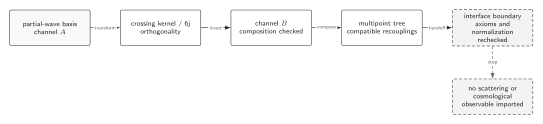
Schematic recoupling map. A conformal symbol changes one binary association of four representations into another; compositions relate higher-point OPE trees, subject to the same shadow, measure, and contour conventions.
An equivalent algebraic reading is:
| Stage | Basis object | Operation | Required check |
|---|---|---|---|
| Four-point channel | Expand a crossed partial wave | Principal-series measure and shadow pairing | |
| Four-point channel | Project onto the basis | External-order and tensor-structure convention | |
| Channel change | Integrate the product of four three-point structures | Normalization and discrete residues | |
| Higher-point tree | Products of partial waves | Compose local recouplings | Equality of two recoupling sequences |
Recoupling consistency
Section titled “Recoupling consistency”A legitimate change of basis must be invertible on the chosen harmonic-analysis space. Schematically,
in a convention where shadow-equivalent labels have been quotiented once. For five representations, comparing two sequences of elementary recouplings gives the conformal analogue of the pentagon identity. These relations are independent checks on a proposed kernel. They are stronger than matching only the locations of a few double-twist poles.
A mean-field check
Section titled “A mean-field check”Take a crossed scalar partial wave and project it into the direct channel. Its kernel has pole pairs at the dimensions associated with the two external pairings; for identical scalars, one family begins at
The residues reproduce the corresponding mean-field OPE data after the block, shadow, and Plancherel normalizations are combined. This check tests both pole locations and residues. A calculation that finds only the locations has not fixed the symbol.
Common pitfalls
Section titled “Common pitfalls”Replacing partial waves by blocks. A Euclidean conformal block is not single-valued and does not by itself furnish the principal-series orthogonal basis. The shadow combination and its normalization are essential.
Moving the contour without recording residues. Discrete terms crossed during a contour deformation are part of the channel transform. Dropping them can erase low-lying or shortened representations.
Calling any large-spin coefficient a crossing kernel. Large-spin residues may be extracted from a kernel, but they do not specify its full meromorphic dependence, inverse transform, or recoupling identities.
Ignoring tensor structures. With spinning external operators, the kernel is a matrix between three-point-structure bases. Each shadow transform carries its own pairing matrix and possible parity label.
Exercises
Section titled “Exercises”Assume the -channel spectral density consists of one delta-normalized partial wave. Use the channel-change equation to identify the -channel spectral density, then state the two extra steps required to obtain physical block coefficients.
Solution
The direct-channel density is the appropriate column of . To obtain a physical OPE expansion, deform the principal-series contour and retain every crossed pole residue, then separate each partial wave into its physical block and shadow block with the declared factors. Regge restrictions enter if Lorentzian inversion is used to evaluate the kernel.
References
Section titled “References”- Karateev, Denis, Petr Kravchuk, and David Simmons-Duffin. “Harmonic Analysis and Mean Field Theory.” Journal of High Energy Physics 2019, no. 10 (2019): 217. doi:10.1007/JHEP10(2019)217.
- Liu, Junyu, Eric Perlmutter, Vladimir Rosenhaus, and David Simmons-Duffin. “d-Dimensional SYK, AdS Loops, and 6j Symbols.” Journal of High Energy Physics 2019, no. 3 (2019): 052. doi:10.1007/JHEP03(2019)052.
- Simmons-Duffin, David, Douglas Stanford, and Edward Witten. “A Spacetime Derivation of the Lorentzian OPE Inversion Formula.” Journal of High Energy Physics 2018, no. 7 (2018): 085. doi:10.1007/JHEP07(2018)085.