

Sphere Partition Functions and Universal CFT Data
The sphere partition function packages a CFT’s response to curvature in one number, but that number is not universally meaningful in every dimension. In even dimensions the logarithmic radius dependence is controlled by the Euler anomaly while the finite part is counterterm dependent. In odd dimensions the real finite part can be universal under the usual locality and symmetry assumptions. Zero modes, gauge volumes, and source contacts must be treated before either statement is applied.
Required background. Anomaly Coefficients and Central Charges fixes type-A normalization. Weyl Covariance on Curved Backgrounds fixes the generating functional. Helpful background. Defect Entropy and Monotonicity compares sphere-like observables localized on a defect.
Radius response on a round sphere
Section titled “Radius response on a round sphere”Consider a CFT on a smooth closed round sphere of radius , with the zero-mode measure fixed and local power-law terms subtracted. Keep the renormalization scale fixed when varying , and reserve for scalar curvature. Define
A constant change of radius is a Weyl rescaling. With the inherited positive covariant-metric variation of ,
For a nonchiral two-dimensional CFT with and , the integral gives . For the parity-even purely gravitational anomaly of a four-dimensional CFT,
the round sphere has , , and , hence
These signs use the stress and positive normalization of the fixed-point trace calculation. In particular, a real conformal scalar has and sphere response in four dimensions; its positive conformal Laplacian has no zero mode. The coefficient of , with fixed reference radius , is universal. A finite -independent term can be shifted by allowed local curvature counterterms, while unsubtracted cosmological or Einstein terms would add separate powers of .
Odd and even dimensions
Section titled “Odd and even dimensions”The useful distinction is:
| Dimension | Universal sphere datum on a closed sphere | Main qualification |
|---|---|---|
| Even | coefficient of the logarithm, proportional to type-A data | finite part is scheme dependent |
| Odd | real finite part | parity-odd phases and topological counterterms are separate |
| Noninteger in an expansion | a chosen analytic continuation such as | continuation and subtraction convention must be stated |
In three dimensions, the use of the real sphere free energy as an endpoint quantity and its perturbative tests are developed in Klebanov, Pufu, and Safdi 2011. This does not remove the zero-mode, phase, or endpoint qualifications stated here.
A frequently useful interpolation is
which connects odd-dimensional finite terms to even-dimensional anomaly residues in dimensional regularization Giombi and Klebanov 2015, §§1–2. Here one uses the chosen dimensionally continued expression before subtracting its even-dimensional pole. If
The limit follows by expanding the sine. A finite change of cannot change it. Continuation away from integer dimension and the finite subtraction still require a prescription; this interpolation by itself is not a dimension-independent monotonicity theorem.
Source derivatives and integrated correlators
Section titled “Source derivatives and integrated correlators”At fixed background metric, introduce real constant sources linearly in the Euclidean action, keeping the displayed operators fixed under this variation:
Then
and
The negative connected term follows from the real action source . If the operators or renormalized counterterms depend explicitly on , their source derivatives must also be retained as local contact contributions. Coincident-point singularities make the double integral regulator dependent; these contacts can alter the Hessian. On a conformal manifold, a protected combination can define the Zamolodchikov metric only after redundant directions and source coordinates are fixed.
Zero modes and normalization
Section titled “Zero modes and normalization”A functional determinant with a zero eigenvalue is not defined by simply including that eigenvalue in . One must separate the zero modes and specify their integration or quotient and measure normalization. Examples include:
- the constant mode of a noncompact massless scalar;
- gauge transformations and ghost zero modes;
- Goldstone modes in a spontaneously broken description;
- collective coordinates around a saddle.
For the real noncompact massless scalar on , let and define the metric-independent field volume with a fixed field-value range. The normalized constant-mode coefficient is , so dividing by leaves in the partition function. The anomaly-normalized scalar free energy is therefore
up to constants fixed by the measure and renormalization units. It has the response ; omitting the constant eigenfunction without the area factor gives a different scale dependence. The closed-surface scalar derivation explains the finite Weyl formula, using the determinant scaling in Sarnak 1990, §1, pp. 603–605, PDF. This scalar example is not a definition of an arbitrary interacting CFT or a prescription for gauge zero modes.
Different mode and quotient choices can add or volume factors. State them before evaluating the determinant and compare the scale derivative with the anomaly in the same normalization.
The anomaly-to-sphere branch of the Weyl response diagram has this structured equivalent:
| Stage | Retain | Do not confuse with |
|---|---|---|
| Regulated determinant or path integral | regulator, measure, zero-mode prescription | renormalized |
| Local subtraction | divergent and finite curvature counterterms | universal coefficient |
| Even-dimensional output | logarithmic coefficient | arbitrary finite constant |
| Odd-dimensional output | real finite part in a symmetry-preserving scheme | parity-odd phase |
| Source differentiation | integrated connected correlator plus contacts | separated-point correlator alone |
The sphere box uses the renormalized generating functional and its local-response information (W + B), with fixed-point and measure assumptions stated explicitly. Follow the dashed endpoint arrow only when the hypotheses of the relevant flow theorem also hold.
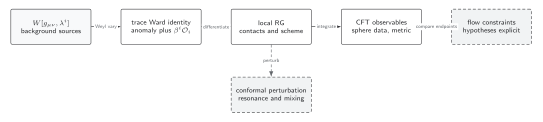
At a conformal fixed point, universal sphere data require controlled local subtraction, measure normalization and zero-mode treatment. The appropriate even-dimensional logarithmic term or odd-dimensional real finite part is selected as described above. Here , is the positive covariant-metric source response, and ; the local trace therefore contains the anomaly minus the beta–operator term. The sphere calculation does not require passing through conformal perturbation, and endpoint comparison alone does not prove monotonicity. Schematic, not to scale.
Comparing sphere calculations
Section titled “Comparing sphere calculations”To compare sphere calculations, specify the spectrum or integrand, regulator, counterterm basis, zero-mode measure, numerical precision and radius convention, and verify the scale derivative. The raw number without those data is not comparable across methods.
Common pitfalls
Section titled “Common pitfalls”Calling the even-dimensional finite part universal. A finite local curvature counterterm shifts it. The logarithmic coefficient is the invariant datum.
Deleting zero modes silently. Their measure and physical quotient can contribute scale dependence. State the treatment before evaluating the determinant.
Equating a source Hessian with an ordinary integrated two-point function. Coincident singularities generate local terms. The metric or susceptibility is defined only after a subtraction and coordinate convention.
Exercises
Section titled “Exercises”Derive in the convention above.
Solution
The round sphere is conformally flat and has constant scalar curvature, so only contributes. Since , the integral is .
References
Section titled “References”-
Giombi, S., and Klebanov, I. R. “Interpolating between and .” Journal of High Energy Physics 2015, 117 (2015). arXiv. DOI.
-
Klebanov, I. R., Pufu, S. S., and Safdi, B. R. “F-Theorem without Supersymmetry.” Journal of High Energy Physics 2011, 038 (2011). arXiv. DOI.
-
Sarnak, P. “Determinants of Laplacians; Heights and Finiteness.” In Analysis, et cetera, edited by P. H. Rabinowitz and E. Zehnder, 601–622. Academic Press, 1990. Open PDF.