

Chiral Blocks, Sewing, and Modular Invariance
Chiral symmetry reduces a correlator to conformal blocks, but those blocks are generally multivalued and basis-dependent. A full CFT pairs holomorphic and antiholomorphic blocks so that monodromy cancels, then satisfies factorization when surfaces are sewn. On the torus, the same cylinder vacuum shift enters characters and modular transformations. The Ising model makes every step finite and exact, including the hypotheses under which modular reconstructs fusion.
Required background. Minimal models and fusion rules provide the Ising modules, BPZ blocks, and fusion algebra. Cosets and orbifolds show why projections, twisted sectors, branching, and fixed points must be completed before modular tests.
Helpful background. Torus partition functions as bootstrap data develops later bounds from modular invariance; here the modular data are constructed exactly.
Chiral blocks are not full correlators
Section titled “Chiral blocks are not full correlators”Fix a punctured Riemann surface, local coordinates at the punctures, representations of a chosen chiral algebra, and a pants decomposition. Chiral Ward identities then define a vector space of conformal blocks. A basis element depends on the intermediate channel and can acquire a matrix monodromy under continuation around collision loci:
A full four-point correlator has the form
on the Euclidean slice . The pairing must be invariant under the relevant monodromy representation and must give the correct OPE coefficients and reality properties. In a Lorentzian continuation, and become independent boundary values; the operator ordering and continuation path then replace naive complex conjugation.
Changing the pants decomposition changes the block basis by fusion and braiding matrices. Crossing is the statement that the paired full correlator is independent of this choice, with consistent local-coordinate factors. The Moore–Seiberg consistency relations organize these changes of basis and their compatibility with sewing; see Moore and Seiberg 1989, §§2–5, pp. 187–225. They constrain chiral data strongly, but a formal solution of a subset of matrix identities is not automatically a reflection-positive local CFT.
For Ising four-spin blocks,
Each block has square-root monodromy; the diagonal sum is single-valued. Keeping only would solve the local BPZ equation but fail crossing and locality. This is the simplest counterexample to identifying a chiral solution with a full correlator.
Sewing and the complete state sum
Section titled “Sewing and the complete state sum”To sew two punctured surfaces, choose local coordinates and and identify annuli by
The phase of records the relative twist, and its magnitude records the cylinder length. Factorization inserts a complete basis of states in the intermediate module. If is the nondegenerate Gram matrix on the irreducible level- quotient, then in a cylinder-normalized sewing convention the amplitude contains
Null submodules must be removed before inverting . Using a Verma basis with a singular Gram matrix either double-counts null descendants or makes the sewing formula undefined. In a local-coordinate plumbing convention one often factors out the universal anomaly contribution and writes instead; the two descriptions must not be mixed term by term. Convergence is initially asserted only for away from other degenerations; continuation to another channel uses the corresponding fusion or braiding transformation.
Full sewing pairs this expression with the antiholomorphic sector and sums every allowed intermediate full-field sector. The left and right chiral algebras, their pairing, spin integrality, and any fermionic spin structure are part of the input. A torus modular invariant is a genus-one necessary condition, not a replacement for all sphere and higher-genus factorization constraints.
Characters and modular transformations
Section titled “Characters and modular transformations”For a chiral irreducible module , define
The is fixed by and
In a rational theory whose characters form a finite representation of the modular group,
A full torus partition function is
For a bosonic theory with the same chiral data on both sides, modular invariance requires to commute with and , together with and for a unique vacuum. These conditions encode integer spin and the allowed gravitational-anomaly phase. They are necessary but not sufficient: must also support nonnegative OPE multiplicities, single-valued correlators, and all sewing identities.
The figure makes the logical order visible. Inspect the downward branch: an individual chiral block may have monodromy, so pairing precedes sewing and modular testing.
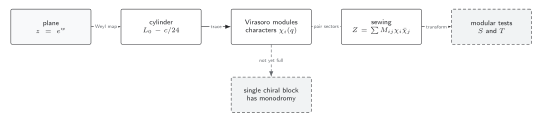
Schematic route from and to genus-one consistency. The sewing parameter satisfies in its plumbing domain. A local chiral block is not labeled a full CFT object; modular tests apply only after sector completion and left–right pairing.
The same information, including its stopping conditions, is:
| Stage | Exact object | Domain or convention | Required inference boundary |
|---|---|---|---|
| Plane to cylinder | , | Fixes the vacuum shift, not the spectrum | |
| Chiral module | Irreducible quotient | Null descendants removed | Defines a character, not a full sector pairing |
| Chiral block | in one channel | Chosen branch on punctured configuration space | May carry monodromy |
| Full correlator | Euclidean reality or declared Lorentzian boundary values | Must be single-valued and crossing-consistent | |
| Sewing | and inverse Gram matrices | initially | Requires a complete intermediate full-field spectrum |
| Modular test | Character matrices and full | includes | Genus-one invariance alone does not prove all sewing |
Exact Ising characters, S, and T
Section titled “Exact Ising characters, S, and T”Order the chiral sectors as with weights . In terms of Jacobi theta functions and the Dedekind eta function, choose the square-root branches with positive leading coefficients:
Their leading expansions are
The missing level-one term in is the vacuum null state . In this basis,
and
Every phase is with . Direct multiplication gives
because all three Ising sectors are self-conjugate. The diagonal full partition function
is therefore invariant under both generators. These characters and their modular transformation are derived in Di Francesco, Mathieu, and Sénéchal 1997, §§10.5–10.8 and 12.5–12.6.
Verlinde formula with all hypotheses visible
Section titled “Verlinde formula with all hypotheses visible”The formula
is valid here because the following assumptions hold simultaneously:
- A fixed chiral algebra has a finite set of simple sectors and finite fusion multiplicities; equivalently, the problem is rational with respect to that algebra.
- The representation and fusion theory is semisimple: is diagonalizable on the relevant modules, every sector decomposes into simples, and tensor products have no unresolved extensions or Jordan blocks.
- There is a unique simple vacuum, duals or charge conjugates exist, and the full set of sectors is closed under fusion.
- The characters or the appropriate genus-one blocks close under a finite modular representation, and the modular matrix used in the formula is invertible and nondegenerate, with for every sector.
- Fusion, braiding, and sewing obey the modular tensor consistency relations that identify the diagonalization of fusion matrices with this same ; a merely numerical matrix commuting with one partition function is insufficient.
- The character basis distinguishes the required sectors and the normalization has in the unitary convention. Positivity is useful for this normalization but is not a substitute for semisimplicity or modular nondegeneracy.
These are the rational, semisimple, finite-spectrum, nondegenerate-, and fusion-closure hypotheses behind Verlinde’s result Verlinde 1988, §§2–4, pp. 363–374. Continuous spectra replace the sum by integral kernels; logarithmic or other nonsemisimple theories can require generalized characters, pseudotraces, and modified fusion formulas. Applying the displayed expression unchanged in those settings is not justified; their correct replacements begin in Nonunitary, Logarithmic, and Noncompact Two-Dimensional CFT.
For Ising, the row of is . Therefore
which reconstructs . This calculation checks the ordering and normalization of the matrix independently of the BPZ exponents.
Reproducible checks
Section titled “Reproducible checks”A reproducible calculation should compare the analytic Kac, null, BPZ, fusion, character, , , torus, and sewing data in one fixed convention. Its target checks include , every Verlinde coefficient, torus invariance on a declared upper-half-plane grid, and a fixed sewing relation with exact-matrix tolerance at most and numerical-correlator tolerance at most .
Common pitfalls
Section titled “Common pitfalls”Using without the cylinder shift. A character is , not . Omitting the shift changes every phase and destroys the modular relations.
Inverting a Gram matrix before quotienting null states. The Verma-module matrix is singular at a degenerate weight. Sewing uses a nondegenerate basis of the irreducible quotient.
Treating modular invariance as a complete existence proof. A nonnegative integral commuting with and is a genus-one constraint. Local OPE associativity and all sewing channels remain necessary.
Using Verlinde for continuous or Jordan spectra. The finite semisimple proof does not survive by replacing a sum with an integral informally. The correct nonrational object may be an integral kernel or a nonsemisimple categorical invariant.
Exercises
Section titled “Exercises”Recover from the Ising matrix.
Solution
The row is . Substitution in the Verlinde formula gives
Thus . The cancellation in the last two coefficients would fail if the sign in were changed.
References
Section titled “References”- Di Francesco, Philippe, Pierre Mathieu, and David Sénéchal. Conformal Field Theory. Graduate Texts in Contemporary Physics. New York: Springer, 1997. DOI.
- Moore, Gregory, and Nathan Seiberg. “Classical and Quantum Conformal Field Theory.” Communications in Mathematical Physics 123, no. 2 (1989): 177–254. DOI.
- Verlinde, Erik. “Fusion Rules and Modular Transformations in 2D Conformal Field Theory.” Nuclear Physics B 300 (1988): 360–376. DOI.