

The Lorentzian Inversion Formula
The Lorentzian inversion formula reconstructs a meromorphic partial-wave coefficient from crossed-channel double discontinuities. Its poles give operator dimensions and its residues give OPE coefficients. The reconstruction is analytic in spin only in the half-plane where the contour at infinity vanishes; low-spin data outside that domain require separate information.
Required background. Double-twist families and anomalous dimensions supplies the large-spin data that inversion organizes. Conformal partial waves and the shadow formalism fixes the Euclidean principal-series basis.
Helpful background. Causality, growth, and analytic domains provides the Froissart–Gribov analogy and the role of arcs at infinity.
The coefficient function behind the OPE
Section titled “The coefficient function behind the OPE”Consider a four-point function of identical real scalars in a unitary CFT with ,
Euclidean harmonic analysis expands the correlator in single-valued partial waves, each a fixed combination of a block of dimension and its shadow of dimension . The corresponding coefficient is initially defined for integer spin and on the principal series. This partial-wave construction and its shadow normalization are reviewed systematically in Kravchuk and Simmons-Duffin 2018, §§2–3. After contour deformation in , a physical primary of generic dimension appears as a pole,
in the block normalization used below. Special coincidences with shadow or null-state poles require the standard limiting prescription rather than this generic residue formula.
For equal external dimensions, the self-adjoint Euclidean measure is
This is the specialization of the general measure. Changing external dimensions changes both the measure and the phases in the double discontinuity.
The Lorentzian formula
Section titled “The Lorentzian formula”Fix the channel as . Let denote the double discontinuity around the -channel branch point , with the continuation and phases defined on Lorentzian Correlators and Causal Orderings. Then
This equality is first stated at integer spin. For complex , even and odd signatures are continued separately; is shorthand for the integer-spin recombination, not a single-valued complex-spin factor.
The -channel contribution is
and
The -channel term is obtained from the corresponding causal diamond, equivalently by exchanging operators and with all prefactors and phases transformed consistently. In the dimension-first notation used here, the kernel has dimension and spin : dimension and spin have exchanged roles in the characteristic Froissart–Gribov combination. Caron-Huot writes block labels in the opposite order, so importing the formula requires translating the labels as well as matching the leading OPE behavior and Casimir eigenvalue Caron-Huot 2017, §§3.1–3.4, especially eqs. (3.19)–(3.20).
For identical scalars in the reflection-positive configuration,
is nonnegative in the appropriate Lorentzian domain. This positivity supports sign results at large spin, but the inversion formula itself is more general than a positivity argument. Mixed correlators can still be inverted with the correct phases even when no pointwise positive integrand exists.
Why the arc and spin threshold matter
Section titled “Why the arc and spin threshold matter”The derivation begins with a Euclidean partial-wave integral and deforms contours around Lorentzian cuts; a direct spacetime treatment derives the same cut structure from commutator regions Simmons-Duffin, Stanford, and Witten 2018, §§3–4. The deformation is valid only if the omitted arcs vanish. If the correlator on the Regge sheet obeys a bound characterized by an intercept , the formula is justified for
For the standard unitary scalar setup, the causality bound used in the original derivation gives the familiar safe domain Caron-Huot 2017, §3.4, pp. 20–21. This does not mean that every spin-zero or spin-one coefficient is wrong; it means the displayed cut integral alone has not determined it. A nonvanishing arc produces a term with no crossed-channel double discontinuity and must be supplied separately.
Endpoint convergence is independent of the Regge arc. The integrations near , , , and must be checked with the actual external dimensions and exchanged spectrum. Singular double discontinuities can be distributions. Regulating an endpoint, doing the integral, and then removing the regulator is not interchangeable with discarding contact terms pointwise.
The diagram below separates the related but distinct inversion and dispersion branches. Both begin with declared Lorentzian continuations and growth control; one integrates a double discontinuity to recover high-spin poles and residues, while the other reconstructs the correlator from cut data plus explicit subtractions.
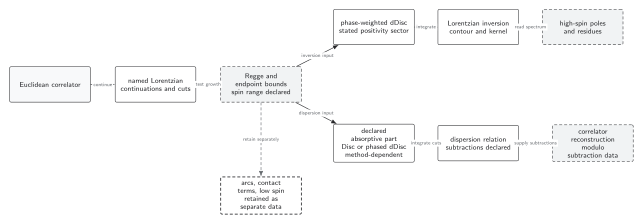
Lorentzian continuation, inversion, and dispersion share analytic and Regge inputs but are not successive steps. The diagram is schematic and not a proof: every arrow is conditional on the displayed convergence, spin, or subtraction hypothesis, and low-spin, arc, and contact terms remain separate data.
Its structured equivalent is:
| Stage | Required datum | If the datum is missing |
|---|---|---|
| Continue | Wightman ordering, hierarchy, path, sheet | The discontinuity has no fixed sign or meaning |
| Form the cut input | Branch point, phases, and double-discontinuity convention | Mixed or unequal correlators acquire wrong phases |
| Deform the contour | Regge bound and arc estimate | Add an undetermined arc term |
| Integrate | Kernel normalization and endpoint regulator | Pole residues and contact terms can shift |
| Read CFT data | Spin domain and pole prescription | Low-spin or shadow coincidences are overinterpreted |
| Reconstruct | Subtraction and crossing completion | Equal discontinuities need not imply equal correlators |
Solvable check: identity plus one scalar
Section titled “Solvable check: identity plus one scalar”The crossed-channel identity contribution in a generalized-free correlator gives a double discontinuity whose inversion produces poles at
with the generalized-free OPE residues. This is a nontrivial check because the direct-channel blocks themselves have zero -channel double discontinuity term by term; the crossed-channel input reconstructs their collective sum.
Now add a crossed scalar of twist and coefficient . Expanding the inversion integral near shifts the pole location of the leading family by
reproducing the lightcone result while making its analytic dependence on explicit. The equality is an asymptotic expansion of the inversion result, not a claim that the first term is exact at low spin.
A reproducible comparison should test direct block poles, inversion residues, wrong-sheet failures, arc estimates, and subtractions on a frozen generalized-free fixture. These comparisons provide bounded checks of this derivation.
What the formula determines
Section titled “What the formula determines”Within its domain, the formula determines:
- pole locations and residues of ;
- analytic large-spin families and controlled expansions;
- positivity consequences when the double discontinuity and kernel are positive;
- the crossed-channel contribution to direct-channel data.
It does not determine without extra input:
- spins at or below the Regge threshold;
- terms with vanishing crossed-channel double discontinuity;
- contact or subtraction ambiguities in a reconstructed correlator;
- nonperturbative corrections invisible to a truncated series;
- a bulk interpretation of the resulting CFT data.
Common pitfalls
Section titled “Common pitfalls”Using a Euclidean block as the Lorentzian kernel. The kernel has shifted dimension and spin and a fixed normalization. Check the Casimir equation and leading behavior.
Equating zero double discontinuity with zero contribution. Contact and low-spin terms can lie in the kernel of the cut operation.
Quoting without the setup. That threshold follows from a particular unitary Regge bound. State the actual intercept for the correlator under study.
Hiding an endpoint regulator. A regulated distribution can leave a finite contact term even when its pointwise expression vanishes.
Exercises
Section titled “Exercises”Suppose the Regge behavior requires one nonzero arc contribution for but not for . What may be inferred from the cut integral alone?
Solution
For , the stated bound removes the arc, so poles and residues obtained from the cut integral are justified subject to endpoint convergence. At , the same integral gives only the cut-determined part. The full coefficient can differ by an arc or subtraction term with zero double discontinuity; its value must be fixed independently.
References
Section titled “References”- Caron-Huot, Simon. “Analyticity in Spin in Conformal Theories.” Journal of High Energy Physics 2017, 078 (2017). doi:10.1007/JHEP09(2017)078.
- Kravchuk, Petr, and David Simmons-Duffin. “Light-Ray Operators in Conformal Field Theory.” Journal of High Energy Physics 2018, 102 (2018). doi:10.1007/JHEP11(2018)102.
- Simmons-Duffin, David, Douglas Stanford, and Edward Witten. “A Spacetime Derivation of the Lorentzian OPE Inversion Formula.” Journal of High Energy Physics 2018, 085 (2018). doi:10.1007/JHEP07(2018)085.