

Primaries, Correlators, and Ordering Sectors
Four points on a line do not move continuously past one another without collision. A one-dimensional four-point function is therefore a collection of ordered boundary values, not a single unqualified formula. Conformal symmetry reduces each ordering sector to one cross ratio; permutations, operator statistics, and a declared continuation path determine how those sectors are related.
Required background. One-Dimensional Conformal Symmetry and SL(2,R) supplies the global action and orientation data. Scalar Two- and Three-Point Functions fixes scalar normalization. Helpful background. Cross Ratios and Four-Point Kinematics explains channel and branch choices in general dimension.
Covariant correlators on an ordered line
Section titled “Covariant correlators on an ordered line”For scalar primaries with positive two-point normalization,
Three-point functions are fixed up to real coefficients when the operators are Hermitian:
The factor carries any statistics or orientation-reversal signs. Absolute values alone do not determine it. For bosonic scalar insertions in a fixed Euclidean order, one may take ; fermionic or graded operator algebras require the sign of the permutation used to reach that order.
For four identical bosonic primaries of dimension , choose
If , then . This interval is the Euclidean OPE region. The three collision points are .
Six permutations, three channel variables
Section titled “Six permutations, three channel variables”Permuting four labels generates six fractional-linear images of the cross ratio:
| Image | Representative permutation | Natural collision |
|---|---|---|
| identity | ||
| after relabeling | ||
| composition | image of | |
| composition | image of | |
| composition | image of |
The table concerns kinematics only. To turn a row into a correlator identity, also transform the prefactor and apply the graded permutation sign. For identical bosons, exchanging the middle pair gives the crossing relation
The same equation for identical fermionic operators acquires the sign dictated by the chosen ordered product. It is safer to derive that sign from the permutation than to encode it in an ambiguous power such as .
This ordered cross-ratio convention and its one-dimensional crossing equation agree with Mazáč and Paulos 2019, §§2–3; changing either the extracted prefactor or the graded ordering changes the displayed equation.
The ordering, channel, and continuation map used throughout the chapter is summarized below. The arrows show which operations are purely algebraic and which require a path in complex .
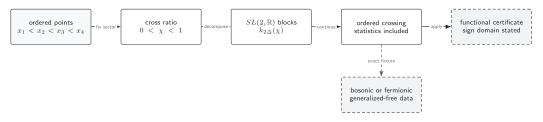
One-dimensional bootstrap data are attached first to an ordering interval. Permutations change the prefactor and statistics sign; analytic continuation additionally chooses a side of each branch cut. The diagram is schematic, not to scale.
The full sequence represented in the figure is:
| Step | Object | Additional datum | What the step establishes |
|---|---|---|---|
| Fix an ordering | Four labeled points on one component of configuration space | Cyclic order and orientation convention | A definite real interval for |
| Choose a channel | block expansion | OPE pairing and normalization | A convergent ordered channel sum |
| Impose crossing | Permuted channel written with transformed prefactor | Graded statistics sign and, when needed, continuation path | Equality of boundary values of one correlator |
| Add positivity | Reflection-paired Hermitian configuration | Positive radial inner product | Nonnegative scalar weights or a positive-semidefinite mixed matrix |
| Apply a functional | Linear map on the crossing vectors | Endpoint, swapping, and spectral sign domain | A conditional exclusion or sum rule |
| Test with exact data | Bosonic or fermionic generalized-free tower | Wick sign and block convention matched | A normalization check, not a construction theorem |
Continuation is extra data
Section titled “Continuation is extra data”An OPE expansion in the interval defines an analytic function in a cut complex domain. Moving to a different real ordering can require a path above or below , , or . If a block contains , the two boundary values across the negative axis differ by
Thus a noninteger dimension produces a phase even before any operator-statistics sign is applied. Euclidean permutation identities relate well-defined boundary values; Lorentzian Wightman orderings require an prescription. A bare statement such as “take outside ” does not specify a correlator.
For four distinct operators, a useful general prefactor is
where . Every permutation then changes both the order of operator labels and these kinematic powers. No positivity statement follows until a reflection-paired configuration and Hermitian conjugation are chosen.
The relation among normalized correlators, the OPE, crossing, and reflection-positive coefficients is reviewed in Poland, Rychkov, and Vichi 2019, §§2–3; the ordering-sector and continuation data above are the additional one-dimensional qualifications.
A complete ordering specification
Section titled “A complete ordering specification”A reproducible one-dimensional correlator calculation states all of the following:
- the cyclic order on and the affine chart used;
- the definition of and the extracted kinematic prefactor;
- the OPE channel and convergence interval;
- bosonic, fermionic, or graded permutation rules;
- orientation-reversal eigenvalues when that symmetry is used;
- the complex continuation path and boundary-value prescription;
- the two-point normalization that makes OPE coefficients comparable.
These items are small, but omitting any one can change a crossing sign or a branch phase. The separation between Euclidean sectors and Lorentzian orderings follows the general analytic-continuation framework of Simmons-Duffin 2017, §§6–7 and becomes essential in the later Lorentzian kinematics chapter.
Common pitfalls
Section titled “Common pitfalls”Moving operators through one another on the real line. Distinct orderings are separated by coincident-point singularities. Use a declared complex path; do not treat the move as a real homotopy.
Using the six cross-ratio images as six complete crossing equations. They are only the kinematic part. Prefactors, operator labels, and graded signs must be transformed too.
Inferring positivity from . That interval gives a convergent Euclidean channel. Nonnegative coefficients additionally require Hermitian external operators, reflection positivity, and a compatible normalization.
Exercises
Section titled “Exercises”For , prove that and that exchanging and sends to .
Solution
All four factors in the definition of occur in same-sign pairs, so . The identity gives . Substitution after the exchange, followed by cancellation of signs, yields .
Explain why the two continuations of from positive to negative agree only when the discontinuity vanishes.
Solution
The upper and lower paths give and . Their difference is , which vanishes for integer but not generically. The path is therefore part of the correlator definition.
References
Section titled “References”- Mazáč, D., and Paulos, M. F. “The Analytic Functional Bootstrap I: 1D CFTs and 2D S-Matrices.” Journal of High Energy Physics 2019, 162 (2019). arXiv. DOI.
- Poland, D., Rychkov, S., and Vichi, A. “The Conformal Bootstrap: Theory, Numerical Techniques, and Applications.” Reviews of Modern Physics 91, 015002 (2019), §§2–3. arXiv. DOI.
- Simmons-Duffin, D. “TASI Lectures on the Conformal Bootstrap.” In New Frontiers in Fields and Strings, 1–74. World Scientific, 2017. arXiv. DOI.