

Averaged Null Energy and Positivity
The averaged null energy condition is a positivity theorem for the stress tensor integrated along a complete null generator. It is neither pointwise positivity nor an inequality for an arbitrarily truncated ray. In a unitary relativistic CFT, its application requires a specified operator domain, normalizable state, affine null normalization, transverse smearing, regulator, and control of endpoint terms.
Required background. Detector operators at null infinity fixes the physical energy-flow normalization and state preparation. Hilbert-space positivity and unitary evolution supplies the positive norm and operator-domain statements used in the theorem.
Helpful background. Causality, growth, and analytic domains explains the analyticity assumptions used by the causality proof; they are not needed in the same form by the relative-entropy proof.
The complete-null-line operator
Section titled “The complete-null-line operator”Let be a future-directed null vector and choose transverse coordinates on a null plane. Formally,
Because is an operator-valued distribution, the safer object is
with a smooth, nonnegative, compactly supported transverse test function . A sharply localized transverse line is a limit of such smearings only when that limit exists. If with and the same geometric line is parameterized by , then : the sign is invariant, but numerical normalization is not.
ANEC with its hypotheses
Section titled “ANEC with its hypotheses”For the unitary Lorentzian CFTs considered in this chapter, the useful statement is:
Averaged null energy condition. Let belong to the dense domain generated from the vacuum by finite sums of local operators smeared with smooth test functions in bounded regions, and suppose the regulated complete-null-line integral and its boundary limit exist. For a future null vector and every nonnegative transverse smearing ,
The stress tensor is the conserved, Ward-normalized tensor of the theory; vacuum and contact subtractions are fixed before the regulator is removed.
The relative-entropy proof applies to relativistic QFT in Minkowski space and establishes the inequality through monotonicity of vacuum relative entropy for nested half-spaces Faulkner et al. 2016, §§3.1–3.3. A causality proof isolates in a lightcone OPE and uses Rindler positivity and analyticity; its initial presentation treats interacting CFTs in and makes additional assumptions when other leading lightcone operators are present Hartman, Kundu, and Tajdini 2017, §§2–4 and §6. The conclusion is the same, but the intermediate hypotheses are not interchangeable.
Several phrases in the theorem carry real content:
- Complete line: a finite interval or half-ray has endpoint terms and need not be positive.
- Normalizable state: a momentum eigenstate is first regulated as a packet or used only in a ratio after common delta functions cancel.
- Nonnegative smearing: an angular or transverse weight of changing sign is a linear combination of positive operators, not itself necessarily positive.
- State domain: the theorem extends by closure only where the quadratic form is closable; it is not a license to insert a singular state.
- Boundary control: the null regulator is removed after showing that contributions at affine infinity vanish or have been included.
Why relative entropy gives the sign
Section titled “Why relative entropy gives the sign”Let be a Rindler half-space and a small inward null deformation. Write the full vacuum modular Hamiltonian as
Monotonicity of relative entropy for , applied to a pure excited state and to the complements, yields the quadratic-form inequality
To first order in a future-directed deformation , the difference contains the horizon term
after the unitary coordinate shift and its commutator term are combined. Dividing by the positive deformation parameter and taking the controlled first-order limit gives ANEC. The derivation, including the complement and purity cancellation, is explicit in Faulkner et al. 2016, eqs. (52)–(69) and §3.
This proof uses unitarity through positivity and monotonicity of relative entropy. It does not first assume a Regge bound, a higher-spin gap, or a semiclassical bulk description.
The causality route and its distinct inputs
Section titled “The causality route and its distinct inputs”In the second route, two probe operators approach a lightcone and the stress-tensor family resums into the null integral. For a normalized four-point function, the relevant term is schematically
Rindler reflection positivity fixes the norm, and microcausality supplies analyticity in a half-disk. A contour sum rule then fixes the sign of the null-energy coefficient. A Euclidean quarter-rotation converts the Rindler-reflected matrix element into an ordinary expectation value Hartman, Kundu, and Tajdini 2017, eqs. (2.1)–(2.9).
Here the operator ordering and Lorentzian boundary value matter. The argument must identify the sheet selected by the prescription, justify the lightcone asymptotics, and project out or include other operators of the same leading twist. It is therefore incorrect to cite “causality” alone without naming those steps.
From a null line to a calorimeter
Section titled “From a null line to a calorimeter”A conformal transformation sends the complete null line to a generator of future null infinity. The stress tensor transforms with its tensor Jacobian and, in even dimensions on curved intermediate frames, possible local anomaly terms; in flat-space separated detector matrix elements the physical normalization is fixed by
The state transforms as well. Thus ANEC positivity implies
for the corresponding normalizable collider state, but only after its wave-packet smearing and the null-limit order are specified. Hartman, Kundu, and Tajdini show explicitly how the detector smearing and limit reproduce conformal-collider inequalities Hartman, Kundu, and Tajdini 2017, §5.
The diagram below separates the theorem from its conformal-collider application. Follow the arrow between the detector and the complete null line; reading it in reverse uses the inverse conformal map. The state, Jacobian, and normalization all change frame.
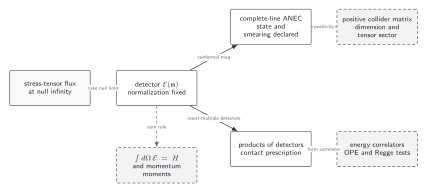
ANEC and its detector consequence. The image is schematic and not to scale. Positivity is a quadratic-form theorem for complete-line and nonnegative transverse smearing; collider bounds additionally fix the dimension, detector normalization, source polarization, parity sector, and coincident-contact prescription.
An equivalent statement of every arrow is:
| Relation | Input | Preserved conclusion | Additional condition at the target |
|---|---|---|---|
| Nested regions modular inequality | Unitarity, pure-state/complement argument, relative-entropy monotonicity | Common operator domain | |
| Modular inequality ANEC | First-order future null deformation | Nonnegative complete-line quadratic form | Transverse smearing, endpoint and regulator control |
| Null line null infinity | Conformal transformation | Sign of the expectation value | Stress-tensor Jacobian, transformed state, detector normalization |
| Detector positivity collider bound | Polarized local-operator packet | Positive energy matrix | Declared , parity and tensor sector, state norm, contacts |
| ANEC Regge statement | No direct implication | None without extra data | Lorentzian sheet, growth bound, arc estimate, and subtractions |
A four-dimensional stress-tensor check
Section titled “A four-dimensional stress-tensor check”Take a parity-even four-dimensional CFT and a zero-momentum state created by the spatial, symmetric-traceless polarization . Normalize the state and detector as above. The one-point energy distribution is
Choose and a helicity-two polarization in the transverse plane, so . ANEC at that detector gives
This is one face of the four-dimensional parity-even collider region, not a dimension-independent theorem. The other polarization sectors are derived on the collider-bounds page. The formula and tensor decomposition follow Hofman and Maldacena 2008, eqs. (2.37)–(2.38).
Saturation and null directions
Section titled “Saturation and null directions”If is a positive self-adjoint operator and a state in its domain obeys , then . This is a statement about the smeared null-energy operator. It does not imply pointwise, that every direction has zero flux, or that the theory is free. Collider-bound saturation can instead reflect a polarization selection rule; further conclusions require additional spectrum and symmetry information.
A planned exact continuation
Section titled “A planned exact continuation”A reproducible calculation should test the four-dimensional free-scalar, Weyl-fermion, and Maxwell normalizations, analytic extrema, collider inequalities, and one two-detector sum rule. Such a calculation would be a bounded executable check of the equations above, not a replacement for the theorem hypotheses.
Common pitfalls
Section titled “Common pitfalls”Replacing an average by a point. ANEC constrains the complete affine integral. Local can be negative, and finite segments acquire endpoint contributions.
Using a singular source. A delta-normalized state or a detector inserted at a coincident operator position can lie outside the quadratic-form domain. Smear first and state the removal limit.
Changing the null-vector scale mid-calculation. The sign survives for , but the operator scales by . Fix the affine normalization before comparing coefficients.
Reading too much from saturation. Zero smeared flux in one state and direction is not pointwise vanishing and is not, by itself, evidence for a higher-spin symmetry.
Exercises
Section titled “Exercises”1. Positivity under smearing. Let and . Show that is positive on the common domain.
Solution
Linearity gives . Its expectation value is a nonnegative linear combination of two nonnegative expectation values.
2. Affine rescaling. Reparameterize the same null line using , , with . Determine the scaling of ANEC.
Solution
while , hence . Positivity is unchanged, but numerical comparisons require the same .
References
Section titled “References”- Faulkner, Thomas, Robert G. Leigh, Onkar Parrikar, and Huajia Wang. “Modular Hamiltonians for Deformed Half-Spaces and the Averaged Null Energy Condition.” Journal of High Energy Physics 2016, no. 09 (2016): 038. doi:10.1007/JHEP09(2016)038.
- Hartman, Thomas, Sandipan Kundu, and Amirhossein Tajdini. “Averaged Null Energy Condition from Causality.” Journal of High Energy Physics 2017, no. 07 (2017): 066. doi:10.1007/JHEP07(2017)066.
- Hofman, Diego M., and Juan Maldacena. “Conformal Collider Physics: Energy and Charge Correlations.” Journal of High Energy Physics 2008, no. 05 (2008): 012. doi:10.1088/1126-6708/2008/05/012.