

Free Bosons and Vertex Operators
The compact free boson is the simplest CFT in which local oscillator algebra, a compact zero mode, momentum and winding, cocycle phases, and modular completion all matter simultaneously. Once one normalization is fixed, every vertex-operator dimension, OPE exponent, neutrality rule, and T-duality map follows. The discussion is restricted to a compact target circle; the noncompact limit changes the Hilbert-space measure and makes correlators distribution-valued in momentum labels.
Required background. The Virasoro algebra and the stress tensor fix the central charge and cylinder shift. Conformal OPE data distinguish primary normalization, OPE coefficients, and conformal-family sums.
Helpful background. Coincident products and contact terms explain normal ordering and why a regulator-dependent self-contraction is removed before defining a vertex operator.
Normalization, oscillators, and the compact zero mode
Section titled “Normalization, oscillators, and the compact zero mode”Use the Euclidean action
This is the convention. Splitting gives
with no singular mixed contraction. The currents and stress tensors are
and similarly in the barred sector. Wick contraction gives the standard OPE with . These normalizations and the compact spectrum are derived in Di Francesco, Mathieu, and Sénéchal 1997, §§6.3, 9.1, and 10.2–10.4.
On a spatial circle, configurations can wind:
Single-valued wavefunctions on the target circle give momentum , . The left- and right-moving momenta are
The compact zero mode is a quantum-mechanical coordinate on a circle. Integrating it enforces Kronecker momentum conservation, rather than the Dirac delta and target-volume factor of a noncompact scalar. That distinction is developed on Noncompact Continuous Spectra and Plancherel Measures.
Vertex operators, dimensions, and cocycles
Section titled “Vertex operators, dimensions, and cocycles”Define the normal-ordered vertex operator
where is a zero-mode cocycle operator. Its weights are
Consequently,
The integer spin is an immediate locality check for the full momentum–winding lattice. Wick’s theorem gives the leading OPE
The monodromy exponent is
This verifies full-field mutual locality, but it does not remove operator-ordering phases. A bimultiplicative cocycle must be chosen so that exchange phases, Hermitian conjugation, and OPE associativity agree. Different cocycle representatives related by rephasing vertex operators describe the same physics; omitting cocycles altogether can give inconsistent signs even when every conformal weight is correct.
On the sphere, a correlator is nonzero only if
equivalently . With an ordering and cocycle convention fixed,
where is the product of cocycle phases. The compact zero-mode integral enforces momentum neutrality; regularity and separate chiral charge conservation enforce the equivalent winding condition on the sphere. Branches are fixed first on a radial-ordering domain, and integer mutual monodromy makes the completed full correlator single-valued.
T-duality and the torus spectrum
Section titled “T-duality and the torus spectrum”The momentum–winding construction and its duality are reviewed in Ginsparg 1990, §§6 and 8. In the present convention, the transformation
leaves invariant and sends . It therefore preserves , , every oscillator degeneracy, and the lattice OPE after the corresponding cocycle isomorphism. This is T-duality in the present convention; a source using instead writes .
The torus partition function is
The factors contain the oscillator trace and the vacuum shifts . Under , the phase is . Under , Poisson resummation exchanges momentum and winding, proving modular invariance only when the complete lattice sum and its normalization are retained. At special radii the chiral algebra extends and the same sum reorganizes into finitely many extended-algebra characters; generic radii are compact and unitary but not rational with respect to a finite set of such sectors.
Construction data and what each path must add
Section titled “Construction data and what each path must add”The compact-boson branch of the figure should be read as a sequence, not as a conclusion from : the charge lattice and cocycles determine local fields, and the full lattice sum supplies modular completion.
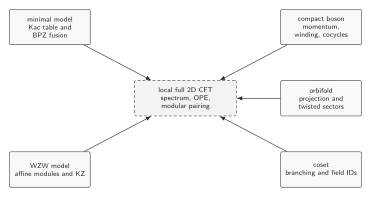
Schematic construction map. For the compact boson, fixes neither the radius nor the momentum–winding lattice; locality additionally needs cocycles, and modular invariance needs the complete lattice sum. The other branches impose different selection and completion rules.
The compact-boson branch can be checked semantically as follows:
| Layer | Declared data | Independent check | Failure if omitted |
|---|---|---|---|
| Chiral algebra | , | Sugawara tensor has | Dimensions float with an unstated normalization |
| Spectrum | and the displayed | Full fields can have untracked monodromy | |
| Local product | Normal ordering and cocycle | Exchange and associativity phases agree | Bare exponentials can have inconsistent signs |
| Selection rule | Separate left/right neutrality | on the sphere | Zero-mode integral or winding conservation fails |
| Modular completion | Full momentum–winding lattice | uses integer spin; follows by Poisson resummation | A momentum-only truncation is not modular invariant |
| Normalization | , | T-duality is | Radius and weight formulas differ by factors of two |
Exactly marginal radius deformation
Section titled “Exactly marginal radius deformation”The spinless operator has weights . In the compact free boson it changes the target-space radius while leaving fixed. The statement is coordinate-dependent at the level of the coupling: a reparametrization of changes the numerical component of the Zamolodchikov metric, although its positive-definite line element in a unitary theory is invariant.
At every radius, maps the plane vacuum to
With and this volume’s curvature convention, the same anomaly is written . The positive trace coefficient and negative cylinder Casimir shift are therefore two convention-consistent manifestations of the anomaly, not opposite choices of .
A reproducible calculation should cover the plane–cylinder shift and the radius baseline at . Local-renormalization-group, curved-background, and relevant-flow stages belong to a later chapter; they are not part of this compact-boson derivation.
Common pitfalls
Section titled “Common pitfalls”Taking the noncompact limit inside Kronecker-normalized correlators. As , sums become integrals and Kronecker deltas become Dirac deltas with volume factors. The limiting normalization must be changed before interpreting correlators.
Using with these momenta. That formula belongs to a different convention. Here , so the dual radius is .
Dropping winding sectors. A momentum-only trace is not closed under modular . Projection or truncation cannot substitute for the complete lattice.
Exercises
Section titled “Exercises”Show that the T-duality map preserves the full torus summand.
Solution
Under , , and ,
while
Therefore equals the original summand, and the integer relabeling is bijective.
References
Section titled “References”- Di Francesco, Philippe, Pierre Mathieu, and David Sénéchal. Conformal Field Theory. Graduate Texts in Contemporary Physics. New York: Springer, 1997. DOI.
- Ginsparg, Paul. “Applied Conformal Field Theory.” In Fields, Strings and Critical Phenomena, Les Houches Session XLIX, edited by Édouard Brézin and Jean Zinn-Justin, 1–168. Amsterdam: North-Holland, 1990. arXiv.