

Single-Correlator Bounds
A single-correlator bootstrap can exclude spectral hypotheses and bound dimensions or squared OPE coefficients under explicit assumptions. It cannot by itself prove that a theory on the boundary exists, identify a kink with a named model, or show that an allowed point is realized Poland, Rychkov, and Vichi 2019, §IV.C, pp. 29–30.
Required background. Solver Certificates and Independent Verification define a verified finite exclusion. Linear Functionals and Positivity define the separating functional. Helpful background. Crossing and positivity in one dimension provide an exact low-dimensional test case.
Literature cutoff: 2026-08-09. Numerical bound locations and feature interpretations are research-sensitive. No undated curve or model assignment is asserted here; durable claims are conditional on the serialized problem and refinements.
Gap and OPE-coefficient bounds
Section titled “Gap and OPE-coefficient bounds”Fix , an external scalar dimension , symmetry sector, identity normalization, and all assumed gaps. To test a trial scalar gap , allow scalar operators only for and all other sectors above their declared thresholds. A verified separating functional excludes that trial. Bisection can bracket the boundary,
with the words “allowed” and “excluded” referring to the tested finite formulation. Failure to find a functional on the allowed side is not an existence proof.
For an OPE coefficient , isolate its block and optimize its coefficient. The bound depends on unit two-point normalization, operator uniqueness or degeneracy, and every gap used to control the remaining spectrum. If several operators share the same quantum numbers and dimension, a single-correlator problem often bounds their summed squared coefficients.
Kinks and independent evidence
Section titled “Kinks and independent evidence”A kink is a change in the geometry of a bound curve. Stability under derivative order, block approximation, spin tail, precision, and parameter interpolation makes it a robust numerical feature. Identification with a CFT additionally requires compatible symmetry, operator dimensions, OPE data, and independent analytic, experimental, lattice, or mixed-correlator evidence. The historical Ising kink illustrates the strategy, not a rule that every kink is a theory El-Showk et al. 2012, §§4–5.
An exact generalized-free-field correlator supplies a safer fixture: insert its known external dimension, spectrum, and nonnegative OPE coefficients, confirm that the finite problem does not falsely exclude the exact solution, and test bounds against known exchanged data. This validates conventions; it does not calibrate all truncation errors for an interacting system.
The figure below classifies each computed object by the strongest claim it supports. Compare the kink, navigator, extremal-reconstruction, and benchmark-reproduction columns with the common inference boundary.
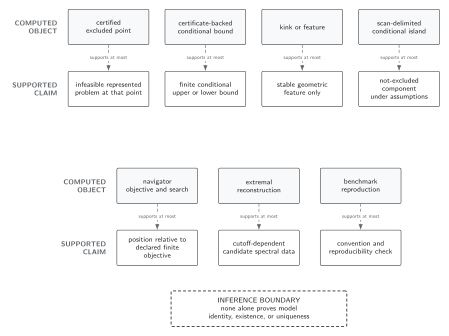
Schematic classification of numerical-bootstrap evidence. Exclusions, bounds, kinks, islands, navigator searches, extremal reconstructions, and benchmark reproductions support different claims. None by itself proves theory identification, existence, or uniqueness.
The seven visible columns have this semantic mapping:
| Computed or reproduced object | Strongest supported claim | Not established by that object alone |
|---|---|---|
| Certified excluded point | The represented problem is infeasible at that point under the stated assumptions | Nonexistence of an exact CFT outside the controlled representation |
| Certificate-backed conditional bound | A finite upper or lower boundary in the declared represented problem | Realization of a CFT at the boundary |
| Kink or feature | A stable geometric feature after the stated refinements | Identification with a particular theory |
| Scan-delimited conditional island | A not-excluded component bounded by tested certificates and brackets | Realization of every interior point or uniqueness |
| Navigator objective and search | Position relative to the declared finite deformed objective in the searched domain | A physical distance to theory space or a unique model |
| Extremal reconstruction | Cutoff-dependent candidate dimensions and OPE data | An exact full spectrum or model identity |
| Benchmark reproduction | A frozen observable or certificate is reproduced within the declared tolerance | Correctness of every method or identification of a theory |
Use the canonical Numerical claim taxonomy to distinguish a certified exclusion, conditional bound, stable feature, scan-delimited component, navigator result, reconstruction, and model-compatibility statement. Its global stop rule applies here: allowedness and boundary location do not establish realization, existence, or uniqueness.
Failure tests
Section titled “Failure tests”Normalization test. Rescale the target operator but quote the old OPE bound. Unit two-point normalization must be restored.
Gap test. Remove one assumed gap. If the feature disappears, report its dependence rather than the original curve alone.
Kink test. Change interpolation mesh and derivative order. A one-pixel corner is not evidence.
Continue to Mixed-Correlator Islands when shared operators and additional OPE data are available.
References
Section titled “References”- El-Showk, Sheer, Miguel F. Paulos, David Poland, Slava Rychkov, David Simmons-Duffin, and Alessandro Vichi. “Solving the 3D Ising Model with the Conformal Bootstrap.” Physical Review D 86 (2012): 025022. DOI. Open PDF
- Poland, David, Slava Rychkov, and Alessandro Vichi. “The Conformal Bootstrap: Theory, Numerical Techniques, and Applications.” Reviews of Modern Physics 91 (2019): 015002. DOI. Open PDF