

Conformal Blocks and Casimir Equations
A conformal block is the contribution of one irreducible conformal family to a correlator in one OPE channel and one normalization. The quadratic Casimir turns this representation-theoretic definition into a differential equation. The equation alone is insufficient because the dimensions and have the same eigenvalue; the physical block is selected by its OPE asymptotic, channel, and branch.
Required background. From the Local OPE to Conformal Data supplies primary and descendant data. Cross Ratios and Four-Point Kinematics fixes and channel maps. Helpful background. Descendant States and Gram Matrices supplies the level-by-level family sum.
One family in a four-point function
Section titled “One family in a four-point function”For four identical Hermitian scalars,
and in the channel,
This defines after the leading OPE normalization is fixed. For , with
held finite as , choose
The normalization makes the leading collinear Gegenbauer polynomial equal to one at . At , the limit is reorganized into left- and right-moving structures; at , there is no transverse angle and the separate one-dimensional block convention applies. Other sources may absorb , , or into the block or OPE coefficient. Such blocks solve the same equation but cannot be mixed in one crossing sum.
For nonidentical or spinning external operators, blocks carry external-dimension differences and tensor-structure indices. A block matrix connects one left three-point structure to one right structure; it is not a new dynamical coefficient.
The quadratic Casimir equation
Section titled “The quadratic Casimir equation”Let act on insertion and define
An exchanged symmetric traceless primary of dimension and spin has eigenvalue
Therefore the family contribution obeys
After stripping the prefactor, this becomes a second-order equation in . One widely used scalar convention sets
and
Then
The apparent pole at is removable on solutions with the correct exchange symmetry. It is a coordinate artifact of reducing the two-variable equation, not a physical singularity of a regular Euclidean correlator. Dolan and Osborn derive the Casimir system and closed forms in special even dimensions in Dolan and Osborn 2004, §§ 2–3.
Selecting the block rather than its shadow
Section titled “Selecting the block rather than its shadow”Because
the same differential equation admits the shadow asymptotic . The OPE boundary condition selects . At the two indicial roots meet and logarithmic solutions can appear; the physical prescription is obtained by continuation with a declared normalization.
Additional checks are needed:
| Check | Physical block | Wrong or incomplete solution |
|---|---|---|
| Channel | Singular behavior tied to | An eigenfunction normalized in another pairing |
| Leading power | shadow behavior | |
| Spin | Gegenbauer degree and correct exchange parity | A solution with another angular representation |
| Regularity | Euclidean regularity away from OPE singularities | A spurious singular branch |
| Null quotient | Shortening removes null descendants | A long block evaluated at a short value without subtraction |
| External convention | Same and prefactor as the correlator | Correct function multiplied by inconsistent powers |
At shortening, the irreducible block can be obtained by subtracting the null-family block or by taking a regulated limit. A naive substitution into a long-block formula can leave a pole whose residue is precisely the null submodule.
Radial expansion and checks
Section titled “Radial expansion and checks”Let and in the symmetric radial frame. In the standard -normalized convention, near the OPE limit, so
The leading term in brackets starts with the spin- primary. Descendant levels determine the allowed and coefficients. For identical Hermitian external scalars in a reflection-positive theory, a compatible radial normalization gives nonnegative contributions to the appropriate radial matrix element, providing useful coefficient checks. This statement is not a claim that every coefficient in every tensor basis is positive.
The rapid convergence of the series and its descendant interpretation are developed in Hogervorst and Rychkov 2013, §§ 2–4.
From data to blocks to crossing
Section titled “From data to blocks to crossing”The flow figure emphasizes that a block sits between primary data and a channel sum.
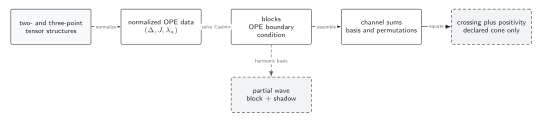
The Casimir eigenvalue fixes a differential equation, while the OPE asymptotic chooses the physical block over the shadow solution. Blocks are kinematic functions; OPE tensors supply dynamical weights. A convergent sum reconstructs one channel, associativity equates channels, and reflection positivity supplies nonnegative scalar or positive-semidefinite matrix weights. The diagram is schematic.
| Input | Operation | Result | Independent check |
|---|---|---|---|
| Evaluate | Casimir eigenvalue | Invariant under | |
| External dimensions and prefactor | Form | Differential equation | Correct transformation under point permutations |
| OPE boundary data | Select | Physical channel block | Excludes the shadow root |
| Descendant module | Expand in | Radial coefficients | Level and spin match the Gram decomposition |
| Short module | Remove null family | Irreducible short block | Null equation and recombination limit agree |
| Spectrum and OPE tensors | Sum blocks | Channel correlator | Converges in the declared radial domain |
Conformal Partial Waves and the Shadow Formalism constructs the block-plus-shadow solution by an integral. Crossing Equations and Positivity uses the normalized block in a positive sum rule. Release-pinned block generation and numerical benchmarks remain outside this page.
Common pitfalls
Section titled “Common pitfalls”The Casimir eigenvalue uniquely determines a block. It is invariant under . The OPE boundary condition and branch select the physical solution.
A block contains an OPE coefficient. The block is kinematic once external and exchanged representations are fixed. OPE tensors multiply it.
Short blocks follow by blind substitution. Null descendants can produce poles or reducible contributions. Take the irreducible quotient or a controlled recombination limit.
Exercises
Section titled “Exercises”Verify the shadow degeneracy of the quadratic Casimir.
Solution
Substitution gives
The spin term is unchanged, so .