

Nonunitary CFTs, Effective Central Charge, and Complex Data
Unitarity is an additional constraint on conformal data, not a prerequisite for the Virasoro algebra, Ward identities, null-vector equations, or crossing symmetry. Once positivity is removed, however, descendant norms need not be positive, OPE coefficients need not enter crossing as squares, and scaling dimensions may leave the real axis. The correct task is to preserve the algebraic consistency conditions while stating exactly which reality, pairing, and interpretive assumptions remain.
Required background. Highest-weight modules, null states, and the Kac determinant provide the representation-theoretic tests used below. Radial conjugation and reflection positivity explain the positive-definite structure that is being relaxed.
Helpful background. Minimal models and fusion rules supply the finite Virasoro example used to separate nonunitarity from irrationality.
Algebra without positivity
Section titled “Algebra without positivity”For a Virasoro primary normalized by some nonzero bilinear pairing, the algebra alone gives
In a unitary radial quantization, and , so is impossible. In a nonunitary theory the same commutator is valid, but the pairing is indefinite, non-Hermitian, or defined between left and right modules rather than by a positive adjoint. This is why crossing equations survive while the usual positive cone of squared OPE coefficients does not. The precise use of reflection positivity in bootstrap bounds is reviewed in Poland, Rychkov, and Vichi 2019, §III.E.
It helps to distinguish four levels of constraint:
- Local conformal covariance: weights determine the coordinate dependence of correlators.
- Representation consistency: null states decouple and the chosen modules close under the OPE.
- Crossing and modular consistency: different decompositions agree in their declared domains.
- Unitarity: a compatible positive-definite inner product exists and the Hamiltonian is self-adjoint.
The first three do not imply the fourth. Conversely, merely solving a truncated crossing equation with signed or complex coefficients does not prove that a local nonunitary CFT exists.
The Yang–Lee model as a controlled test
Section titled “The Yang–Lee model as a controlled test”The Virasoro minimal model —equivalently denoted after exchanging the two coprime labels—has
Its two irreducible primary families are the identity and a scalar with
These data and the associated null-vector construction are derived in Di Francesco, Mathieu, and Sénéchal 1997, §§7.3–7.4, pp. 211–221. If were assigned positive norm, its level-one descendant would have norm
an immediate failure of positive definiteness. Yet the spectrum is finite, is diagonalizable on the irreducible modules, and the model is rational. Nonunitary therefore does not mean logarithmic, continuous, or nonrational.
Effective central charge
Section titled “Effective central charge”On a circle of circumference , the Hamiltonian is
If the lowest state in a diagonal theory has , then
For Yang–Lee, , hence
controls the leading modular or finite-size growth after the true lowest-weight state is identified. It does not replace in the stress-tensor OPE, the Virasoro commutator, or the Weyl anomaly. A useful failure test is to compute both: substituting for in the Yang–Lee Virasoro algebra gives the wrong null vectors, while substituting for gives the wrong leading torus growth.
Real, signed, and complex conformal data
Section titled “Real, signed, and complex conformal data”Dropping positivity opens several distinct possibilities.
| Data type | What must be specified | What remains testable |
|---|---|---|
| Real dimensions with an indefinite pairing | The adjoint or bilinear form and the signs of two-point normalizations | Ward identities, null decoupling, crossing, and modular covariance |
| Real dimensions with signed OPE products | Which external operators are conjugate and how three-point coefficients are normalized | Crossing with signed coefficients; positivity-based bounds are unavailable |
| Complex dimensions | The conjugation map, usually pairing with when correlators are required to be real | Single-valuedness, crossing, spectral symmetries, and growth conditions |
| Complex OPE coefficients | Allowed field rephasings and the invariant products that enter correlators | Crossing and reality of complete correlators, not the phase of an isolated coefficient |
A complex scaling dimension makes radial evolution non-self-adjoint in any positive metric. It need not by itself make every Euclidean correlator complex: a conjugate pair of contributions can combine to a real function. The claim is conditional on the specified conjugation and contour. Likewise, an OPE coefficient changes under ; the products appearing in a fixed four-point function are the invariant objects to compare.
Probabilistic language must therefore be earned rather than inherited. A negative two-point norm is not a negative probability, and a signed spectral coefficient is not a probability measure. In statistical applications such as the Yang–Lee edge singularity, universal critical exponents and scaling functions remain meaningful even though no positive Hilbert-space interpretation is available.
A map of the three nearby failures
Section titled “A map of the three nearby failures”The figure below separates loss of positivity from loss of diagonalizability and loss of discreteness. Inspect the labels at the branch points: each branch changes a different ingredient of a conformal decomposition.
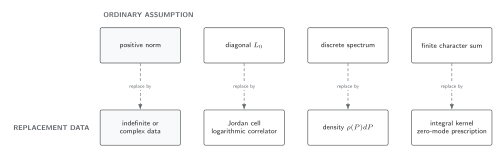
Three independent departures from a discrete unitary CFT and the replacement datum required by each. The diagram is schematic and not to scale; this page follows the nonunitary branch, where the Virasoro algebra survives but positivity does not.
The same distinctions are summarized textually here:
| Observed failure | Do not infer | Add to the calculation |
|---|---|---|
| A negative descendant norm or complex conformal datum | That has a Jordan block | An explicit indefinite or non-Hermitian pairing and conjugation rule |
| A logarithm forced by a generalized eigenvector | That the spectrum is continuous | The nilpotent part of and extension data |
| A delta-normalized continuum | That reflection positivity fails | A measure, contour, and zero-mode normalization |
Checks before interpreting a result
Section titled “Checks before interpreting a result”For any proposed nonunitary solution, perform the following checks in order.
- Pairing: compute low-level Gram matrices using the declared adjoint or bilinear form. A hidden use of can reintroduce unitarity by assumption.
- Lowest weight: determine the actual lowest state contributing to the torus trace before quoting .
- Reality: state how complex dimensions and coefficients are paired under conjugation; check a complete correlator, not an isolated block.
- Crossing: test the signed or complex OPE products in more than one channel.
- Modular growth: distinguish the anomaly coefficient from the effective asymptotic quantity .
- Interpretation: restrict probability or positivity claims to observables for which a positive measure has independently been established.
A bounded calculation can be used for finite-level Gram matrices and regulated toy decompositions. Its output, when run with declared truncation and precision, can test examples; it cannot establish positivity, crossing, or existence for an untruncated theory.
The next page, Logarithmic CFT and indecomposable modules, addresses the logically separate failure of diagonalizability.
Exercises
Section titled “Exercises”A descendant sign
Section titled “A descendant sign”Normalize a Virasoro primary with . Show that is incompatible with a positive-definite radial inner product even before studying the full Kac determinant.
Solution
Using and ,
This is negative for , contradicting positive definiteness. No higher-level determinant is needed.
Central charge versus effective central charge
Section titled “Central charge versus effective central charge”For a diagonal theory with and lowest chiral weight , compute and the lowest cylinder energy on a circle of circumference .
Solution
The negative value is not forbidden without unitarity. The local Virasoro central charge remains .
References
Section titled “References”- Di Francesco, Philippe, Pierre Mathieu, and David Sénéchal. Conformal Field Theory. Graduate Texts in Contemporary Physics. New York: Springer, 1997. DOI.
- Poland, David, Slava Rychkov, and Alessandro Vichi. “The Conformal Bootstrap: Theory, Numerical Techniques, and Applications.” Reviews of Modern Physics 91 (2019): 015002. DOI.