

Conformal Geometry, Maps, and Compactification
A conformal transformation preserves the metric only up to a nonzero local scale. Locally this condition determines translations, rotations or Lorentz transformations, dilatations, and special conformal transformations in dimension . Globally, however, inversions and special conformal transformations can cross conformal infinity, while Lorentzian null surfaces divide the coordinate formula into distinct causal domains. The correct symmetry statement must therefore specify signature, patch, connected component, compactification, and—when spinors occur—the relevant cover.
Required background. Lie Groups, Lie Algebras, the Exponential Map, and the Adjoint Action supplies the distinction between a Lie algebra and its global groups. Lorentz-Field and Poincaré-Particle Representations supplies the Lorentz real form and its covers. Helpful background. Smooth Manifolds, Tangent Spaces, and Tensors supplies charts and pullbacks. Branches, Sheets, Analytic Continuation, and Monodromy supplies the analogous distinction between a local formula and a single-valued global continuation.
Conformal maps in one coordinate patch
Section titled “Conformal maps in one coordinate patch”Let be either the Euclidean metric or the Lorentzian mostly-minus metric . A smooth map is conformal wherever its Jacobian is invertible and
Thus its differential is a scale times an orthogonal or Lorentz transformation. For an infinitesimal map , the traceless part of the metric variation vanishes:
This is the conformal Killing equation. On flat space and for , its smooth local solutions are at most quadratic,
where . The four terms generate translations, rotations or Lorentz transformations, dilatations, and special conformal transformations. The derivation and algebraic closure are carried out on The Conformal Algebra and Its Generators. In , the local conformal Killing equation instead has infinitely many solutions; the finite-dimensional Möbius subgroup remains important, but it is not the whole local conformal algebra.
Finite translations, orthogonal or Lorentz transformations, and positive dilatations stay within an affine patch. Inversion,
does not. In Euclidean signature it exchanges the origin and infinity. In Lorentzian signature it is undefined on the entire null cone , not just at the origin. Composing inversion, translation by , and inversion again gives a finite special conformal transformation,
The denominator hypersurface is mapped to conformal infinity. A formula valid on one connected component of its complement is therefore a local chart expression, not automatically a globally defined transformation of uncompactified space. The finite maps and their domains are reviewed with explicit signature distinctions in Simmons-Duffin 2017, §§ 2.1–2.2 and Poland, Rychkov, and Vichi 2019, § III.A.
The elementary round trip is explicit: if , then and hence . This identity does not extend across the excluded Euclidean origin or Lorentzian null cone.
Compactification and real form
Section titled “Compactification and real form”Compactification supplies the missing points on which the conformal group can act globally. For the unit Euclidean sphere, stereographic coordinates give the round-trip chart
Direct substitution gives and recovers whenever . The omitted south pole is the point at infinity of the affine chart. The diagram is intended to separate three facts that are often conflated: the local Lie algebra, the compactified spacetime, and the global group or cover.
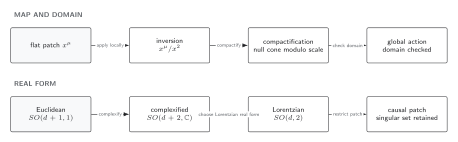
Signature selects the conformal real form and changes the singular and causal domains. Euclidean gains one point to become . Compactified Lorentzian Minkowski space is , and its universal cover replaces by . The diagram is schematic: discrete quotients and connected components must still be specified, and spinorial actions require a lift to a Spin cover.
The same information can be checked without the diagram:
| Starting geometry | Compactified geometry | Local algebra | Global qualification |
|---|---|---|---|
| Euclidean | The faithful full bosonic action is projective, ; its identity component excludes inversion and orientation reversal | ||
| Lorentzian | The faithful bosonic action is ; a chosen causal component and the universal time cover are additional data | ||
| Either signature with spinors | Same base spacetime | Same Lie algebra | The action must lift from an orthogonal group to a compatible or covering group; a projective bosonic action is insufficient |
One efficient construction embeds the compactification as the projective null cone in for Euclidean signature or for Lorentzian signature, with for nonzero real . A choice of section of this cone is a coordinate patch. Linear transformations of the embedding space induce conformal transformations on the section, and a denominator zero simply says that the transformed ray has left that section. This makes global linearity manifest while preserving the fact that different quotients and covers can share one Lie algebra. The construction is dimension independent; its four-dimensional realization and field transformation law are worked out explicitly in Weinberg 2010, §§ II–III.
Scale invariance is a separate logical condition: possessing does not supply . Compactification turns already conformal maps into a global projective action; it does not prove that a scale-invariant stress tensor can be improved. Scale versus Conformal Invariance gives that additional test.
Lorentzian compactification needs an additional caution. A conformal map preserves null directions wherever it is regular, but a finite map may carry a region through infinity and change the time orientation represented in a chosen Minkowski patch. Correlators with Lorentzian operator ordering also require an prescription or an analytic continuation from Euclidean signature. A bare rational coordinate formula does not decide those ordering data.
Scalar primaries and the inversion check
Section titled “Scalar primaries and the inversion check”Suppose the Jacobian decomposes locally as
A scalar primary of scaling dimension transforms in the passive convention as
For Euclidean inversion, direct differentiation gives
The matrix in parentheses is a reflection, so it is orthogonal but has determinant . This is the first place where a discrete component matters for spinning operators.
Now apply inversion to the Euclidean scalar two-point function
The transformed separation satisfies
Since , one finds
This verifies covariance only when , , and their images lie in regular patches. In Euclidean space, neither insertion may be the origin if the single affine inversion formula is used. In Lorentzian signature, each and can change sign or vanish; a Wightman, time-ordered, or Euclidean-continuation prescription must be carried through rather than replacing every power by a naive real power. The calculation therefore illustrates both the power of conformal covariance and the domain information it does not supply.
A practical global-domain test
Section titled “A practical global-domain test”Before treating a finite conformal formula as a symmetry, record:
- the dimension and Euclidean or Lorentzian signature;
- the open patch on which every denominator and Jacobian is regular;
- the connected component and whether orientation or time orientation is preserved;
- the compactification or universal cover on which images through infinity live;
- the quotient by any central element acting trivially on bosonic coordinates;
- the lift required by spinors or other projective representations; and
- in Lorentzian correlators, the causal ordering and boundary-value prescription.
Passing the local Jacobian test settles only item 2. The remaining items determine whether the same expression represents a global symmetry, a transition between coordinate patches, or no allowed transformation on the stated spacetime at all.
The Conformal Algebra and Its Generators now differentiates these maps, derives every generator and bracket, and fixes the Hermiticity convention. General Lie-group and Lorentz-representation classification remains in the required Mathematical Methods pages; this page supplies only the conformal specialization and its domains.
Common pitfalls
Section titled “Common pitfalls”The Lie algebra determines the global conformal group. Several groups and covers have the same Lie algebra. Discrete quotients, connected components, and spin structures affect which operators transform faithfully.
Inversion is singular only at one point. That is true in Euclidean signature, where implies . In Lorentzian signature the singular set is the full null cone.
A conformal coordinate map automatically preserves a Lorentzian correlator. The map preserves the conformal metric locally. Operator ordering, branch choices, and the prescription remain additional data.
Exercises
Section titled “Exercises”Verify that special conformal transformations are obtained as .
Solution
After the first inversion, . Translation gives . The second inversion gives . Multiplying numerator and denominator by yields
The derivation is valid only where both inversions and the denominator are defined.
In Euclidean signature, prove that the matrix is orthogonal and determine its eigenvalues.
Solution
Write . Then and . It sends to and fixes the directions perpendicular to , so its eigenvalues are and its determinant is .
References
Section titled “References”- Poland, David, Slava Rychkov, and Alessandro Vichi. “The Conformal Bootstrap: Theory, Numerical Techniques, and Applications.” Reviews of Modern Physics 91 (2019): 015002. DOI; Open PDF
- Simmons-Duffin, David. “TASI Lectures on the Conformal Bootstrap.” In New Frontiers in Fields and Strings, 1–74. Singapore: World Scientific, 2017. DOI; Open PDF
- Weinberg, Steven. “Six-Dimensional Methods for Four-Dimensional Conformal Field Theories.” Physical Review D 82 (2010): 045031. DOI; Open PDF