

Large-Charge EFT and Fixed-Charge CFT Data
Fixing a large global charge can make a sector of an otherwise strongly coupled CFT semiclassical. On the cylinder, a large charge density introduces a scale much greater than the inverse sphere radius, and the lowest state is often a homogeneous superfluid described by a compact Goldstone field. The resulting EFT predicts the charge dependence of the lowest scaling dimension and low-lying excitations, but only within the chosen charge sector and symmetry-breaking phase.
Required background. The cylinder map and Hamiltonian supplies . Power counting and predictive order supplies the derivative expansion. Helpful background. Effective field theory as a controlled expansion gives the general validity tests, and controlled interacting families compares this sectoral limit with whole-theory expansions.
Fixed charge on the cylinder
Section titled “Fixed charge on the cylinder”Let a CFT in have a compact symmetry with the smallest declared charge equal to one. The Goldstone variable is then periodic, , and . Quantizing on
maps the lowest primary of charge to the lowest-energy state in that sector, . A fixed-charge path integral can be defined by projecting a twisted partition function,
This Fourier integral treats the compact zero mode rather than integrating it as an unconstrained Gaussian. In a saddle description, the conjugate chemical potential is determined by ; it is not an independent observable.
Assume the lowest state at large positive is homogeneous and breaks the symmetry with no additional gapless fields. Using the inherited Lorentzian metric convention, define
on configurations with a timelike phase gradient. Weyl invariance and the shift symmetry give the leading local terms
where on the sphere. The coefficients depend on the CFT and on the charge normalization; stability requires for the homogeneous branch.
Leading dimension and the Goldstone mode
Section titled “Leading dimension and the Goldstone mode”For , the leading charge and energy densities are
Consequently,
and
with the leading normalization
receives the curvature contribution proportional to and therefore is not universal across CFTs. The powers of are fixed by the EFT. Since , each additional pair of derivatives is suppressed by on the homogeneous background.
Write . Expanding to quadratic order and canonically normalizing gives a relativistic Goldstone with
for sphere harmonic number . The phase mode is tied to changing the total charge and is absent from the oscillator spectrum at exactly fixed . The first nonzero modes and their loop vacuum energy generate universal subleading information once the field content and regularization are fixed.
In , the common single-Goldstone universality class has
For the and cubic Wess–Zumino examples studied by Hellerman and collaborators, the Goldstone Casimir contribution is and the excited mode has Hellerman, Orlando, Reffert, and Watanabe 2015, §§3 and 5. The coefficients and remain theory-dependent. The relation between the derivative expansion and inverse charge, including higher-rank symmetry breaking, is systematized in Monin, Pirtskhalava, Rattazzi, and Seibold 2017, §§2–4.
Scope and competing phases
Section titled “Scope and competing phases”The EFT does not follow from large charge alone. Its assumptions can fail in several ways.
Extra light fields. Supersymmetric flat directions, moduli, gauge fields, or additional Goldstones change the low-energy field content and can change the powers or logarithms in .
Inhomogeneous ground states. A helical, crystalline, vortex, or phase-separated configuration can have lower energy than the homogeneous saddle. Stability must be checked against fluctuations in every available channel.
Several charges. For a higher-rank group, the answer depends on the direction in charge space. Noncommuting charges, type-B Goldstones, and unbroken subgroups require a coset and power counting specific to that charge matrix.
Wrong sector. Large- control says nothing by itself about neutral operators, arbitrary high-energy states, or the existence of a tunable coupling for the whole CFT. It is a controlled kinematic sector, not a weakly coupled theory globally.
The schematic map below places large charge beside the other solvable limits. Inspect that its small parameter is fixed by a quantum number of the state, rather than by changing , , or a microscopic coupling.
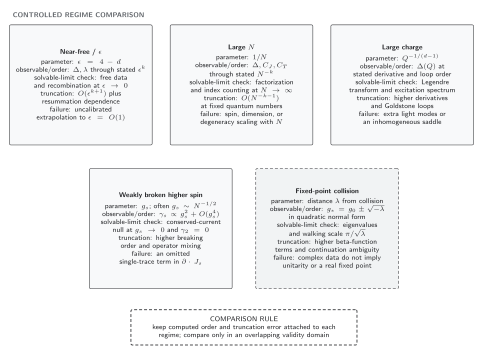
Controlled higher-dimensional limits, shown schematically and not to scale. Large charge produces the hierarchy inside one CFT, whereas the neighboring limits vary a theory parameter or continue fixed-point data.
The large-charge part has the following structured form:
| Ingredient | Assumption or normalization | Parameter and order | Prediction | Remainder or independent check | Failure signal |
|---|---|---|---|---|---|
| Charge projection | compact , unit minimal charge, integer | exact Fourier projection | fixed-sector cylinder energy | reproduce charge orthogonality | an inconsistent charge lattice or untreated zero mode |
| Homogeneous saddle | , , no lower inhomogeneous state | leading in | Legendre-transform check | a negative fluctuation eigenvalue or competing phase | |
| Leading EFT | one Goldstone, | leading derivative order | and | higher derivatives suppressed by | extra gapless modes or nonlocal response |
| Curvature term | sphere radius , coefficient | first curvature order | correction | next local operators and coefficient matching | flat directions making curvature leading |
| Quantum correction | fixed-charge zero mode removed; remaining harmonics regularized locally | stated Goldstone-loop order | universal terms within a specified Goldstone universality class | regulator dependence must be absorbed into local EFT coefficients | a residual regulator dependence or changed light spectrum |
Checks and further applications
Section titled “Checks and further applications”Legendre test. Verify and . Missing the second relation gives the wrong factor of .
Power-counting test. Express every correction in powers of . A term that grows relative to the retained action signals a missing light field or a nonuniform limit.
Spectrum test. Confirm that the fixed-charge ground state is a scalar before applying the state–operator map to . Excited states carry additional spin and oscillator quantum numbers.
A bounded calculation can be used for fitting synthetic or supplied finite- data to competing truncations once implemented. This page neither assumes that calculation has run nor uses a fit produced by it.
Exercises
Section titled “Exercises”Derive from the homogeneous charge and energy densities.
Solution
Solve . Then , which simplifies to the displayed .
Why is the Goldstone oscillator omitted at fixed ?
Solution
The spatially constant phase and total charge are conjugate variables. Fixing the charge removes fluctuations that change it; the constant mode is handled by the compact charge projection rather than counted as an independent harmonic oscillator.
References
Section titled “References”- Hellerman, S., Orlando, D., Reffert, S., and Watanabe, M. (2015), “On the CFT operator spectrum at large global charge,” Journal of High Energy Physics 2015(12), 071. doi:10.1007/JHEP12(2015)071. Open PDF
- Monin, A., Pirtskhalava, D., Rattazzi, R., and Seibold, F. K. (2017), “Semiclassics, Goldstone bosons and CFT data,” Journal of High Energy Physics 2017(06), 011. doi:10.1007/JHEP06(2017)011. Open PDF