

Completeness and the Operator Basis
Inserting conformal families between two groups of operators is justified by a resolution of the identity on a sphere that separates the groups. For a discrete positive spectrum this is a sum over primaries, descendants, spin components, degeneracies, and superselection sectors; in a nonorthonormal descendant basis it includes the inverse Gram matrix. A continuous spectrum replaces the sum by a direct-integral measure, while logarithmic theories can require generalized states and Jordan blocks. Completeness is an exact state-space statement. Keeping finitely many operators is a separate approximation whose error must be controlled.
Required background. Descendant States and Gram Matrices constructs the conformal-family basis and its null quotient. Helpful background. Free-Field OPE Preview supplies the general operator-product idea, while Bounded, Compact, and Integral Operators reviews discrete and continuous spectral resolutions.
Resolution of the identity on a sphere
Section titled “Resolution of the identity on a sphere”Let be a radial-quantization slice and let denote the completed local sector after quotienting null states. If the dilatation operator is self-adjoint with discrete spectrum and finite multiplicities, choose an orthonormal basis of states organized into conformal families. Then
The compact index includes
- the primary label and any degeneracy label;
- the descendant level and rotation representation;
- magnetic or spin components;
- global-symmetry and other superselection labels; and
- only states that survive the null-state quotient.
Computations often use a convenient descendant basis that is not orthonormal. With Gram matrix
the family projector is
The inverse is taken only on the quotient by null states. At a shortening point the unreduced Gram matrix is singular; using a numerical pseudoinverse without identifying the exact null submodule can introduce spurious contributions. The discrete resolution is then
This formula is basis independent. A change of descendant basis alters and the coefficient vectors but leaves unchanged.
From completeness to a conformal-family expansion
Section titled “From completeness to a conformal-family expansion”Consider a four-point function with strictly inside a sphere and strictly outside it. The inner pair prepares the ket
and the outer pair, after radial conjugation, prepares the bra . Inserting the identity gives
Each primary projector together with all of its descendants is one conformal block in the chosen channel and normalization. Thus a block expansion is not obtained by summing primaries alone; descendants are fixed by the representation and are already included in the block.
This passage from a complete radial-state basis to the OPE and conformal-block decomposition is developed in Simmons-Duffin 2017, §§8–9, pp. 40–48, Open PDF.
The geometric condition is decisive. A sphere must separate the two sets of insertions without crossing any of them. In radial variables the expansion parameter is schematically
where bounds the inner insertions and bounds the outer insertions after choosing the radial center. A state of dimension is suppressed by . This is the spectral origin of Euclidean OPE convergence and of the rapid convergence obtained from an optimized radial coordinate. Pappadopulo, Rychkov, Espin, and Rattazzi 2012, §§2–5, pp. 3–16, Open PDF proves exponential tail bounds under unitary-CFT hypotheses; Hogervorst and Rychkov 2013, §§2–3, pp. 4–15, Open PDF relates the descendant expansion to radial coordinates for conformal blocks.
The figure shows the logic to inspect: a separating sphere licenses a state insertion, the state resolution produces family projectors, and an overlap of two valid channel domains is needed before associativity can be imposed term by term.
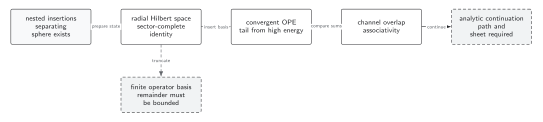
Completeness and Euclidean OPE domains. The inner-to-outer radius ratio controls spectral suppression. A different channel requires a different separating sphere; crossing compares the resulting sums only after analytic functions are identified on a common domain. The drawing is schematic and not to scale.
The structured equivalent is:
| Step | Exact object | Domain requirement | What is not implied |
|---|---|---|---|
| Prepare | Inner ket and outer bra on a sphere | No insertion lies on or crosses the sphere | Positivity or completeness in an unspecified sector |
| Resolve | Sum or integral of family projectors | Correct null quotient, degeneracies, sectors, and measure | A finite list of primaries |
| Propagate | Radial factor with | A positive radial separation | Convergence on a Lorentzian sheet reached across a cut |
| Reorganize | One block per conformal family | Descendant normalization fixed consistently | Equality of a block and a partial wave or shadow pair |
| Compare channels | Equality of the full correlator | Common Euclidean domain or declared analytic continuation | Term-by-term equality of different-channel spectra |
Continuous spectra and generalized resolutions
Section titled “Continuous spectra and generalized resolutions”Discreteness is not part of the definition of conformal covariance. When has continuous spectrum, the Hilbert space is represented schematically as a direct integral,
and the identity becomes
The measure is part of the CFT data. Delta-normalized states cannot be assigned ordinary unit norm, and a spectral density cannot be replaced by a list of OPE coefficients without changing the theory.
Logarithmic CFTs introduce a different modification: may have Jordan blocks. Radial evolution then contains polynomials in , which appear as logarithms in correlation functions. A complete generalized basis may exist, but it is not an orthonormal eigenbasis and the positive projector formula above no longer applies. These two failure modes—continuous spectrum and nondiagonalizability—are independent and are developed in Nonunitary, Logarithmic, Noncompact, and Nonrational Two-Dimensional CFT.
Sectors and missing states
Section titled “Sectors and missing states”A resolution of the identity must match the state prepared by the operator pair. If the pair has total global charge , only intermediate states in the corresponding charge sector contribute. With boundaries, defects, twists, or background fluxes, the sphere can carry additional labels. Symbolically,
where labels superselection sectors, and a given correlator selects only the allowed projectors.
Ordinary local operators at the origin span the local sector if the state–operator assumptions hold. They do not automatically span states created by line or surface operators piercing the sphere, disorder sectors with prescribed singular boundary conditions, or states on a spatial manifold not conformally equivalent to . A completeness claim that omits the sector is therefore incomplete even if every displayed Gram matrix is correct.
Completeness is not truncation
Section titled “Completeness is not truncation”Let project onto states of dimension at most . Replacing the identity by this projector,
defines a truncation. Its omitted contribution is
In a reflection-positive Euclidean configuration, Cauchy–Schwarz and the positive spectral weights can bound this tail; in the setting of the convergence theorem it is exponentially suppressed at fixed . Near the boundary , suppression deteriorates. In a nonunitary theory, cancellations can invalidate positive-tail estimates even when an analytic expansion still exists.
Three statements must remain distinct:
- Completeness: the full sum or integral equals the identity in the stated sector.
- Convergence: the resulting expansion approaches the correlator in a stated geometric or analytic domain.
- Truncation control: a finite partial sum approximates it with a quantified remainder.
None follows merely from observing that the first few terms look stable.
Check your understanding
Section titled “Check your understanding”Suppose descendants of one primary have a nonsingular Gram matrix but are not orthonormal. Why is not the family projector?
Answer
The dual bra to is . Therefore . Omitting makes the result depend on the chosen basis and fails unless the basis is orthonormal.
References
Section titled “References”- Hogervorst, Matthijs, and Slava Rychkov. “Radial Coordinates for Conformal Blocks.” Physical Review D 87 (2013): 106004. doi:10.1103/PhysRevD.87.106004. Open PDF.
- Pappadopulo, Duccio, Slava Rychkov, Johnny Espin, and Riccardo Rattazzi. “OPE Convergence in Conformal Field Theory.” Physical Review D 86 (2012): 105043. doi:10.1103/PhysRevD.86.105043. Open PDF.
- Simmons-Duffin, David. “The Conformal Bootstrap.” In New Frontiers in Fields and Strings, 1–74. Singapore: World Scientific, 2017. doi:10.1142/9789813149441_0001. Open PDF.