

Bulk-to-Defect Expansion and Defect Operators
The bulk-to-defect operator expansion replaces a bulk insertion near a conformal defect by local operators on its support. Its coefficients are genuine defect CFT data, independent of the ordinary bulk OPE coefficients. Distance powers, transverse harmonics, descendant terms, and the identity contribution are fixed only after both bulk and defect two-point normalizations have been chosen.
Required background. Defect representations, transverse spin, and tensor structures provide the defect quantum numbers and harmonics. The local OPE and conformal data provide the operator-expansion logic and normalization conventions.
Helpful background. The displacement operator and defect Ward identities explain the protected defect operator forced by broken transverse translations.
Expansion near a flat defect
Section titled “Expansion near a flat defect”Put a -dimensional defect at and write
For a bulk scalar , the expansion takes the form
contracts the transverse representation with the unit normal , while generates parallel descendants. With unit-normalized two-point functions,
the number is unambiguous up to orthogonal changes inside a degenerate defect-operator subspace. A rescaling of either operator rescales ; quoting it without the two two-point conventions is incomplete.
For a symmetric-traceless transverse rank and no parallel spin, the primary term is
Parallel descendants appear in even powers of for this scalar-to-scalar structure. Their coefficients are fixed by requiring covariance under the preserved special conformal generators. They should not be fitted independently.
Identity and one-point functions
Section titled “Identity and one-point functions”The defect identity has and . Its term is
Therefore
in this distance convention. If the correlator convention instead uses , its quoted coefficient differs by . Internal symmetries and transverse tensor structure can force . For example, the -odd free scalar has zero one-point function, whereas the even composite does not.
The ordinary bulk OPE and the bulk-to-defect expansion answer different questions. In
the bulk OPE converges by bringing toward without crossing the defect. The defect expansion brings each point toward the support and resolves defect excitations. Equating the resulting decompositions of one correlator produces defect crossing; it does not identify their spectra term by term Billò et al. 2016, §§1 and B.1.
Exact Neumann and Dirichlet leading terms
Section titled “Exact Neumann and Dirichlet leading terms”Return to the canonical half-space scalar, with
For Neumann boundary conditions,
Define the unit-normalized boundary primary
The leading expansion is
The absence of a term linear in is the Neumann condition. The terms are parallel descendants fixed by the bulk equation of motion.
For Dirichlet boundary conditions, the boundary value vanishes and
Thus
and Taylor expansion gives
The relative powers and coefficients can be checked directly by taking in the image propagator. They reproduce the one-block boundary-channel content derived in Liendo, Rastelli, and van Rees 2013, §3.1, pp. 10–12.
The even composite gives an identity-sector check:
Here “ren” means that the full-space coincident contraction has been subtracted. A different local subtraction can change contact terms, but not the displayed separated-point image contribution after the convention is fixed.
Where the expansion converges
Section titled “Where the expansion converges”Radial quantization centered on a point of the defect turns the bulk insertion into a state on a sphere intersecting the defect. The defect OPE converges when that sphere can be chosen without enclosing another insertion. For a two-bulk-point correlator, the expansion of point about the defect point nearest it is valid when the corresponding radial surface separates from .
This geometric statement is more robust than a power series in a particular cross-ratio. Defect radial coordinates map the convergence domain to and make the descendant-level expansion explicit. In a unitary reflection-positive configuration, truncating above defect dimension is exponentially suppressed away from ; the exact rate depends on the correlator and spectral density Lauria, Meineri, and Trevisani 2018, §§2 and 4.
Four limitations should remain explicit:
- convergence is a statement inside correlation functions, not pointwise equality of operator-valued distributions;
- coincident bulk or defect insertions require contact-term extensions;
- continuous defect spectra replace a sum by an integral with a declared measure;
- null states, degeneracies, and operator mixing require an independent basis before coefficients are compared.
The figure below connects the transverse harmonic in the primary term to the defect channel and contrasts it with the bulk OPE limit. Inspect which distance becomes small in each expansion.
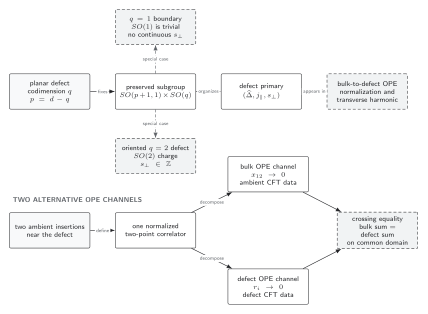
Schematic bulk and defect OPE channels for a planar codimension- defect. In the defect channel, and an harmonic carry the transverse approach; in the bulk channel, the separation of two ambient insertions tends to zero. The boundary case removes the angular harmonic but not the distinction between channels.
The structured equivalent is:
| Expansion | Small geometric quantity | Intermediate data | Leading asymptotic | Independent check |
|---|---|---|---|---|
| Bulk OPE | and | Full-space short-distance singularity | ||
| Defect OPE, general | and | Defect radial quantization | ||
| Neumann scalar boundary | constant plus | |||
| Dirichlet scalar boundary | plus |
Failure tests
Section titled “Failure tests”Distance-factor test. Replace by and translate every coefficient. If a reported one-point or BOE coefficient changes without a declared conversion, its normalization is incomplete.
Identity test. Apply every unbroken internal and transverse symmetry to the candidate one-point function. An identity term forbidden by symmetry cannot be repaired by descendants.
Boundary-condition test. Take the boundary limit of the reconstructed two-point function. Dirichlet must remove ; Neumann must remove .
Convergence test. Draw the radial surface separating the expanded insertion from all others. If no such surface exists, changing series variables does not restore OPE convergence.
The resulting contributions are assembled into Boundary and defect correlators and blocks, and their equality with the bulk channel becomes the boundary and defect bootstrap.
References
Section titled “References”- Billò, Marco, Vasco Gonçalves, Edoardo Lauria, and Marco Meineri. “Defects in Conformal Field Theory.” Journal of High Energy Physics 04 (2016): 091. DOI. Open PDF
- Lauria, Edoardo, Marco Meineri, and Emilio Trevisani. “Radial Coordinates for Defect CFTs.” Journal of High Energy Physics 11 (2018): 148. DOI. Open PDF
- Liendo, Pedro, Leonardo Rastelli, and Balt C. van Rees. “The Bootstrap Program for Boundary CFT.” Journal of High Energy Physics 07 (2013): 113. DOI. Open PDF