

Primaries, Descendants, and Conformal Multiplets
A conformal multiplet is generated from a primary local operator by translations. Its descendants have dimensions raised by integers and spins obtained by tensoring with the vector representation. Generic modules are long; at special dimensions a descendant can itself be primary, generating an invariant submodule. Quotienting that submodule produces a short multiplet. This algebraic organization is the bridge from local operators to conformal blocks, but it must not be confused with the separate positivity statement that makes a null vector have zero norm.
Required background. The Conformal Algebra and Its Generators fixes the commutators and radial adjoint. Local Composite-Operator Insertions supplies the renormalized local operators on which the algebra acts. Helpful background. Representations, Intertwiners, and Invariants supplies irreducible decomposition. Multiplets, Invariants, and Selection Rules supplies the general multiplet language.
Primaries at the origin
Section titled “Primaries at the origin”Work first in a Euclidean CFT in with the no- radial convention. A primary is a scaling eigenoperator whose components transform in an irreducible representation of or its Spin cover:
The matrices satisfy and represent the rotation algebra. If the theory contains fermionic operators, is a representation of rather than an honest representation of . The pair labels a generic conformal module; internal-symmetry representations and parity are additional labels.
Translation moves the operator away from the origin,
and fixes the conformal action at every regular point. A primary is therefore not an operator annihilated by at arbitrary ; the defining condition is at the origin. At general ,
These conditions and their relation to radial states are derived in Simmons-Duffin 2017, §§ 4.1 and 7.2.
Descendant levels
Section titled “Descendant levels”The state created by the primary is . Since , a level- descendant
has dimension . Translations commute, so their vector indices lie in the symmetric tensor power . Before quotienting null states, the rotation content at level is
It must then be decomposed into irreducible rotation representations, including traces and any dimension-specific identities.
For a scalar primary, the first three levels make the rule concrete:
| Level | Raw descendant | content for generic | Dimension |
|---|---|---|---|
| 0 | scalar | ||
| 1 | vector | ||
| 2 | symmetric traceless rank two scalar trace |
For a symmetric traceless rank- primary, level one comes from . In generic dimension it contains a rank- symmetric traceless piece, a hook-type piece, and a rank- divergence piece. At a conserved-current shortening point, the last component becomes null. Low dimensions can identify or eliminate some of these representations; one must decompose using the actual or representation, not a Young diagram imported unchanged from larger .
The conformal algebra also lets one lower descendants with . For example,
Thus raises level and lowers it. A primary is a lowest-dimension state under this grading, while the full multiplet contains every nonzero descendant that remains after quotienting.
Reducibility, null states, and shortening
Section titled “Reducibility, null states, and shortening”A descendant becomes a singular vector when it is also annihilated by every . All of its -descendants then form an invariant submodule. The original induced module is reducible, and an irreducible short module is obtained by the quotient
In a positive-definite radial Hilbert space, such a vector at a unitarity threshold has zero norm and is called null. Outside a unitary theory, “singular” and “zero norm” need not coincide: an indefinite form can contain zero-norm vectors that do not decouple, and a reducible module can have nontrivial extensions rather than an orthogonal quotient. The representation-theoretic distinction is summarized in Poland, Rychkov, and Vichi 2019, §§ III.B and III.E.
The figure shows the generic pattern. Inspect the difference between the full descendant cone and the subcone generated by the first singular descendant.
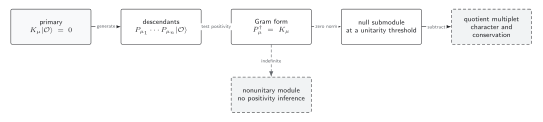
Translations raise descendant level, while lowers it. At a shortening value, a descendant is killed by all and generates an invariant submodule. In a reflection-positive module that submodule has zero norm and is quotiented. A level-one divergence gives a conserved spinning operator; a scalar level-two trace gives a free-field equation. The diagram is schematic and does not assert positivity without the radial-inner-product hypotheses.
The same structure in semantic form is:
| Stage | Algebraic test | Rotation content | Local-operator consequence under state–operator correspondence |
|---|---|---|---|
| Primary | Irrep | Independent conformal operator at the origin | |
| Ordinary descendant | and not killed by all | Component of | Derivative fixed by the primary data |
| Singular descendant | for all | A specific component at level | New invariant submodule; an equation only after an appropriate quotient |
| Null descendant in a unitary module | with a positive-semidefinite invariant form | Same component as the singular vector | Decouples; its local operator vanishes in separated-point correlators |
| Short multiplet | Quotient by the singular/null submodule | Remaining components only | Conservation, a free equation, or another shortening condition |
Two standard cases should be kept distinct:
- For a symmetric traceless spin- primary at , the level-one divergence is null in a unitary CFT. In position space this is .
- For a scalar at , no level-one scalar descendant exists. Instead the level-two trace is null, giving and the free-scalar multiplet.
The actual positivity derivations, including their theorem hypotheses, belong to Unitarity Bounds and Null States.
Primary, quasiprimary, descendant, and operator mixing
Section titled “Primary, quasiprimary, descendant, and operator mixing”Terminology changes across dimensions, so the annihilation condition should be stated rather than inferred from a word.
- In , “conformal primary” normally means annihilated by every at the origin.
- In two-dimensional CFT, a Virasoro primary is annihilated by all positive Virasoro modes, while a quasiprimary need only be primary under the global Möbius subalgebra. A Virasoro descendant can consequently be a global quasiprimary.
- A descendant is generated by translations—or, in two dimensions, by negative Virasoro modes—from another operator. It is not independent OPE data even if its rotation representation happens to match that of a primary.
- Renormalized local operators with the same quantum numbers can mix. Diagonalizing is part of identifying scaling operators. In a logarithmic CFT, can have Jordan blocks, so the simple eigenoperator decomposition assumed above fails and correlators acquire logarithms.
This last case is a useful counterexample to an overly broad statement: translation descendants still exist in a logarithmic CFT, but the module need not be a direct sum of positive-energy irreducibles labeled only by .
First two levels of a vector primary
Section titled “First two levels of a vector primary”Let be a vector primary. At level one, decomposes into
These are the symmetric traceless, antisymmetric, and scalar pieces. At in a reflection-positive module, the scalar divergence is null. The short current multiplet therefore retains the other two level-one components but removes and every descendant generated from it.
At level two the raw space is . In the short module, one must subtract the level-one scalar null module at its own levels. Merely deleting a single scalar at level one undercounts the subtraction: its vector descendant at the next level is also absent. This is precisely why characters are useful; Characters and Conformal Multiplet Counting performs the subtraction systematically.
Applications to correlators and radial quantization
Section titled “Applications to correlators and radial quantization”This page constructs modules algebraically. Radial Quantization and State–Operator Correspondence constructs the state space, adjoint, and cylinder energy interpretation. Descendant States and Gram Matrices tests positivity level by level. Spin and Tensor Representations makes the label computable, while Spinning Correlators and Tensor Structures uses to build correlators. The OPE and conformal blocks then sum a primary together with all of its non-null descendants.
Common pitfalls
Section titled “Common pitfalls”A primary is annihilated by everywhere. The defining condition is at the origin. Translation fixes the nonzero- action, which contains orbital, scaling, and spin terms.
Every zero-norm vector may be discarded. This requires a positive-semidefinite invariant form or an independently justified quotient. Indefinite and logarithmic theories can contain nondecoupling zero-norm states.
Removing the first null vector completes the count. One must remove its entire descendant submodule. Character subtraction implements that closure.
Exercises
Section titled “Exercises”Decompose the first two descendant levels of a scalar primary under .
Solution
At level one, is a vector. At level two, commuting translations make symmetric. It splits into
a symmetric traceless rank-two tensor plus a scalar trace.
Show that if is killed by every , its -descendants form an invariant submodule.
Solution
and preserve the span because their commutators with are linear in . Acting with plainly stays in the span. Moving a through any monomial in produces terms with fewer ‘s multiplying and ; after these act on , the result is again a linear combination of -descendants, while the term in which reaches vanishes.
References
Section titled “References”- Poland, David, Slava Rychkov, and Alessandro Vichi. “The Conformal Bootstrap: Theory, Numerical Techniques, and Applications.” Reviews of Modern Physics 91 (2019): 015002. DOI; Open PDF
- Simmons-Duffin, David. “TASI Lectures on the Conformal Bootstrap.” In New Frontiers in Fields and Strings, 1–74. Singapore: World Scientific, 2017. DOI; Open PDF