

OPE Convergence, Associativity, and Domain Control
In a unitary Euclidean CFT, the OPE is more than a formal short-distance series: radial quantization makes it a convergent expansion whenever a sphere separates the operators being fused from the remaining insertions. Associativity is then equality of two convergent expansions on their common domain. Outside that overlap, crossing requires analytic continuation along a declared path; it is not justified by rearranging two divergent series.
Required background. From the Local OPE to Conformal Data supplies the family expansion. Completeness and the Operator Basis supplies the radial resolution of the identity. Helpful background. Asymptotic Scales, Remainders, and Uniformity distinguishes convergence from asymptotics. Bounded, Compact, and Integral Operators supplies operator-norm and spectral language.
The separating-sphere criterion
Section titled “The separating-sphere criterion”Choose a radial center . Suppose the pair to be fused lies inside a sphere and every other insertion lies outside:
Radial evolution between the two spheres is generated by . Inserting a complete set of eigenstates gives a series weighted schematically by
For a reflection-positive CFT with a positive-energy radial Hilbert space and the required completeness, the state created by the inner operator product converges in Hilbert norm. Matrix elements with the outer state then converge by Cauchy–Schwarz. Under the hypotheses made precise by Pappadopulo et al. 2012, §§ 2–4, the high-dimension tail is exponentially suppressed, up to correlator- and geometry-dependent polynomial factors:
This notation is a scaling estimate, not a universal bound with coefficient one. The exponent , prefactor, and admissible uniform region depend on the correlator, external dimensions, and distance from the convergence boundary.
Four points and radial coordinates
Section titled “Four points and radial coordinates”Map a Euclidean scalar four-point configuration to
in a two-dimensional plane containing the four points. The OPE converges for . The channel converges for . Their open overlap is the lens
For block expansions a more efficient coordinate is
with the square root chosen on the Euclidean cut plane . The inverse is
The symmetric radial frame maps the cut plane to , improving convergence away from the original disk. Descendant levels then appear as powers of with Gegenbauer angular dependence Hogervorst and Rychkov 2013, §§ 2–3.
The geometry and logical implications are summarized below. Inspect which arrows require positivity and which require analytic continuation.
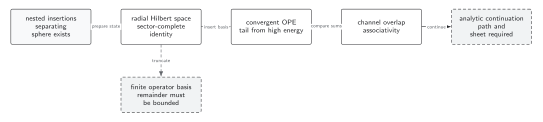
Nested spheres give a convergent Euclidean OPE when all fused insertions lie inside and spectators outside. The radial ratio , or the optimized coordinate , controls high-dimension suppression. Associativity is first an equality on the open overlap of two such domains. Extension beyond it uses analyticity; Lorentzian orderings are boundary values on specified sheets. The figure is schematic and does not identify a formal asymptotic expansion with a convergent OPE.
An equivalent structured account is:
| Situation | Geometric test | Mathematical input | Valid conclusion | Not yet justified |
|---|---|---|---|---|
| One Euclidean channel | A sphere separates fused and spectator insertions | Positive-energy radial evolution and completeness | Hilbert-norm OPE convergence; exponentially suppressed tail on compact subdomains | Equality to another channel |
| Two-channel overlap | Both separating-sphere tests hold | Locality and the same Euclidean correlator | Associativity equates the two convergent sums | Continuation around a branch point |
| Euclidean point outside one disk | A frame or another channel has | Analyticity on the cut configuration space | Use the convergent representation in that frame | Termwise use of the original divergent series |
| Lorentzian ordering | Complexified path with an ordered boundary value | Wightman analyticity or another stated continuation theorem | A boundary value on one sheet | Equality to a different ordering without continuation |
| Nonunitary or continuous spectrum | Positivity or discrete sum fails | Model-specific spectral measure or generalized states | Only the separately established expansion | The unitary exponential-tail theorem |
Associativity before crossing
Section titled “Associativity before crossing”Let and denote channel sums constructed from the same four-point function. In the Euclidean overlap,
because both are convergent resolutions of the same radial matrix element. Analyticity can then extend equality through a connected domain by the identity theorem, provided the continuation avoids singularities and the branches are fixed.
This order matters. If the point lies only in the -channel domain, the -channel series need not converge there even though its analytic continuation equals the correlator. Termwise differentiation, integration, or action by a functional requires uniform convergence or a separate dominated-convergence estimate on the functional’s support.
Choosing and checking a truncation
Section titled “Choosing and checking a truncation”For a proposed Euclidean configuration:
- draw or compute a separating sphere for each candidate pairing;
- evaluate the corresponding ;
- choose the channel with the smallest maximum radial modulus;
- truncate by scaling dimension or radial level, stating which;
- compare successive cutoffs and a source-backed tail estimate; and
- keep a safety margin from if uniform derivatives are needed.
At ,
The and channels are symmetric and both converge rapidly. By contrast, a point close to is poorly represented by a -series about zero but well represented in the channel.
Failure cases
Section titled “Failure cases”Reflection positivity is essential to the clean Hilbert-norm and Cauchy–Schwarz argument. Nonunitary theories can still possess convergent OPEs, but the unitary bound cannot simply be copied. A continuous spectrum replaces a discrete sum by an integral and needs control of its measure. Logarithmic multiplets introduce powers of radial time, hence logarithms multiplying radial powers. Coincident limits, light-cone limits, and Regge limits are boundary regimes; convergence on compact Euclidean subsets does not automatically give uniform control there.
Cross Ratios and Four-Point Kinematics records the channel and sheet maps. Crossing Equations and Positivity adds reflection-positive spectral weights only after this convergence step.
Common pitfalls
Section titled “Common pitfalls”The OPE is merely asymptotic. Under the stated unitary Euclidean hypotheses it converges in a finite radial domain. This does not make it uniformly convergent at the domain boundary.
Crossing permits arbitrary termwise rearrangement. Associativity first equates convergent sums on an overlap. Continuation and interchange of limits require their own estimates.
The nearest pair always gives the best channel. A conformal transformation and the optimized coordinate can change the effective radial ratio. Use the separating-sphere geometry.
Exercises
Section titled “Exercises”Verify the inverse relation between and .
Solution
Starting from , multiply numerator and denominator by to obtain . Solving for the square root and squaring gives .
References
Section titled “References”- Hogervorst, Matthijs, and Slava Rychkov. “Radial Coordinates for Conformal Blocks.” Physical Review D 87 (2013): 106004. DOI; Open PDF
- Pappadopulo, Duccio, Slava Rychkov, Johnny Espin, and Riccardo Rattazzi. “OPE Convergence in Conformal Field Theory.” Physical Review D 86 (2012): 105043. DOI; Open PDF