

Logarithmic CFT and Indecomposable Modules
A logarithmic conformal field theory is characterized by a nondiagonalizable action of dilatations on some space of states or fields. The resulting logarithms are not arbitrary corrections to power laws: conformal Ward identities fix them once the Jordan action and two-point pairing are specified. This page derives the rank-two case and identifies which constants survive changes of logarithmic basis.
Required background. Nonunitary CFTs, effective central charge, and complex data separates loss of positivity from loss of diagonalizability. Highest-weight modules, null states, and the Kac determinant provide the Virasoro modules that can occur as submodules and quotients.
Helpful background. Representations, intertwiners, and invariants introduces exact sequences and invariant maps used to describe extensions.
A rank-two dilatation block
Section titled “A rank-two dilatation block”Let and be scalar quasiprimary fields of generalized scaling dimension . In radial quantization, suppose the dilatation generator acts on the corresponding states as
Thus on this two-dimensional generalized eigenspace, with but . Exponentiating the transformation gives
The sign of the term follows from . It is a useful convention check: reversing it reverses the logarithm below.
The module is reducible because the span of is invariant, but it is indecomposable because no invariant complementary eigenspace exists. Abstractly it fits into a nonsplit exact sequence
The composition factors and do not determine the extension . Treating their characters as a direct sum discards precisely the information responsible for logarithmic correlators.
Deriving the logarithmic two-point functions
Section titled “Deriving the logarithmic two-point functions”Translation and rotation invariance make the scalar two-point functions depend only on . Write
The dilatation Ward identity acts on both insertions. With the Jordan action above it gives
Special conformal invariance for an equal-rank quasiprimary pair forces and . Integrating the remaining equations yields the canonical form first exhibited in logarithmic CFT by Gurarie 1993, §§2–3, pp. 538–543:
Here is an arbitrary inverse-length scale inserted to make the logarithm dimensionless. The coefficient couples the eigenvector to its generalized partner; is not invariant.
Indeed, the allowed basis change
preserves the Jordan action but sends
A change similarly shifts . Thus a quoted value of has no meaning without a basis and scale convention. The nonzero nilpotent action , the existence of the extension, and appropriately normalized logarithmic couplings such as carry the structural information. Even rescales if and are jointly rescaled, so comparisons must fix a two-point normalization.
An exact chiral example
Section titled “An exact c=−2c=-2c=−2 chiral example”In the model analyzed by Gurarie, a degenerate chiral field has weight . Its four-point BPZ equation has the two independent solutions
The second solution has the local form
where and are regular at and . Consequently the OPE contains the identity and a generalized partner satisfying
This is an exact mechanism rather than a formal insertion of logarithms: the collision of the hypergeometric exponents forces the logarithmic solution, and channel consistency prevents simply discarding it. The differential equation, elliptic-integral solution, and Jordan OPE are worked out in Gurarie 1993, §2, pp. 537–541.
A finite scaling check
Section titled “A finite scaling check”The formulas can be checked without differentiating. Under ,
The extra is exactly the sum of the two mixed correlators generated by transforming both insertions. If it is absent, either the finite Jordan transformation or the two-point function has been normalized inconsistently.
Null states, quotients, and fusion
Section titled “Null states, quotients, and fusion”Indecomposability must be checked at the module level, not inferred from a logarithm seen in one perturbative expression. A practical analysis has four stages:
- Find singular and subsingular vectors in the candidate module.
- State which null submodules are quotiented and which zero-norm states remain paired with generalized partners.
- Compute the action of and enough other modes on representatives to decide whether the exact sequence splits.
- State the fusion category and boundary conditions under which the proposed indecomposable module is produced.
Quotienting every zero-norm state can destroy a logarithmic theory: itself has zero self-pairing but nonzero pairing with . Conversely, a degenerate Gram matrix does not by itself prove a Jordan block; an ordinary null vector can be consistently removed from a diagonalizable module.
Fusion is also assumption-sensitive. In a nonsemisimple category, the fusion product of irreducible modules can be reducible but indecomposable. Writing only the list of composition factors omits how one factor is glued to another, and therefore cannot determine logarithmic OPEs.
Why characters are insufficient
Section titled “Why characters are insufficient”On a rank-two generalized eigenspace,
Because , the ordinary trace sees
exactly as it would for two diagonal states of weight . An ordinary character can therefore reproduce the correct graded dimension while missing the extension and the logarithmic coupling. Modular closure may require pseudo-traces, torus amplitudes with additional insertions, or other generalized characters; the correct choice depends on the category and pairing, not just on the list of weights.
Locating the logarithmic branch
Section titled “Locating the logarithmic branch”The figure below should be read at the central fork. The logarithmic branch changes the spectral decomposition of dilatations even when the set of generalized eigenvalues is discrete.
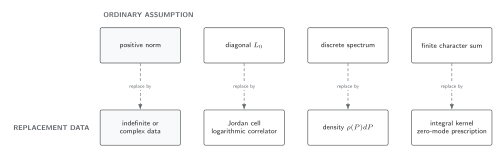
Loss of semisimplicity is diagnosed by a nilpotent part of dilatation and requires extension data in addition to eigenvalues and characters. The diagram is schematic and not to scale.
The diagram’s content has the following structured equivalent:
| Test | Ordinary diagonal module | Rank-two logarithmic module |
|---|---|---|
| Minimal polynomial of at | ||
| Two-point dependence | and | |
| Basis data | Eigenvector normalization | Eigenvector normalization plus generalized-partner shift |
| Ordinary character | Records multiplicity | Records multiplicity but can miss and |
| Required extra structure | None beyond the pairing | Nonsplit extension, logarithmic coupling, generalized torus amplitudes when needed |
A bounded calculation can exponentiate finite Jordan matrices and test basis changes. A finite matrix example verifies the formulas above; it does not determine the module category or fusion rules of a full CFT.
For the independent replacement of sums by direct integrals, continue to Noncompact CFTs and continuous spectra.
Common pitfalls
Section titled “Common pitfalls”A logarithm is not automatically a Jordan block. Perturbative logarithms can arise from expanding a family of ordinary powers in a parameter. A logarithmic CFT claim requires a limiting operator basis and a demonstrably nondiagonalizable dilatation action.
A zero norm is not automatically a null state to quotient. In the pair above, has zero self-pairing but . Removing it would make the generalized partner and its correlators ill-defined.
Characters do not classify indecomposable modules. They count generalized eigenspaces with signs or multiplicities determined by the trace; they need not record extension classes or logarithmic couplings.
Exercises
Section titled “Exercises”Solve the Ward identities
Section titled “Solve the Ward identities”Assume , , and the rank-two Ward identities above. Derive .
Solution
Write . The last Ward identity becomes
so . Hence , where a change of is absorbed into .
Detect what the trace misses
Section titled “Detect what the trace misses”Let on an -dimensional Jordan block with nilpotent . Show that the ordinary character contribution is , independent of the off-diagonal entries of .
Solution
Since is nilpotent,
Every positive power is nilpotent and has zero trace. Therefore . The result counts the generalized eigenspace but contains no extension data.
References
Section titled “References”- Gurarie, Victor. “Logarithmic Operators in Conformal Field Theory.” Nuclear Physics B 410, no. 3 (1993): 535–549. DOI.