

From Crossing Equations to Convex Optimization
A numerical bootstrap exclusion starts before any solver runs. One must first show that the assumed spectrum contributes to crossing with nonnegative scalar weights or positive-semidefinite quadratic forms. Only then is the crossing equation a cone-membership problem, and only then can a separating functional rule out the spectral hypothesis. This page builds that logic twice: first for an identical-scalar CFT, then for an exact rational fixture that will follow us through the next three pages.
Required background. Crossing equations and positivity fix the CFT sign conditions. Convex cones, separation, and conic duality supply the separation theorem. Helpful background. Conformal Hamiltonian truncation illustrates a different finite approximation whose errors must not be confused with functional truncation.
Crossing as a cone-membership question
Section titled “Crossing as a cone-membership question”Fix the external operators, block normalization, symmetry sectors, and a trial spectral hypothesis . For an identical Hermitian scalar, crossing has the schematic form
Here abbreviates the exchanged dimension, spin, and representation. In a single-correlator problem, is a squared OPE coefficient. In a mixed-correlator problem, the corresponding statement is matrix-valued: OPE vectors contract positive-semidefinite blocks. A gap, an operator-uniqueness assumption, or a spin-dependent unitarity threshold belongs to ; none of these assumptions is produced by the eventual bound.
Let
The primal question is whether . A real linear functional belongs to the dual cone when for every allowed generator. If
then
Thus lies strictly on the opposite side of the separating hyperplane. Applying to crossing would give
whose left side is strictly positive. The hypothesis is impossible. Finding such a functional proves exclusion on its stated domain. Failing to find one in a finite search space proves neither feasibility nor the existence of a CFT; a converse separation statement also needs the relevant closure or regularity hypotheses.
An identical-scalar gap exclusion
Section titled “An identical-scalar gap exclusion”The one-dimensional crossing calculation supplies a concrete CFT example. For an identical scalar with , define
With the block convention used there,
The identity is , so a unitary solution whose only operator below is the identity would make the functional sum strictly positive. Crossing says it must vanish. Therefore at least one nonidentity primary has . This is an exact, deliberately nonoptimal exclusion; no block interpolation or solver tolerance enters it.
Now remove the positivity hypothesis. If some may be negative, a negative contribution can cancel the positive identity action. The same algebraic crossing equation may still be studied, but this functional no longer supplies a positive-cone contradiction. Nonunitarity is one common reason for the failure, but the precise stop rule is narrower: stop whenever the particular channel and pairing do not provide the scalar or PSD positivity the proposed cone requires.
Worked fixture, stage 1: exact cone separation
Section titled “Worked fixture, stage 1: exact cone separation”Before approximating conformal blocks, test the logic on a problem with no floating-point ambiguity. Let
and let be the cone generated by all such . The control target
is feasible: it is one generator with weight one. Consider instead
For every ,
but . Therefore . The same functional separates the finite control cone generated by , where its generator actions are exactly .
The stop rule becomes visible in the same numbers. If signed weights are permitted, then
The target has an exact signed decomposition even though the positive-cone certificate excludes it. Thus the separator rules out nonnegative weights, not arbitrary algebraic decompositions—the precise distinction needed when reflection positivity is absent.
This toy problem is not a CFT. Its value is diagnostic: it exercises target signs, ordered bases, continuous positivity, a boundary zero at , and exact serialization. Linear Functionals and Positivity will treat as a basis-dependent coefficient vector; Block Approximations and Semidefinite Programs will encode by a PSD Gram matrix; and Solver Certificates and Independent Verification will verify the saved record independently.
Finite projection and the claim it supports
Section titled “Finite projection and the claim it supports”An exact crossing equation lives in a function space. A derivative computation chooses finitely many probes and maps each crossing vector to
Separation in is exact for the projected vectors when those entries and their positivity are exact. It is generally weaker than separation in the full function space: increasing can reveal additional separators, while nonexclusion at finite says only that this search did not find one.
A production calculation adds several logically independent layers. Conformal blocks are evaluated or approximated; dimensions remain continuous; spin sectors and high-spin behavior must be covered; numbers are rounded and rescaled; and a solver returns finite-precision variables. The numerical-method reduction is reviewed in Poland, Rychkov, and Vichi 2019, §§IV.A–IV.B, pp. 25–29, while the polynomial-matrix formulation is derived in Simmons-Duffin 2015, §§2.1–2.3, pp. 4–8.
| Layer | Exact object | New finite choice | Passing evidence | Failure or nonresult means |
|---|---|---|---|---|
| Crossing | functions and an infinite spectrum | derivative or integral basis | algebra and normalization regenerated | wrong physical problem |
| Spectral domain | all allowed , spins, and sectors | interval and tail representation | positivity covers the full declared domain | sampled statement only |
| Blocks | exact conformal blocks | radial, pole, or polynomial approximation | independent block comparison and remainder control | finite surrogate only |
| Conic problem | cone membership or optimization | matrix scaling and serialization | canonical unscaled input with hashes | irreproducible finite problem |
| Solver | primal or dual equations | precision and stopping tolerances | candidate variables with margins | algorithmic status only |
| Verification | original unscaled equations | independent arithmetic or enclosures | residual, cone, interval, and tail checks pass | no certified claim |
Primal, dual, and boundary cases
Section titled “Primal, dual, and boundary cases”The primal search asks for nonnegative spectral weights reproducing . The dual search asks for a separator. Strict feasibility gives a margin that can dominate verified numerical error. Bootstrap optima, however, often lie on cone boundaries: the exact toy separator already has the zero . Near such boundaries, conditioning deteriorates and a solver label can be ambiguous.
A verified dual separator supports exclusion for the declared finite problem, with any additional CFT statement limited by block and continuum control. A verified primal point supports feasibility of that finite conic problem only. It does not construct an exact crossing solution, much less prove that a local CFT exists.
The diagram shows the information that must survive this progression. Inspect both outcomes after independent checking: a verified dual separator and a verified primal point have different claim ceilings, while any failed check stops the inference.
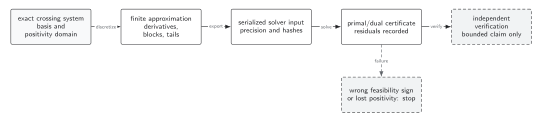
Schematic certification path from an exact positive crossing system to a finite conic problem. Solver variables are candidates, not certificates. Independent reconstruction checks identity, residuals, cone or PSD membership, normalization, continuous intervals, and tails; only then can dual separation support a conditional exclusion or primal variables support finite-problem feasibility. The diagram is schematic and not to scale.
The same logic in structured form is:
| Stage | Required declaration | Independent check | Passing output | Maximum conclusion |
|---|---|---|---|---|
| Exact crossing | external data, sectors, gaps, positivity | algebraic crossing and sign derivation | well-posed hypothesis | cone question exists |
| Finite representation | functional basis, blocks, all truncations | regenerate entries and cover approximation domain | canonical finite problem | no physics conclusion yet |
| Serialization | order, scaling, precision, hashes | byte identity and inverse scaling | solver-ready input | one named finite problem |
| Solver output | candidate primal or dual variables | none from status alone | candidate record | algorithmic run only |
| Independent verification | residual, cone, interval, tail criteria | separate evaluator on unscaled data | verified dual or primal record | finite exclusion or feasibility |
| Interpretation | all physical assumptions and error scope | refinement and exact-to-finite comparison | bounded statement | conditional exclusion, never automatic CFT existence |
Common pitfalls
Section titled “Common pitfalls”Losing the target sign. With and , one must have . Changing only one convention reverses the conclusion.
Treating nonexclusion as existence. Failure to find a separator means the selected search space did not exclude the point. It does not supply positive OPE data for the full crossing equation.
Using positivity outside its domain. A signed OPE product, an indefinite pairing, or an unorganized mixed system cannot inherit a scalar positive-cone proof merely because its truncated equations look similar.
Exercises
Section titled “Exercises”Apply to and prove the exclusion statement. Which line fails if the are allowed to have either sign?
Solution
Linearity gives . The first term is strictly positive and every other term is nonnegative, so equality is impossible. If a coefficient can be negative, then need not be nonnegative and can cancel the identity term; the cone-membership premise has been lost.
Show directly that is in the cone generated by . Then prove that is outside both that finite cone and the cone generated by all for .
Solution
The weights reproduce . For , the functional has actions on the three finite generators and action on the target, so finite-cone membership is impossible. On the continuous family its action is for every , so the same contradiction excludes membership in the full half-line cone.
References
Section titled “References”- Poland, David, Slava Rychkov, and Alessandro Vichi. “The Conformal Bootstrap: Theory, Numerical Techniques, and Applications.” Reviews of Modern Physics 91 (2019): 015002. DOI. Open PDF
- Simmons-Duffin, David. “A Semidefinite Program Solver for the Conformal Bootstrap.” Journal of High Energy Physics 06 (2015): 174. DOI. Open PDF