

The Conformal Algebra and Its Generators
In flat dimension , the conformal Killing equation has only a finite-dimensional solution space. Its constants become the generators of translations , rotations or Lorentz transformations , dilatations , and special conformal transformations . Their commutators form in Euclidean signature and in Lorentzian signature. Signs and factors of depend on whether one writes differential actions or Hermitian charges, so this page fixes one convention and gives the translation rule.
Required background. Conformal Geometry, Maps, and Compactification supplies the conformal Killing equation, signature, and global-domain qualifications. Lie Groups, Lie Algebras, the Exponential Map, and the Adjoint Action supplies Lie brackets, exponentiation, and global-form distinctions. Helpful background. Classical Symmetries, Currents, and the Stress Tensor supplies Noether charges and their action on fields.
Solving the conformal Killing equation
Section titled “Solving the conformal Killing equation”With a constant Euclidean or Lorentzian metric , an infinitesimal conformal vector field obeys
Define . Differentiating the equation and permuting its three indices gives
Taking and using yields
Its trace gives . For , therefore, : is affine and is at most quadratic. Integrating gives
There are parameters , parameters , one , and parameters , for a total . This equals the dimension of and . The step multiplying by is exactly why the argument does not apply in . In every local reparametrization is conformal at the metric level; in holomorphic and antiholomorphic vector fields give infinite-dimensional local algebras. The finite set above remains the global conformal subalgebra on the compactified geometry Simmons-Duffin 2017, § 2.1.
One commutator convention
Section titled “One commutator convention”For the remainder of this chapter, , , , and denote the Euclidean radial-quantization generators with no explicit factors of . Replacing below by the mostly-minus gives the corresponding Lorentzian real-form brackets:
All other independent brackets vanish. This algebra and its action on local operators are summarized independently in Poland, Rychkov, and Vichi 2019, §§ III.A–III.B. Radial conjugation is
Thus is represented anti-Hermitian in a unitary finite-dimensional rotation representation, while and are adjoints of one another rather than separately Hermitian. If instead denotes a Hermitian Lorentzian Noether charge, its action is conventionally and its algebra contains explicit multiplying the same real structure constants. Dropping those ‘s without also changing the generator definitions reverses signs in later norm calculations. The convention and radial adjoint above agree with Simmons-Duffin 2017, Eqs. (32)–(37) and §§ 7.1–7.2.
Embedding the algebra
Section titled “Embedding the algebra”Introduce antisymmetric generators in an auxiliary space with two extra coordinates and metric of signature or . They obey
In a null basis with , , and , choose
With the displayed metric, these definitions reproduce the preceding brackets directly. Rescaling and inversely changes the displayed factors but not the algebra. The invariant statement is that and occupy opposite null directions while is the boost in their plane. This construction explains the real forms but does not choose a global quotient or Spin cover.
The geometric relation is summarized below. Inspect how the same complexified algebra acquires different real forms and global domains.
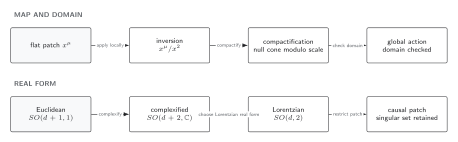
The generators act linearly in an embedding space and nonlinearly in an affine spacetime patch. Euclidean signature gives ; Lorentzian signature gives . Compactification resolves coordinate infinities, but the connected group, discrete quotient, universal cover, and Spin lift remain separate choices. The diagram is schematic.
| Feature | Euclidean realization | Lorentzian realization |
|---|---|---|
| Metric used in brackets | Positive | Mostly-minus |
| Local conformal real form | ||
| Natural compactified base | or its universal cover | |
| Positivity convention used later | Reflection-positive radial quantization, | Positive-energy Hilbert space after a declared continuation and charge convention |
| Information not fixed by the algebra | Orientation component, quotient, Spin cover | Time orientation, quotient, time cover, Spin cover |
| Scale symmetry alone | Contains , , and but does not imply | Same; enhancement requires a stress-tensor and virial-current argument |
Action on a primary scalar
Section titled “Action on a primary scalar”Let be a scalar primary of dimension :
Translations define . Repeated use of the Baker–Campbell–Hausdorff formula terminates because is proportional to and the next commutator vanishes. The result is
For a spinning primary one adds in this convention. At the right-hand side vanishes, as required. Acting with on the same expression gives weight for , while commuting it with translations reproduces . This is a concrete closure check rather than an appeal to the name of the group.
Exponentiating the scalar action gives the finite special conformal law
on a Euclidean patch where the denominator has fixed positive sign. If is not an integer, crossing a negative or complex value requires a branch prescription; in Lorentzian signature it must be correlated with the causal boundary value. The algebraic exponential does not remove the domain qualifications established on the geometry page.
A bounded calculation can be used for checking commutators and small descendant Gram matrices after the dimension, signature, generator convention, and representation matrices have been supplied. Its output is evidence for those declared inputs, not a replacement for the analytic derivation above.
Primaries, Descendants, and Conformal Multiplets uses this grading to build local-operator modules. The separate Radial Quantization and the State–Operator Correspondence constructs the positive form and explains why the radial adjoint is physical rather than a formal involution.
Common pitfalls
Section titled “Common pitfalls”Changing signature by replacing one symbol. The metric substitution translates local brackets, but the adjoint, positive-energy condition, compactification, and global group also change. State all of them before transferring a positivity result.
Calling every generator Hermitian. That is inconsistent with the no- Euclidean convention used here. Either keep the radial adjoint above or convert every bracket and field action to Hermitian charges.
Using the finite-dimensional derivation in two dimensions. The inference divided by . Two-dimensional local conformal transformations require a separate complex-analytic treatment.
Exercises
Section titled “Exercises”Count the conformal generators in and verify that the result equals .
Solution
There are translations, rotations or boosts, one dilatation, and special conformal generators. Their sum is
which is the number of independent antisymmetric pairs in dimensions.
Use the algebra to show that has scaling dimension when .
Solution
From ,
References
Section titled “References”- Poland, David, Slava Rychkov, and Alessandro Vichi. “The Conformal Bootstrap: Theory, Numerical Techniques, and Applications.” Reviews of Modern Physics 91 (2019): 015002. DOI; Open PDF
- Simmons-Duffin, David. “TASI Lectures on the Conformal Bootstrap.” In New Frontiers in Fields and Strings, 1–74. Singapore: World Scientific, 2017. DOI; Open PDF