

Noncompact CFTs and Continuous Spectra
In a noncompact conformal field theory, individual momentum eigenstates are generally delta-normalized rather than normalizable, and completeness is a direct integral rather than a discrete sum. Partition functions and OPE decompositions are still meaningful, but only after the spectral measure, zero-mode volume, contour, and possible discrete residues have been stated. The noncompact free boson provides an exact model in which every normalization can be checked.
Required background. Completeness and operator bases provide the discrete formulas generalized here. Free bosons and vertex operators supply the oscillator algebra and normal-ordering conventions.
Helpful background. Tempered distributions and Fourier calculus explain why delta-normalized matrix elements are defined by their action on test functions.
The noncompact free boson
Section titled “The noncompact free boson”Take a real scalar on the plane with
and normal-ordered vertex operators
We normalize momentum states by
Neither nor is a normalizable vector. A normalizable wave packet is
Thus the Hilbert space is a direct integral over , with an oscillator Fock space above each momentum. The continuum and its normalization in the uncompactified boson are described explicitly in Ribault 2018, §4.1.3, pp. 101–103.
Zero-mode integration and momentum conservation
Section titled “Zero-mode integration and momentum conservation”Split the field into a constant mode and nonzero modes,
For vertex operators, the zero-mode integral is
The oscillator contractions then give
The delta function is part of the correlator, not an infinite numerical coefficient to be discarded. For two insertions it gives
This expression is a distribution in . It becomes a number only after smearing with wave packets or after imposing a finite-volume regulator. The general role of Dirac-delta two-point normalization in continuous CFT spectra is set out in Ribault 2018, §2.2.3, pp. 39–42.
From a compact sum to a continuum measure
Section titled “From a compact sum to a continuum measure”Regulate the target by identifying . Momentum is then
For this decompactification test we follow the zero-winding sector. In the full compact-boson theory, nonzero winding sectors are also present; their weights grow with the square of the target radius and they decouple at fixed torus modulus as .
For a sufficiently decaying test function ,
The factor is the target-space volume. In the continuum convention used above,
Consequently, an uncompactified torus partition function carries an overall target volume. Dividing by produces a partition-function density; retaining it produces the trace over the regulated target. Both conventions are legitimate, but they are different observables. The zero-mode factor and its modular transformation are derived in Di Francesco, Mathieu, and Sénéchal 1997, §§10.1–10.2, pp. 337–343.
With and the state normalization above, the density is
Changing the kinetic-term normalization rescales , the target length, and the measure together. Quoting only the final factor of is not enough to compare conventions.
Continuous OPE decompositions
Section titled “Continuous OPE decompositions”Suppose a four-point function is expanded in states labelled by on a contour . The correctly typed expression is
The set records isolated states or residues not included in the continuum. The density multiplying a block depends on the coordinate used on the spectrum: under , and the density transform with the Jacobian. A spectral density is therefore not a degeneracy assigned to one exact value of .
Analytic continuation in external dimensions or couplings can move poles of the structure constants across . Deforming the contour back to its defining location then adds the residues of the crossed poles. Omitting them changes the correlator. This mechanism is central in Liouville theory and is developed on Liouville theory and the Virasoro bootstrap.
Failure tests for a continuum calculation
Section titled “Failure tests for a continuum calculation”Before accepting a noncompact decomposition, test each of the following.
- State normalization: insert the proposed completeness relation between two wave packets. It must reproduce with the same convention.
- Compact limit: replace by or the convention-equivalent expression and recover the regulated result.
- Zero mode: verify that the correlator has the correct conserved-charge delta function and determine whether has become a target volume.
- Contour: list the poles on each side of and track those that cross during analytic continuation.
- Residues: check a limit in which a continuous pole becomes a known discrete contribution.
- Regulator order: take the infinite-volume, coincident-point, and analytic-continuation limits in a declared order; these operations need not commute.
Locating the continuum branch
Section titled “Locating the continuum branch”The figure below highlights the replacement relevant here: a discrete resolution of the identity becomes a measured direct integral. Inspect the measure and zero-mode labels, which are independent of whether the pairing is positive or is diagonalizable.
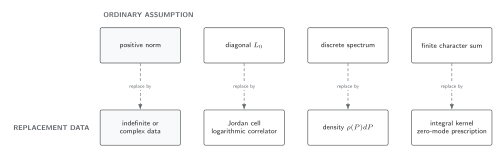
Noncompactness changes state normalization and spectral summation: delta-normalized fibers are integrated with a declared measure, while zero modes can produce volume factors. The diagram is schematic and not to scale.
The same information is available in this structured form:
| Ingredient | Compact regulator | Noncompact limit |
|---|---|---|
| Momentum labels | , | |
| Normalization | ||
| Completeness | after matching state conventions | |
| Trace | Extensive in target length | A volume-divergent trace or a finite density after division by |
| Charge conservation | Kronecker delta | Dirac delta from the zero-mode integral |
| Analytic continuation | Discrete terms followed individually | Continuum contour plus residues from crossed poles |
A bounded calculation can be used for comparing a large compact momentum sum with its regulated integral. Agreement at finite cutoff tests the normalization and convergence rate; it does not prove continuum crossing or justify an undeclared interchange of limits.
The distributional meaning of the delta functions is developed further on Distributional correlators, zero modes, and normalization.
Exercises
Section titled “Exercises”Normalize a wave packet
Section titled “Normalize a wave packet”Using , show that
has norm .
Solution
Insert the definition twice:
This calculation also verifies the factor in the completeness relation.
Recover the target-volume factor
Section titled “Recover the target-volume factor”Let be smooth and rapidly decreasing. Use the momentum spacing to derive the leading large- relation between and .
Solution
The sum is a Riemann sum:
Since ,
The extensive factor is the regulated target volume.