

Cosets and Orbifolds
Cosets and orbifolds construct new CFTs by removing degrees of freedom, but neither operation is a naive deletion. A coset keeps the commutant of an embedded current algebra and must account for branching, selection rules, field identifications, and fixed points. An orbifold projects in every sector and must add twisted sectors for modular closure. This page carries both constructions through explicit Ising and circle-orbifold checks.
Required background. Affine current algebras and WZW models provide levels, Sugawara tensors, integrable modules, and affine characters. Free bosons and vertex operators provide the compact circle spectrum, cocycles, and momentum–winding lattice used in the orbifold example.
Helpful background. Gauging higher-form symmetry supplies the broader projection, twisted-sector, and anomaly logic; here only an ordinary finite zero-form group is gauged.
Coset stress tensors and branching
Section titled “Coset stress tensors and branching”Let be an affine embedding. The induced level is fixed by the embedding index :
with the obvious sum of contributions for a diagonal embedding in a product numerator. The coset stress tensor is
Because the two Sugawara tensors use compatible invariant forms and induced levels, has a regular OPE with the denominator currents. It generates the chiral algebra commuting with , not merely a formal difference of central charges.
A numerator module branches as
and its character obeys
The branching functions are coset characters only after enforcing the selection rule inherited from common centers or simple currents. Some label pairs describe the same coset module and must be identified. If an identification orbit has a fixed point, that branching space can split; fixed-point resolution and its multiplicities are required before claiming a complete spectrum. The coset construction and these qualifications originate in Goddard, Kent, and Olive 1985, pp. 88–92 and are developed in Di Francesco, Mathieu, and Sénéchal 1997, §§18.1–18.5.
The unitary minimal series as a coset
Section titled “The unitary minimal series as a coset”The diagonal embedding gives
with
This is the unitary Virasoro minimal series . At ,
has and reproduces Ising. Write a branching label as for the two numerator spins and the denominator spin. The diagonal selection rule requires , and a simple-current identification relates
Representatives for the three sectors at are
| Ising sector | Coset label | Lowest coset weight | Check |
|---|---|---|---|
| Vacuum branch begins at grade zero | |||
| Direct difference of affine weights | |||
| Denominator spin one first occurs at numerator grade one |
The last row illustrates why central-charge subtraction is insufficient: the affine-grade offset is part of the branching function. With identifications and grade shifts included, the resulting characters and fusion agree with the Ising Kac-table data.
Orbifold sectors and modular closure
Section titled “Orbifold sectors and modular closure”Let a finite, non-anomalous group act on a parent CFT. Denote by the torus amplitude with spatial twist and temporal insertion . It is defined only when and commute. With a consistent discrete-torsion phase , the orbifold partition function is
For trivial discrete torsion, modular transformations act schematically as
with phases added when the theory has the corresponding projective data. The untwisted projection alone,
cannot be modular invariant unless every -twisted sector required by is also present. In the -twisted Hilbert space one projects by the centralizer , not automatically by all of . The construction of modularly complete twisted sectors is given in Dixon, Harvey, Vafa, and Witten 1985, pp. 678–686.
Discrete torsion is not an arbitrary sign assigned term by term. Its phases form a consistent cohomology class, satisfy modular and factorization constraints, and can change projection eigenvalues in twisted sectors; see Vafa 1986, §§2–3, pp. 595–602. If the symmetry has an ‘t Hooft anomaly, no choice of such phases produces an ordinary standalone orbifold without additional anomaly-canceling data.
Reflection orbifold of the compact boson
Section titled “Reflection orbifold of the compact boson”Consider for . The untwisted Hilbert space is projected onto reflection-even combinations of and . That projection is incomplete by itself. The spatially twisted boundary condition
has two fixed-point ground sectors, associated with and . Half-integer oscillator modes shift the chiral ground weight to
Thus the complete generic-radius orbifold includes untwisted even states and projected excitations above both twisted ground states. At special radii the chiral algebra can extend, identification orbits can shorten, and fixed-point fields may split; their multiplicities must be resolved in the extended-character basis. A list containing only invariant parent vertex operators fails both the modular test and OPE closure of twist fields.
Construction paths and completion tests
Section titled “Construction paths and completion tests”The figure shows cosets and orbifolds as separate routes into local full-CFT data. Inspect the dashed orbifold box: projection and twisted sectors are one inseparable completion step.
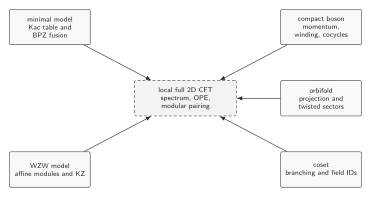
Schematic construction map. A coset needs induced levels, branching selection, field identification, and fixed-point resolution. An orbifold needs a specified group action, projection in each twisted sector, modular closure, and any consistent discrete-torsion choice. Equal central charges do not identify the resulting theories.
The two relevant branches are equivalently:
| Requirement | Coset | Orbifold by |
|---|---|---|
| Chiral algebra | Commutant of in | Invariant algebra plus twisted modules |
| Spectrum input | Numerator integrable modules and their branching | Parent sectors and a non-anomalous finite group action |
| Selection or projection | Branching selection rule and simple-current identifications | Centralizer projection in every -twisted sector |
| Fixed points | Resolve shortened identification orbits | Resolve geometrical or algebraic fixed-point multiplicities |
| Modular completion | Modular-closed set of branching functions and left–right pairing | All commuting amplitudes, with consistent discrete torsion |
| Normalization | Embedding index and induced denominator level | , twist conventions, cocycle phases, parent normalization |
| Decisive counterexample | Subtracting without branching overcounts or misses states | Keeping only untwisted invariant states fails under |
Common pitfalls
Section titled “Common pitfalls”Subtracting central charges and stopping. The stress tensor difference is only the start. Branching grades, selection rules, identifications, and fixed-point resolution determine the actual coset spectrum.
Projecting without twisting. Modular exchanges a temporal insertion with a spatial twist. An invariant untwisted subspace alone is not an orbifold CFT.
Choosing discrete-torsion phases independently. The phases must satisfy cocycle, modular, and sewing constraints. They are additional global data, not arbitrary signs.
Exercises
Section titled “Exercises”Verify the central charge of the minimal coset and the weight of its spin sector.
Solution
Using ,
For ,
This matches the Ising module.
References
Section titled “References”- Di Francesco, Philippe, Pierre Mathieu, and David Sénéchal. Conformal Field Theory. Graduate Texts in Contemporary Physics. New York: Springer, 1997. DOI.
- Dixon, Lance, Jeffrey A. Harvey, Cumrun Vafa, and Edward Witten. “Strings on Orbifolds.” Nuclear Physics B 261, no. 4 (1985): 678–686. DOI.
- Goddard, Peter, Adrian Kent, and David Olive. “Virasoro Algebras and Coset Space Models.” Physics Letters B 152, nos. 1–2 (1985): 88–92. DOI.
- Vafa, Cumrun. “Modular Invariance and Discrete Torsion on Orbifolds.” Nuclear Physics B 273, no. 3–4 (1986): 592–606. DOI.