

Conformal Collider Observables and Stress-Tensor Bounds
A conformal collider prepares a normalizable state with a local operator and measures its angular energy distribution at future null infinity. Because the energy detector is positive, its expectation value is a positive-semidefinite matrix on source polarizations. In a fixed spacetime dimension and tensor basis, this converts positivity into linear inequalities on current and stress-tensor three-point data.
Required background. Averaged null energy and positivity supplies the positive detector operator and its state domain. Current and stress-tensor data supplies the Ward-normalized tensor structures whose coefficients the detector probes.
Helpful background. Anomaly coefficients and central charges is useful when a supersymmetric or four-dimensional convention converts collider parameters into - and -type data.
The energy matrix
Section titled “The energy matrix”Choose operators with the same conserved quantum numbers and create wave-packet states
with future-timelike , smooth , and positive norm. For fixed detector direction , define
ANEC implies : every finite superposition obeys . Diagonal entries give ordinary collider bounds; off-diagonal entries give interference bounds. The matrix depends linearly on the appropriate coefficients after the two-point norms and stress-tensor Ward identity have been fixed.
The statement is sector-specific. The rest of this page derives the standard four-dimensional, parity-even bounds in the rest frame , with the physical detector normalized by . Parity-odd structures, , and general require their own polarization spaces and basis conversions.
A conserved-current state
Section titled “A conserved-current state”Let be a Hermitian conserved current and use a purely spatial polarization . Rotations and the total-energy sum rule fix the normalized distribution to one coefficient:
The two extrema occur for and . Positivity gives
The coefficient is a particular ratio of the two parity-even structures in this four-dimensional convention. A different normalization of cancels between the state norm and numerator, but a different tensor basis changes the formula relating to named OPE coefficients. The angular distribution and interval are derived in Hofman and Maldacena 2008, eqs. (2.30)–(2.34).
Stress-tensor polarization sectors in four dimensions
Section titled “Stress-tensor polarization sectors in four dimensions”Create the state with a spatial complex polarization satisfying
Conservation removes time components in the zero-momentum frame. In the standard parity-even collider convention,
The constants and make both anisotropic terms integrate to zero. Thus the distribution always obeys the energy sum rule, independently of Hofman and Maldacena 2008, eq. (2.37).
Set . The stabilizer is , and the five-dimensional space of symmetric-traceless polarizations splits into helicity-two, helicity-one, and helicity-zero sectors. The energy matrix is diagonal on these irreducible sectors:
| sector | Representative nonzero components | Angular ratios | Normalized detected energy |
|---|---|---|---|
| Helicity two | or | , | |
| Helicity one | or | , | |
| Helicity zero | , |
Here
Positive semidefiniteness is therefore equivalent to the three inequalities
Their intersection is a triangle in the plane. In the same normalization, the free scalar, free Weyl-fermion, and free Maxwell stress-tensor structures furnish its three vertices. A boundary equality means that one polarization detects zero energy; it does not by itself prove that an interacting CFT is a free theory. The diagonalization and saturation statement are given in Hofman and Maldacena 2008, eq. (2.38) and surrounding discussion.
What must be fixed before comparing coefficients
Section titled “What must be fixed before comparing coefficients”| Item | Required declaration | Failure if omitted |
|---|---|---|
| Dimension | Here | The transverse little group and numerical inequalities change with . |
| Stress tensor | Conserved, traceless, Ward-normalized conformal tensor | Improvements and basis changes can be mistaken for physical violations. |
| Detector | Every quoted coefficient can acquire a common mismatch. | |
| State | Normalized packet centered at | Plane-wave delta functions or packet corrections contaminate the ratio. |
| Tensor sector | Parity-even and spatial symmetric-traceless | Parity-odd interference terms are silently discarded. |
| Contacts | Separated source and detector with the Wightman prescription | Local terms can be confused with the finite angular distribution. |
| Saturation | Named polarization eigenvalue | Equality is overinterpreted as a complete characterization of the theory. |
An improved stress tensor must still be the conformal, Ward-normalized tensor used to define translations. Under adequate falloff, the integrated detector is insensitive to total derivatives, but the conversion between a position-space basis and can change through contact or improvement terms. Perform that conversion before applying the inequalities.
The diagram below summarizes how a normalized detector, complete-line ANEC, and a polarized state lead to a positive collider energy matrix. The four-dimensional parity-even triangle is then obtained from the three eigenvalue inequalities derived above; it is not drawn in the shared schematic.
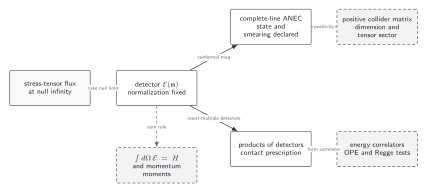
From detector normalization and ANEC to collider-matrix positivity. The diagram is schematic and not to scale; the separately derived four-dimensional parity-even triangle follows by imposing nonnegativity of the helicity-two, helicity-one, and helicity-zero eigenvalues in the convention above. That conclusion presupposes a normalizable state, the total-energy detector normalization, separated-source Wightman ordering, and the stated polarization basis.
The structured equivalent is:
| Step | Mathematical operation | Check | Scope boundary |
|---|---|---|---|
| Prepare | Smear and divide by its positive norm | future timelike; packet corrections controlled | Not a bare plane wave |
| Measure | Insert at null infinity | Not local positivity | |
| Construct | Form | Hermitian and positive semidefinite | Contacts and ordering fixed |
| Decompose | Restrict to irreducible polarizations of the detector stabilizer | In , helicities | Different in other dimensions/parity sectors |
| Constrain | Require each eigenvalue nonnegative | Three displayed inequalities | No automatic gap or Regge conclusion |
Checks and interpretation
Section titled “Checks and interpretation”At every polarization gives the isotropic value and all inequalities are strict. For any point on one boundary, the corresponding row of the polarization table vanishes. A point outside the triangle supplies an explicit negative-energy state: choose the representative polarization of the violated row. Thus the inequalities are necessary and sufficient for positivity of this one-detector energy matrix in the declared sector.
They are not sufficient for the existence of a complete CFT. Crossing, unitarity of all local correlators, spectrum consistency, and higher-point detector positivity impose additional conditions.
Common pitfalls
Section titled “Common pitfalls”Quoting the triangle without its dimension. The three coefficients above are tied to and the parity-even basis. General-dimensional collider bounds have different numerical factors.
Testing only real polarizations. The energy matrix is Hermitian on complex polarizations. Decomposition into helicity sectors is the efficient complete test.
Converting too early. Relations between and anomaly coefficients require symmetry and convention assumptions. Establish the collider basis first.
Treating a saturated face as a theory identification. One zero eigenvalue is a selection rule for a detector polarization, not a proof of free-field dynamics.
Exercises
Section titled “Exercises”1. Vector sector. With and only nonzero, reproduce the helicity-one inequality.
Solution
The norm is . The numerator of is , so , while gives . Substitution yields .
2. Exclusion witness. Suppose . Find a polarization sector that proves this point is excluded.
Solution
The helicity-two and helicity-one eigenvalues are both . Either a transverse helicity-two polarization or an helicity-one polarization produces negative detected energy.
References
Section titled “References”- Hofman, Diego M., and Juan Maldacena. “Conformal Collider Physics: Energy and Charge Correlations.” Journal of High Energy Physics 2008, no. 05 (2008): 012. doi:10.1088/1126-6708/2008/05/012.