

Superconformal Blocks and Crossing
A superconformal block is a fixed linear combination of ordinary conformal blocks contributed by all conformal primaries in one exchanged supermultiplet. Supersymmetry fixes relative dimensions, spins, R-symmetry representations, and descendant OPE coefficients once the superprimary convention is chosen. In four-dimensional half-BPS examples, conformal partial-wave analysis explicitly separates protected short and semishort contributions from long-multiplet data Dolan and Osborn 2006, abstract. Crossing then sums complete supermultiplets, keeping protected coefficients fixed and unprotected dimensions and OPE matrices explicit.
Required background. Superconformal Ward Identities supplies the reduced correlator. Spinning Conformal Blocks supplies the ordinary block basis. Helpful background. Symmetry and Spinning Systems explains matrix-valued crossing, while Protected Data as Bootstrap Input supplies the import gate.
From a supermultiplet to ordinary blocks
Section titled “From a supermultiplet to ordinary blocks”Let be an exchanged supermultiplet. Decompose it into conformal primary components , each with dimension , spin , and R-symmetry channel . Its contribution can be written
The relative coefficients follow from superconformal three-point structures and the normalization of the superprimary. They need not all be positive. Positivity applies to the overall matrix of superprimary OPE products in a reflection-positive crossing system, not separately to every ordinary-block coefficient inside .
There is no superblock independent of its external operators. The same exchanged multiplet can contribute different combinations of conformal blocks to different external components or tensor structures Fortin, Intriligator, and Stergiou 2011, §§2–3.
Shortening and recombination
Section titled “Shortening and recombination”For a long multiplet approaching its unitarity threshold , null states become primaries and the representation decomposes:
The blocks must satisfy the corresponding identity
in the same normalization. This is one of the strongest implementation checks: it tests the conformal-primary content, relative coefficients, and short-versus-long bookkeeping at once.
A protected list imported at one point on a conformal manifold must also say whether multiplets can recombine elsewhere. Counting both a threshold long block and its short constituents double counts the same representation content.
Crossing by complete multiplets
Section titled “Crossing by complete multiplets”Collect the reduced crossing equations into a vector . For external sectors ,
For identical Hermitian external operators, the coefficient of an allowed supermultiplet can reduce to a nonnegative square. For mixed correlators, the products form positive-semidefinite matrices only after the two-point metric, reality convention, and reflection pairing are fixed. R-symmetry crossing matrices can carry negative entries without violating unitarity.
The protected term may contain the identity, stress-tensor multiplet, current multiplets, or other short sectors. Fix only coefficients supplied by the accepted protected record. All remaining protected multiplicities or coefficients stay as variables; “protected” does not mean “known.” This separation of fixed protected contributions from variable long-sector data underlies supersymmetric numerical bootstrap systems Poland, Rychkov, and Vichi 2019, §8.
Assembly and verification
Section titled “Assembly and verification”The complete protected-input flow is shown below. The superblock step consumes a Ward-reduced tensor basis and a recombination-complete conformal-primary list.
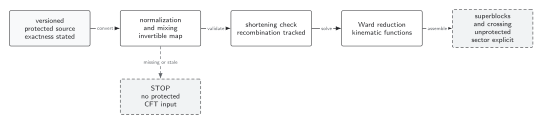
Complete supermultiplets, rather than isolated conformal blocks, enter crossing. Recombination and Ward checks precede numerical or analytic constraints, and missing protected input remains an explicit unknown. The diagram is schematic.
| Assembly step | Exact check | Typical failure |
|---|---|---|
| Enumerate conformal primaries in | character or state-count agreement | omitted component |
| Fix | Ward or super-Casimir residual | normalization mismatch |
| Approach | recombination identity | short sector counted twice |
| Apply R-symmetry projectors | projector completeness and crossing group relations | wrong channel sign |
| Insert protected coefficients | inverse convention round trip | source normalization lost |
| Form positivity cone | Hermitian reflection pairing | internal block signs treated as OPE squares |
A second, independent test acts with the relevant quadratic super-Casimir on and checks its eigenvalue or coupled differential system. A third expands in an OPE limit and matches the multiplicities and leading powers of the conformal components.
Executable boundary
Section titled “Executable boundary”The designated upstream object is N=1 , protected data v1.0.0, whose source derivation belongs to the N=1 protected-data export. Its required tuple is
Acceptance requires a generated hexadecimal RFC 8785 canonical-JSON digest plus passing schema, label, anomaly, normalization, and inverse-map checks. This edition passes those generator gates; the independent convention hash is 81124c40cb39131147e94235022cbcea42222795e2a4e4c4842936fc212bfd95 and the literature cutoff is 24 August 2026. The record can therefore fix the protected identities, dimensions, central data, and current normalizations that it actually contains.
It does not specify a unit-normalized non-Ward OPE coefficient, a complete list of protected multiplicities, an external-correlator tensor basis, or a long-sector hypothesis. Those missing choices remain variables rather than being inferred from shortening. A reproducible crossing calculation must first specify the external correlator problem and superblock basis, and should then impose a Ward/Casimir and recombination residual. Consequently, these SQCD data alone do not determine a numerical bound or protected crossing solution.
Common pitfalls
Section titled “Common pitfalls”Applying positivity to the ordinary components inside a superblock. Supersymmetry can fix relative coefficients of either sign. Positivity constrains the superprimary OPE matrix in the correct reflection channel.
Omitting a conformal primary that is a superdescendant. Superdescendants can be conformal primaries and contribute their own blocks. State counting and Ward identities detect the omission.
Fixing every short coefficient. Shortening protects representation data, not necessarily the OPE coefficient. Leave any coefficient not supplied by the protected record as an unknown.
Exercises
Section titled “Exercises”Why is the recombination identity more informative than checking only the leading OPE power of a long superblock?
Solution
The leading power tests the superprimary normalization. Recombination tests every conformal-primary component that becomes part of the short multiplets, including relative coefficients, spins, R-symmetry channels, and null-state subtraction.
References
Section titled “References”- Dolan, F. A., and Osborn, H. “Conformal Partial Wave Expansions for Chiral Four-Point Functions.” Annals of Physics 321 (2006): 581–626. arXiv. DOI.
- Fortin, J.-F., Intriligator, K., and Stergiou, A. “Current OPEs in Superconformal Theories.” Journal of High Energy Physics 2011, 071 (2011). arXiv. DOI.
- Poland, D., Rychkov, S., and Vichi, A. “The Conformal Bootstrap: Theory, Numerical Techniques, and Applications.” Reviews of Modern Physics 91, 015002 (2019), §8. arXiv. DOI.