

Crossing and Positivity in One Dimension
In a reflection-positive one-dimensional CFT, an ordered identical-scalar correlator is a positive sum of blocks. Crossing then becomes a convex feasibility problem: a putative spectrum is impossible if a linear functional has one sign on every allowed block, including the identity. The force of the conclusion comes from the complete list of hypotheses, not from crossing symmetry alone.
Required background. One-Dimensional Conformal Blocks and Casimir Equations fixes the physical block and normalization. Crossing and Positivity supplies reflection-positive OPE coefficients. Helpful background. Bounded and Compact Operators clarifies continuity and interchange of limits.
The positive crossing sum rule
Section titled “The positive crossing sum rule”For an identical Hermitian bosonic primary of dimension , define
Crossing on is
Each is odd under . At , only odd derivatives provide independent scalar equations. Degenerate primaries contribute through their summed weight .
The nonnegative coefficients require all of the following: a positive Hilbert-space inner product, Hermitian identical external operators, a reflection-compatible ordering, unit two-point normalization, and a convergent OPE in the domain where a functional is applied. For nonidentical operators the coefficients form positive-semidefinite matrices in a mixed system; for nonunitary theories even scalar coefficients need not be positive.
Separating a forbidden cone
Section titled “Separating a forbidden cone”Let be a real linear functional on crossing vectors. Suppose a proposed gap is such that
If the identity is the only operator below the gap, applying to crossing gives a sum of nonnegative terms with a strictly positive identity contribution. It cannot vanish. The assumed gap is excluded.
This is a separation theorem, not a construction theorem. Failure to find in a finite search space does not produce a CFT, and finding an allowed point in a truncated system does not prove that an untruncated spectrum exists.
The finite-dimensional numerical version of this convex separation argument, including derivative functionals and positivity domains, is reviewed in Poland, Rychkov, and Vichi 2019, §§IV.A–IV.C, pp. 25–30. Analytic one-dimensional functionals require the stronger endpoint, swapping, and Regge controls constructed by Mazáč and Paulos 2019, §§3–5.
A transparent derivative certificate
Section titled “A transparent derivative certificate”Take and define
With the block normalization of the preceding page,
Here is a short proof of the second sign. Put and . The Casimir equation reduces the functional to
The Euler representation defines a positive probability measure
and gives
The beta weight before the last factor is symmetric about , while is increasing. Therefore . Since is increasing and convex, Jensen’s inequality yields
For this ratio is at least , and the bracket is bounded below by
Hence any unitary solution with these hypotheses contains a nonidentity primary with . This deliberately low-order certificate is not optimal: analytic extremal functionals prove the sharper for the positive integer and half-integer cases covered by the theorem, with generalized-free-fermion data saturating the corresponding ordered crossing problem Mazáč 2017, §§3–5. That saturation statement does not by itself exhibit a bosonic local CFT saturating the subclass declared on this page.
The hierarchy is pedagogically useful. A short derivative functional shows exactly why convex separation yields a rigorous exclusion. A nonlocal analytic functional can be optimal, but then its kernel, endpoint behavior, swapping with the OPE sum, and Regge assumptions must all be proved.
From derivative searches to certified bounds
Section titled “From derivative searches to certified bounds”A finite derivative ansatz has the form
To turn a numerical candidate into a certificate:
- fix , all symmetry or parity sectors, and the proposed gap;
- compute block derivatives with controlled truncation and precision;
- normalize or another declared nonzero value;
- prove positivity on each continuous allowed interval, not merely on a grid;
- bound the large- tail analytically;
- rerun at higher precision and with an independent block representation.
For polynomial or rational approximations, interval arithmetic can cover compact dimension ranges while asymptotic estimates cover the tail. A grid scan is a diagnostic, never the final proof: a narrow negative region between grid points invalidates the exclusion.
Functional sum rules and their domain
Section titled “Functional sum rules and their domain”If is represented by an integral kernel, schematically
then the formal step
requires uniform bounds that control OPE endpoints and any contour at infinity. Different Regge behavior can change which kernels are admissible. Complete functional bases and Polyakov-block reorganizations belong to Analytic Functionals and Polyakov Blocks; the present chapter uses only the crossing-separation logic.
The figure makes the dependency order explicit. Read it from left to right: an ordering fixes the real cross-ratio interval and the crossing vector, reflection positivity supplies the cone, and a functional separates a proposed spectrum only after its domain and sign conditions are justified.
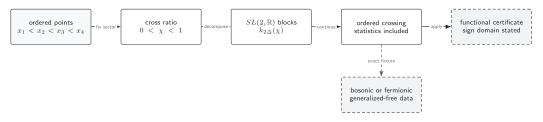
One-dimensional crossing and functional separation. The ordering sector and statistics determine the crossing equation; positivity is an additional reflection assumption, and a functional certificate applies only on its proved spectral domain. The generalized-free branch is an exact normalization test. The diagram is schematic and not to scale.
The same dependencies in structured form are:
| Stage | Mathematical object | Required condition | Valid conclusion |
|---|---|---|---|
| Ordering | and | Statistics and prefactor fixed | One real boundary value of the correlator |
| Blocks | Physical Casimir solution and OPE normalization | One conformal-family contribution | |
| Crossing | Compatible continuation and complete channel sum | Equality of two ordered channel expansions | |
| Positive cone | Hermitian external operator and reflection-positive sector | Convex spectral feasibility problem | |
| Functional | and on the assumed spectrum | Swapping, endpoint, and continuous-interval signs proved | Exclusion of that spectrum, not construction of a CFT |
What a bound does and does not say
Section titled “What a bound does and does not say”| Result | Justified conclusion | Not justified |
|---|---|---|
| A positive functional exists | Every CFT satisfying the stated assumptions violates the proposed gap or coefficient range | A particular model realizes the boundary |
| No functional is found at order | The chosen finite search did not exclude the point | The point is allowed in the exact problem |
| Successive derivative orders converge numerically | Evidence for a limiting bound, with a stated extrapolation | A theorem without error control |
| An extremal spectrum solves truncated equations | A candidate explanation of boundary data | Existence, uniqueness, or locality of a full CFT |
This distinction prevents the two most common overclaims: turning exclusion into existence, and turning a sharp boundary feature into identification with a named model.
Common pitfalls
Section titled “Common pitfalls”Forgetting the identity sign. The normalization of and can be reversed, but the identity must lie strictly on the forbidden side while all assumed nonidentity blocks lie on the other.
Checking positivity only at sample dimensions. The spectrum is not confined to the sampling grid. Certify every continuous interval and the asymptotic tail.
Using scalar positivity in a mixed system. Mixed correlators carry matrices of OPE products. Positivity is matrix-valued and depends on the chosen reflection pairing.
Exercises
Section titled “Exercises”Using , show that all even derivatives vanish at .
Solution
Set . Then , so its Taylor series contains only odd powers of . Every even derivative at therefore vanishes.
Explain why the derivative certificate above excludes a gap .
Solution
Under that assumption the identity contributes , and every nonidentity primary contributes . Their sum is strictly positive, contradicting the functional applied to crossing, which must give zero.
References
Section titled “References”- Mazáč, D. “Analytic Bounds and Emergence of Physics from the Conformal Bootstrap.” Journal of High Energy Physics 2017, 146 (2017). arXiv. DOI.
- Mazáč, D., and Paulos, M. F. “The Analytic Functional Bootstrap I: 1D CFTs and 2D S-Matrices.” Journal of High Energy Physics 2019, 162 (2019). arXiv. DOI.
- Poland, D., Rychkov, S., and Vichi, A. “The Conformal Bootstrap: Theory, Numerical Techniques, and Applications.” Reviews of Modern Physics 91, 015002 (2019). arXiv. DOI.