

Local Operations, Separability, and Distillability in QFT
Entanglement in QFT is defined relative to a bipartition of commuting algebras and a declared class of local operations. A split inclusion can realize the pair on a tensor product, but separability, PPT, and distillability must still be stated for the chosen algebra, state, operation class, energy budget, and number of copies. Formal vacuum distillability does not by itself give a finite-rate detector protocol.
Required background. Review the subsystem decision rule and split property. Helpful background. Operational independence and Reeh–Schlieder limits prevent algebraic existence statements from being mistaken for cheap preparation.
Algebraic bipartitions and separability
Section titled “Algebraic bipartitions and separability”Let be commuting subalgebras of a common algebra. A state is a product state when
It is separable when it lies in the appropriate weak closure of convex combinations of product states; otherwise it is entangled. The topology and normality class matter in infinite dimensions.
For a tensor-product realization, partial transposition uses a basis on one factor, but positivity of the partially transposed state is invariant under local basis changes. The algebraic PPT condition can be formulated through finite-dimensional local compressions. PPT is necessary for separability and sufficient for nondistillability under LOCC, but it is not sufficient for separability. As assessed through 10 August 2026, whether every NPT state is distillable in general dimensions remains unsettled.
Verch and Werner formulate PPT and distillability for general bipartite systems and prove broad QFT distillability results Verch and Werner 2005, §§2–7. Their conclusion is algebraic: suitable finite-dimensional subalgebras and local completely positive maps can extract a non-PPT pair. It does not assign a universal rate or bounded detector energy.
The structural map places Local Operations, Separability, and Distillability in QFT among sharp local algebras, split inclusions, and regulated or operational substitutes.
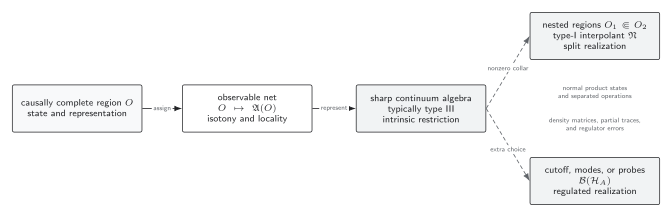
A causally complete region determines a sharp local algebra, usually type III. A nonzero split collar or an explicit cutoff, mode selection, or probe model can instead supply a type-I realization; these alternatives enable ordinary density matrices but retain different physical approximations. Schematic, not to scale.
The operation class is part of the quantity
Section titled “The operation class is part of the quantity”In the Heisenberg picture, a local operation is a normal completely positive unital map on observables; an instrument is a family of completely positive maps whose sum is unital. LOCC additionally specifies the order and amount of classical communication. For QFT one must also state localization, causal ordering, and whether split-property operations or only explicitly generated system–probe couplings are admitted.
A complete distillation claim records
where input copies produce an -pair target within error , under energy budget and success probability . Distillability asserts that some finite number of copies can be mapped by the allowed operations to a two-qubit entangled state; a nonzero rate requires a controlled asymptotic family.
Vacuum and thermal comparison
Section titled “Vacuum and thermal comparison”For two spacelike separated free-field regions, use a split inclusion to select finite-dimensional subalgebras generated by bounded functions of smeared fields. Evaluate a two-mode covariance or Bell witness, then construct the explicit local filters that map it to an entangled qubit pair. Repeat for a thermal state and vary separation, smearing, and temperature.
The vacuum can remain algebraically distillable at arbitrary separation while the detector coupling, success probability, or signal-to-noise ratio becomes prohibitively small. This is not a contradiction: existence and finite-resource yield are different claims.
Validity tests
Section titled “Validity tests”- Change the split collar and verify that the extracted result is stable for the stated observable class.
- Restrict classical communication and record whether the protocol still works.
- Bound probe energy and switching bandwidth rather than using arbitrary algebra elements.
- Distinguish nonseparability, non-PPT structure, one-copy distillability, asymptotic rate, and experimentally extracted entanglement.
Before applying this result, use the validity map to keep the algebra, state, operation class, resources, and approximation fixed.
For a side-by-side statement of the chapter’s subsystem choices, use the subsystem comparison table.
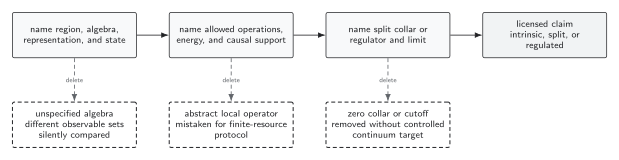
Every local-information claim must specify the represented algebra and state, the allowed operations and resource support, and any split collar or regulator. The dashed lower boxes show what fails when the algebra, protocol, or limiting prescription is left implicit. Schematic.
References
Section titled “References”- Verch, Rainer, and Reinhard F. Werner. “Distillability and Positivity of Partial Transposes in General Quantum Field Systems.” Reviews in Mathematical Physics 17 (2005): 545–576. arXiv; DOI.
Further reading
Section titled “Further reading”- Summers, Stephen J., and Reinhard Werner. “Maximal Violation of Bell’s Inequalities Is Generic in Quantum Field Theory.” Communications in Mathematical Physics 110 (1987): 247–259. DOI.