

Sphere Entanglement and Three-Dimensional F Monotonicity
In a 2+1-dimensional unitary Lorentz-invariant vacuum, the entropy of a disk is concave as a function of its radius. The combination removes the perimeter term, equals the round-sphere free energy at a CFT, and decreases with . This statement uses one smooth disk family and a common continuum prescription; neither raw disk entropy nor an arbitrarily subtracted sphere partition function is the theorem’s interpolating quantity.
Required background. Information measures along RG flows fixes the regional family, scale direction, and endpoint criteria used here.
Helpful background. Monotonicity and flow constraints supplies the fixed-point theorem context; universal terms and geometry explains why the disk constant is the CFT datum.
The chapter’s scale-separation map, comparison table, and independent validity gates should be applied before treating a fitted disk curve as an RG statement.
The disk F-function removes the perimeter term
Section titled “The disk F-function removes the perimeter term”For a round disk of radius and a geometric cutoff , a 2+1-dimensional CFT vacuum has
Define
The Euler operator gives , so at a fixed point . Away from a fixed point, is a dimensionless function of ratios such as or . It is a derivative of one continuum family, not the constant obtained by deleting the largest term in a single fit.
At a three-dimensional CFT, the causal development of a ball is conformal to a thermal state on hyperbolic space. For odd spacetime dimension the universal disk term satisfies
in the standard unitary convention, as shown in Casini, Huerta, and Myers 2011, § 4.3 and § 5, eq. (5.3). This is a fixed-point identity. Away from criticality, finite local terms in a sphere partition function do not have to reproduce point by point.
Null-cone disks imply concavity
Section titled “Null-cone disks imply concavity”Choose . A spatial plane cuts a common light cone in a boosted circle of invariant radius , tangent in the null geometry to constant-time circles of radii and . Rotate this boosted disk to obtain , . Repeated strong subadditivity compares the equal disks with the full symmetric sequence of unions of -fold intersections. As , the extreme members approach disks of radii and ; the intermediate boundaries are finely wiggled circles on the same null cone.
The figure shows the two geometric steps to inspect: the invariant radius of each boosted disk and the limiting concentric circles produced by rotation.
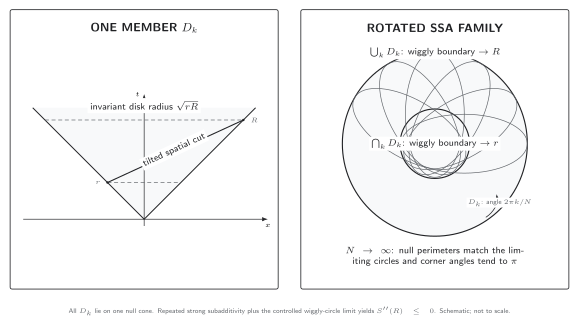
Null-cone geometry in the entropic proof. Every has invariant radius , and all rotated copies—not merely two disks—enter the symmetric strong-subadditivity sequence. In the large- null-cone limit, the wiggly boundaries have the perimeters of their limiting circles, their corner angles tend to , and the extreme radii are and . The state is the unitary Lorentz-invariant vacuum, , and one covariant regulator or algebraic prescription is used throughout. Schematic; not to scale.
For finite , the symmetric strong-subadditivity inequality is
where the tilde records that the right-hand boundaries are still wiggly. The matched null perimeters and the corner-angle limit license replacing by the smooth-circle entropy as . The finite inequality becomes
The perimeter and constant pieces saturate this relation. Expanding it at gives
The original construction, including the wiggly-circle limit and the differential inequality, appears in Casini and Huerta 2012, § 4, eqs. (16)–(19). Therefore
and a flow between CFT endpoints obeys
There is also a later formulation that makes the cancellation of local null-surface terms systematic. Let
The UV CFT vacuum—not the flowing vacuum—is Markov for regions bounded on a common null cone, so it saturates strong subadditivity. Subtracting that equality from the flowing theory’s inequality leaves an SSA inequality for without the UV-local wiggle terms. This formulation and its implication are given in Casini, Testé, and Torroba 2017, § III, eq. (8), and § IV, eqs. (14)–(16).
The theorem assumes a positive entropy framework, a relativistic vacuum, a scalable smooth disk family, Lorentz-covariant causal domains, and the common-regulator limit. Boundary RG flows, defects, finite density, topological sectors, or nonunitary theories require their own statements. In particular, below refers to a trivial gapped phase; a topologically ordered infrared phase can retain a universal constant.
A real massive scalar supplies a reproducible benchmark
Section titled “A real massive scalar supplies a reproducible benchmark”Take one real scalar with mass and set . The ultraviolet endpoint is the conformal scalar CFT, while the infrared theory is trivial and gapped. The exact CFT value, radial-lattice calibration, and leading massive asymptotic are Liu and Mezei 2013, § 6, Eqs. (52) and (54), and Appendix B, Eqs. (B14)–(B16):
The same work obtained the massless radial-lattice value . Its reported controls were total radial lattice size , fit window , and absolute entropy accuracy . The difference from the exact value is about , within the quoted uncertainty. For the massive crossover, the calculation must additionally declare in lattice units and demonstrate stability as , angular-momentum truncation, and the fit window change.
| Check | Result | Error or control |
|---|---|---|
| UV endpoint | Exact analytic sphere value | |
| Published lattice UV extraction | , , entropy accuracy | |
| Trivial gapped IR | Leading tail ; truncation | |
| Theorem check | Requires common continuum disk family; finite differences use correlated errors |
This benchmark executes an endpoint and crossover check without claiming more precision than the source supplies. A fresh computation should fit over overlapping windows, propagate the full covariance into , and quote separate discretization, angular-mode, finite-volume, and window-spread errors.
An area counterterm is an exact adversarial test
Section titled “An area counterterm is an exact adversarial test”Change the entropy by the most relevant allowed local disk term,
where may contain divergent and finite pieces but is fixed once for the entire family. Then
for every numerical value of . Thus the ambiguous perimeter coefficient is removed exactly, not approximately. Changing the local fit window can still move a numerical derivative because the fitted slope and intercept are correlated; that movement is an uncertainty diagnostic, not scheme dependence in the continuum definition.
By contrast, an arbitrary constant shift would give . Such a constant is not an orientation-even covariant local counterterm for a smooth closed circle in the pure Lorentz-invariant vacuum. If a boundary, defect, or topological sector makes a new constant admissible, the original theorem’s geometric class has changed and the strongest surviving claim is the explicitly matched quantity in that enlarged problem.
Common pitfalls
Section titled “Common pitfalls”Calling the flowing vacuum Markov. The UV CFT reference saturates the null-cone SSA combination. Its subtraction controls local terms; the deformed vacuum need not be Markov.
Using a one-window constant fit as . At finite cutoff the perimeter coefficient and constant are correlated. Apply the differential operator to a covariance-aware local fit and repeat under refinement.
Equating every sphere finite part with the disk function. The equality with is a CFT endpoint statement. Other finite interpolants can disagree during the crossover.
Exercises
Section titled “Exercises”- Verify the fixed-point normalization of and show that disk concavity implies its monotonicity.
Solution
For , one has , so
Differentiating the definition gives
Since and the null-cone argument gives , it follows that .
- Test both a perimeter term and a constant term under the differential operator, and explain why the outcomes have different status.
Solution
Let . Then
The perimeter term is an allowed local contribution for a smooth disk and is removed by construction. An arbitrary constant would survive, but it is not generated by an orientation-even covariant local surface counterterm in the theorem’s smooth, boundaryless, pure-vacuum class. If the physical setup admits such a term, one must add a matching condition and no longer invoke the original claim unchanged.
- Use the massive-scalar infrared asymptotic to determine the leading sign of and its mass dimension.
Solution
With ,
Therefore
at sufficiently large . Since is dimensionless, is dimensionless and its derivative has dimension inverse length, as the displayed expression does.
References
Section titled “References”- Casini, Horacio, and Marina Huerta. “On the RG Running of the Entanglement Entropy of a Circle.” Physical Review D 85 (2012): 125016. DOI. Open PDF.
- Casini, Horacio, Marina Huerta, and Robert C. Myers. “Towards a Derivation of Holographic Entanglement Entropy.” Journal of High Energy Physics 2011, no. 5 (2011): 036. DOI. Open PDF.
- Casini, Horacio, Eduardo Testé, and Gonzalo Torroba. “Markov Property of the Conformal Field Theory Vacuum and the a Theorem.” Physical Review Letters 118 (2017): 261602. DOI. Open PDF.
- Liu, Hong, and Mark Mezei. “A Refinement of Entanglement Entropy and the Number of Degrees of Freedom.” Journal of High Energy Physics 2013, no. 4 (2013): 162. DOI. Open PDF.