

Channel Capacities During Scrambling
As access to output regions changes during scrambling, the induced channel to an observer changes with time. Its classical, quantum, private, and entanglement-assisted capacities answer different asymptotic coding tasks; none is simply a mutual information plotted for one finite state. A QFT capacity additionally requires a channel-use model, an energy constraint, and control of regulator removal.
Required background. Decoupling and Subsystem Information Loss supplies the complementary-channel criterion. Helpful background. Energy-Constrained Capacities and Coding Tasks supplies the general channel and coding conventions.
The time-dependent induced channel
Section titled “The time-dependent induced channel”Choose an encoding into the field theory, evolve to time , and restrict to the accessible output algebra :
The complementary channel contains the inaccessible output and any environment. Scrambling can make poor for a small while making a larger union capable of recovery. This is an access-dependent statement, not monotonic decay of a single global capacity.
For a regulated memoryless channel, the coherent information of an input is
The quantum capacity is the regularized coding quantity introduced through coherent-information coding by Lloyd 1997, pp. 1613–1622:
when the limit and memoryless-use assumptions apply. A positive one-shot coherent information is an achievable lower-bound route; a negative value for one input does not prove .
Four capacities, four tasks
Section titled “Four capacities, four tasks”| Quantity | Resource/task | Characteristic optimization | Common misuse |
|---|---|---|---|
| Classical capacity | reliable classical messages | ensembles and collective decoding | calling one Holevo information the capacity without regularization |
| Quantum capacity | entanglement or unknown-state transmission | coherent information over many uses | identifying it with of one channel state |
| Private capacity | classical data secret from complement | receiver advantage over environment | omitting the complementary output |
| Entanglement-assisted | classical messages with shared entanglement | channel mutual information | comparing it to an unassisted protocol |
The entanglement-assisted formula and its coding resources are established by Bennett et al. 1999, pp. 3081–3084. These tasks cannot be interchanged by matching notation alone.
The access region, ancillas, feedback, classical communication, and decoder locality belong to the task definition.
Energy constraints and correlated uses
Section titled “Energy constraints and correlated uses”For field channels, restrict codewords by an additive cost such as
The ground-state subtraction and treatment of correlations among uses must be explicit. Time slices of one closed many-body evolution are not independent uses of a memoryless channel. If the same field environment persists, the correct object is a memory channel or a one-shot transmission task, not .
Scrambling does not force every capacity down
Section titled “Scrambling does not force every capacity down”Consider a unitary output split into and . As information delocalizes, the capacity to alone may fall, but the capacity to remains that of an isometry. Classical information protected by a conserved charge can remain transmissible even when quantum capacity falls. Entanglement assistance can change the rate again. Therefore a statement such as “capacity decreases during scrambling” is incomplete until the access and resource columns are fixed.
A bounded workflow
Section titled “A bounded workflow”- Specify the logical alphabet or code subspace and energy cost.
- Construct and its complement.
- Decide whether the task is one shot, repeated memoryless use, or correlated use.
- Compute an achievable lower bound and a converse upper bound in compatible metrics.
- Vary the output region and side information.
- Resolve symmetries, finite size, and recurrences.
- Take a controlled continuum limit at fixed physical task.
Scientific evidence cutoff: 10 August 2026. The capacity comparisons and literature-sensitive qualifications on this page are current through that date.
Exercises
Section titled “Exercises”Why does for the maximally entangled channel state not generally equal ?
Solution
is the entanglement-assisted mutual information for one selected input and helps determine after optimization. Quantum capacity is governed by coherent information, may require inputs entangled across many channel uses, and is regularized. The quantities answer different coding tasks.
Continue to Recovery Thresholds, Access Structures, and Side Information to organize capacities and recovery across many output unions.
Diagnostic and failure maps
Section titled “Diagnostic and failure maps”The first diagram separates influence diagnostics from the decoupling and recovery test; inspect the declared output access, norm, and decoder class. The second collects mechanisms that can imitate scrambling and the controls that distinguish them.
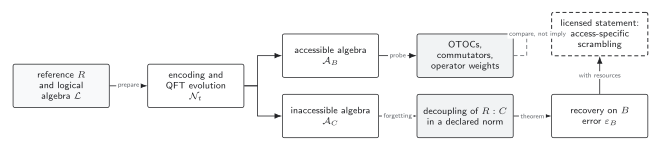
Scrambling becomes operational only after the input algebra, output access structure, side information, norm, energy restriction, and decoder class are declared. OTOCs and operator weights diagnose influence; decoupling and a recovery theorem license a statement about information access. The diagram is schematic and not to scale.
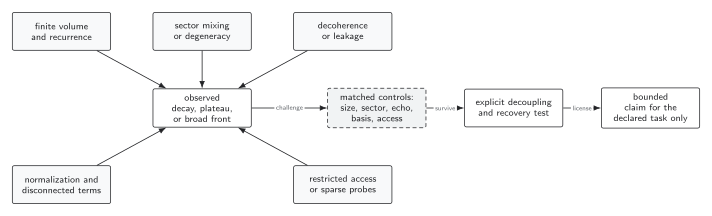
Several mechanisms can suppress a correlator or produce an entropy plateau without delocalizing recoverable quantum information. Sector resolution, recurrence windows, normalization checks, access variation, and an explicit recovery test distinguish these alternatives. The diagram is schematic.
References
Section titled “References”- Bennett, Charles H., Peter W. Shor, John A. Smolin, and Ashish V. Thapliyal. “Entanglement-Assisted Classical Capacity of Noisy Quantum Channels.” Physical Review Letters 83 (1999): 3081–3084. DOI. Open PDF.
- Lloyd, Seth. “Capacity of the Noisy Quantum Channel.” Physical Review A 55 (1997): 1613–1622. DOI. Open PDF.