

Half-Sided Modular Inclusions and Emergent Translations
A half-sided modular inclusion turns one-sided compression by modular flow into a positive-energy translation. This page fixes one orientation throughout, states separately what follows from the inclusion theorem and what belongs to its converse, and tests every sign in the elementary half-line model.
Required background. Tomita–Takesaki flow supplies the two modular groups. Helpful background. The split property helps distinguish standard inclusions from naive tensor-factor nesting.
The chapter overview places this result in the route from standard pairs to geometric flow, compares representative modular flows and their boundaries, and gives a final checklist for deciding when a modular-flow claim is licensed.
A negative half-sided inclusion and the stronger standard condition
Section titled “A negative half-sided inclusion and the stronger standard condition”Let
and let the same vector be cyclic and separating for both algebras. Write
We use the negative half-sided convention
Calling the pair standard adds that is cyclic for the relative commutant . Separation for then follows from cyclicity of for : if and , then for every , and density of gives . Thus “standard” is stronger than the statement that is standard for and separately.
The positive convention replaces by . It is equivalent after reversing modular time, but every formula involving translations, generators, or reflections changes orientation with it.
The completed structure theorem
Section titled “The completed structure theorem”For the convention (1), the completed Araki–Zsidó structure theorem gives more than the existence of an unspecified translation. On
the symmetric operator
is essentially self-adjoint. Its closure is positive, and
is a strongly continuous unitary group satisfying
and, in the theorem’s canonical affine normalization,
Equations (2)–(6), including the domain assertion and closure in (2), are Araki–Zsidó 2005, Theorem 2.1, equations (2.20)–(2.25). They repair the operator-domain gap in Wiesbrock 1993, Theorem 3 and Corollaries 6–7, as described explicitly in Araki–Zsidó 2005, §1.
The group identity (4) is the safe statement for unbounded generators. On a common invariant core of analytic vectors it implies
The commutator in (7) is not an equality on all of .
The theorem and its converse are different statements
Section titled “The theorem and its converse are different statements”The forward theorem starts with a half-sided inclusion whose common vector is cyclic and separating for both algebras, and constructs , , and the affine relations. A Borchers-type converse instead starts with a standard pair and a strongly continuous unitary group satisfying , , and an appropriate one-sided endomorphism condition such as
The Borchers commutation relations then constrain , , and ; defining a translated subalgebra can recover a half-sided inclusion. Positivity and the endomorphism hypothesis are inputs to this converse, not conclusions from arbitrary nesting. See Borchers 1995, Theorem 4.1, pp. 345–346 and the completed inclusion result above.
First application: half-lines and every sign
Section titled “First application: half-lines and every sign”Let a Möbius-covariant chiral net in its vacuum representation have geometric modular action for half-lines, including the endpoint reflection implemented by modular conjugation, and choose
Fix the geometric implementation
If , then , and isotony gives
Thus (8) realizes precisely the negative half side in (1). With
one obtains and verifies (4) directly:
The modular conjugations act geometrically as reflections about the endpoints and . Their product is translation by twice the separation, explaining the normalization . The application is exact conditional on geometric modular action, isotony, and the common cyclic/separating vacuum. There is no truncation parameter or numerical uncertainty; the unbounded logarithms and generator are used only through the domain and closure statement of the completed theorem.
The following diagram separates this one-inclusion conclusion from the stronger compatibility needed when several modular positions are combined; inspect the left panel for the exact theorem used here.
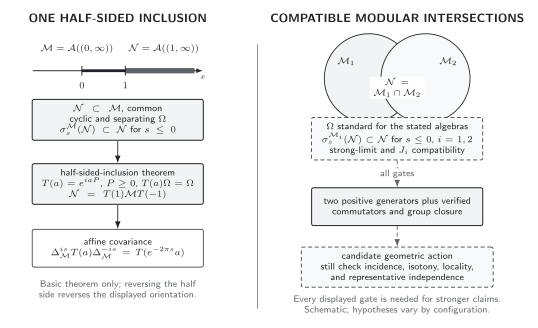
In the negative half-sided orientation for , the basic inclusion theorem gives the positive translation, its affine scaling, and the modular-conjugation relations. Claims based on several modular positions require additional standardness of the overlap, strong-limit and -compatibility, group closure, and—if a local net is asserted—well-defined transport, isotony, and locality. The diagram is schematic and not to scale.
An adversarial orientation test
Section titled “An adversarial orientation test”Keep (8) but incorrectly claim the half-sided condition for . At ,
so the alleged compression is reversed. Equally, defining changes the generator to . Although
still has the same formal affine shape, its generator is nonpositive. The paired checks
therefore detect two distinct convention errors.
What the result does not license
Section titled “What the result does not license”The theorem does not turn every inclusion of local algebras into a spacetime translation. For the basic forward theorem, a proposed application must verify that the common vector is cyclic and separating for both algebras and that the correct half-sided containment holds; the completed theorem then supplies the domain and closure statement in (2). Cyclicity of the relative commutant—the stronger “standard inclusion” condition described above—is required only by later reconstruction or converse results that explicitly assume it. A geometric interpretation additionally needs a net and covariance identifying the abstract affine action with motion of regions.
If for both signs, the situation is different: the smaller algebra is globally invariant under the larger modular group, and Takesaki 1972, first main theorem, pp. 306–313 gives the corresponding state-preserving conditional expectation rather than a nontrivial half-sided translation.
Common pitfalls
Section titled “Common pitfalls”Treating spatial nesting as the theorem’s hypothesis. The condition is modular compression for one time direction, not merely .
Subtracting logarithms without a domain theorem. Equation (2) is meaningful because the completed theorem proves essential self-adjointness and positivity of its closure.
Mixing the forward theorem with a converse. In the forward direction positivity is derived. In a Borchers converse, positivity and a one-sided endomorphism property are assumptions.
Exercises
Section titled “Exercises”1. Recover the affine Lie algebra
Section titled “1. Recover the affine Lie algebra”Let . Starting from (4), derive the commutator on a common analytic core and check the sign.
Solution
Differentiate (4) with respect to at :
Differentiating at gives
hence
Since , this is equivalent to the second relation in (7). The differentiations are justified on analytic vectors; the unitary relation (4) remains the global statement.
2. Locate the compressed half-line
Section titled “2. Locate the compressed half-line”For , calculate in the half-line model. Express it using and verify the inclusion direction.
Solution
Here , so (8) gives
Because , the negative half-sided condition holds. Translation by one maps the endpoint to , so
This also checks that positive moves the endpoint to the right in the chosen orientation.
3. Diagnose a false converse
Section titled “3. Diagnose a false converse”Suppose is strongly continuous, fixes , satisfies the affine relation (4), and obeys , but its generator has spectrum . Explain why these data do not establish the positive-energy converse.
Solution
The affine covariance alone preserves the sign of every spectral value because conjugation rescales by the positive factor ; it does not remove negative spectral values. The endomorphism condition at one parameter also does not imply without the hypotheses of an applicable converse theorem. Since
the positive-energy hypothesis fails. One cannot infer the positive-energy half-sided-inclusion structure from these incomplete data.
References
Section titled “References”- Araki, Huzihiro, and László Zsidó. “Extension of the Structure Theorem of Borchers and Its Application to Half-Sided Modular Inclusions.” Reviews in Mathematical Physics 17 (2005): 491–543. DOI. Open HTML, Theorem 2.1.
- Borchers, Hans-Jürgen. “On the Use of Modular Groups in Quantum Field Theory.” Annales de l’Institut Henri Poincaré, Physique théorique 63 (1995): 331–382. Open PDF.
- Takesaki, Masamichi. “Conditional Expectations in von Neumann Algebras.” Journal of Functional Analysis 9 (1972): 306–321. DOI.
- Wiesbrock, Hans-Werner. “Half-Sided Modular Inclusions of von Neumann Algebras.” Communications in Mathematical Physics 157 (1993): 83–92; erratum, Communications in Mathematical Physics 184 (1997): 683–685. DOI for the original article.