

Energy-Constrained Errors and Infinite-Dimensional Norms
Energy-constrained state and channel errors make approximate QEC nontrivial for oscillator and field systems by restricting the supremum to physically intended inputs. The constraint Hamiltonian, energy origin, ancillary reference, and order of cutoff and energy limits are part of the guarantee. A bound at fixed energy cannot be extrapolated to an energy window that grows without control.
Required background. Approximate Recovery and Information–Disturbance supplies the recovery-versus-leakage theorem.
Helpful background. Infinite-Dimensional and Energy-Constrained Channel Distances supplies the norm topology used here.
State and channel error on an energy ball
Section titled “State and channel error on an energy ball”Let be a physical constraint Hamiltonian. The allowed states are
For two channels and , define
The reference tests preservation of entanglement; in standard formulations its dimension can be bounded in finite truncations but should not simply be omitted. State whether the factor is included. Other useful errors include worst-case entanglement infidelity on and bounded-observable error
where is a declared local observable class. The latter can be weaker but closer to an experimental task.
Why the unconstrained norm can be pathological
Section titled “Why the unconstrained norm can be pathological”Two bosonic attenuation channels with nearby transmissivities can be perfectly distinguished in the limit of arbitrarily large input energy. Their unconstrained diamond distance can therefore be maximal even though they agree well on all low-energy states. Energy-constrained norms generate a topology compatible with strong convergence on physically bounded inputs and are developed systematically for infinite-dimensional channels by Shirokov Shirokov 2018, §§2–4; Winter derives continuity applications for continuous-variable channel capacities Winter 2017, §§3–5.
The constraint is not arbitrary bookkeeping. Changing changes which high-frequency, high-occupation, or spatially concentrated states are admitted. Two papers using the same numerical but differently normalized Hamiltonians do not share a domain.
Recovery test for a bosonic code
Section titled “Recovery test for a bosonic code”For a code encoder , noise , and recovery , report
Because both channels here take a logical input, the energy ball must also be defined on that input. One may use a declared logical Hamiltonian , or, for an isometric encoding into physical Hamiltonian , set on the code domain. Constraining the physical output while optimizing over unconstrained logical inputs is a different and generally ill-posed task.
Numerically, introduce a Fock cutoff , optimize or bound , and perform two limits:
- increase at fixed physical until the error and energy tail are stable;
- vary only after cutoff convergence, recording how the guarantee weakens.
A finite code subspace may have maximum energy , in which case the exact task is naturally restricted. For an approximate code family with no sharp maximum, bound high-energy tails rather than assuming the numerical truncation is the physical constraint.
An energetic reference ancilla can be a loophole if only system energy is bounded and the channel couples jointly to system and reference. State the precise admissible joint states and use the theorem matching that convention.
Translating among error metrics
Section titled “Translating among error metrics”Fuchs–van de Graaf inequalities translate state trace distance and fidelity without dimension factors, but average-to-worst-case and state-to-channel translations can depend on code dimension or energy compactness. Keep the direction of each inequality. Small error for one test state gives an upper bound on nothing beyond that state unless covariance, convexity, or a complete basis argument is supplied.
Exercises
Section titled “Exercises”Monotonicity in energy. Show that is nondecreasing in .
Solution
If , then . The supremum over the larger set cannot be smaller.
Cutoff illusion. Why can a fixed Fock cutoff make recovery look artificially good as increases?
Solution
The truncated model excludes precisely the energetic states that may distinguish the noisy and recovered channels. Once approaches the truncation ceiling, the numerical domain no longer represents the intended energy ball. Increase the cutoff first and bound the excluded tail.
Recovery and continuum maps
Section titled “Recovery and continuum maps”The first diagram follows the task from logical algebra through noise, environmental leakage, and constrained recovery; inspect which metric and recovery family support the guarantee. The second identifies the additional uniformity tests required before finite-regulator correctability becomes a continuum field-code statement.
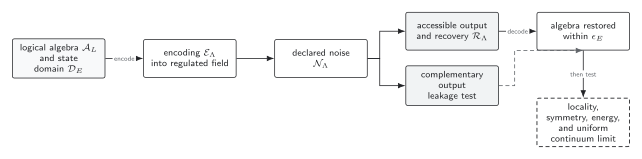
Correctability relates one logical algebra, one noise channel and complement, one state or energy domain, and one recovery class. Environmental forgetting supports recovery only in the matching metric; locality, symmetry, and continuum convergence are additional tests. The diagram is schematic and not to scale.
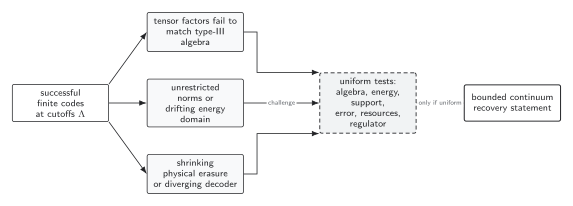
A sequence of successful finite codes does not establish a continuum code unless its logical algebra, physical erasure region, energy domain, recovery error, and locality bounds converge uniformly. Type-III structure and regulator-dependent tensor factors require an algebraic target. The diagram is schematic.
References
Section titled “References”- Shirokov, Maxim E. “Energy-Constrained Diamond Norms and Their Use in Quantum Information Theory.” Problems of Information Transmission 54 (2018): 20–33. DOI. Open PDF.
- Winter, Andreas. “Energy-Constrained Diamond Norm with Applications to the Uniform Continuity of Continuous Variable Channel Capacities.” arXiv:1712.10267 (2017). Preprint.