

Zero Modes, Boundaries, and Infrared Sensitivity
Entropy calculations can be ultraviolet regulated and still be ill defined in the infrared. A zero-frequency mode has no normalizable Gaussian vacuum, and physical boundaries, compactification, finite volume, and limit ordering determine whether such a mode is present. These choices can shift constants or logarithms without changing the local ultraviolet structure near the entangling surface.
Required background. Start with free-field entropy. Helpful background. Gaussian correlation-matrix entropy supplies the spectral diagnostic for a singular mode.
The periodic scalar zero mode
Section titled “The periodic scalar zero mode”For a real scalar on a spatial circle of length ,
The constant mode has . In the massive vacuum,
As , the field variance diverges and the limiting Hamiltonian for the zero mode is that of a free particle, which has no normalizable ground state. This entropy obstruction is exhibited directly for oscillator chains in Yazdi 2017, §§ 2–3. A covariance-matrix calculation therefore needs either , a removed or fixed zero mode, a compact target with a specified zero-mode state, or another explicit infrared prescription. These choices define different regulated states; none is supplied by the phrase “massless scalar vacuum” in finite periodic volume.
The structural map places Zero Modes, Boundaries, and Infrared Sensitivity on the route from a regulated subsystem to integer moments, spectral checks, analytic continuation, and a continuum claim.
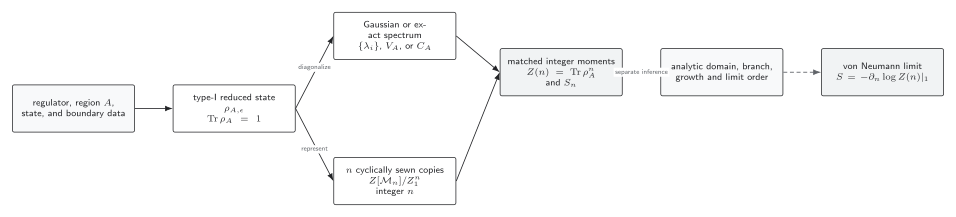
The spectral and replica routes must agree on matched integer moments at fixed regulator. Continuation from those moments to is logically separate and must state its analytic domain, branch, growth conditions, and order of limits. Schematic.
Boundaries and compactification
Section titled “Boundaries and compactification”Dirichlet boundaries remove the spatially constant eigenfunction, whereas Neumann and periodic conditions retain one. Boundary conditions also modify the nonzero spectrum and can contribute boundary-dependent constants. A compact boson has a compact position zero mode and quantized momentum and winding sectors; its entropy depends on compactification radius and on how those sectors are included. It cannot be obtained by deleting the zero mode of a noncompact scalar and declaring the remainder equivalent.
The relevant distinction is between local ultraviolet terms and global infrared data. A zero-mode prescription can affect an apparently constant term or, in delicate scaling regimes, contaminate a fitted logarithm. It should not be reinterpreted as universal local defect data without a calculation showing independence from , boundary conditions, and compactification.
Noncommuting limits
Section titled “Noncommuting limits”Consider an interval of fixed fraction . The limits
need not agree because controls the lowest-mode sector. The accumulation of near-zero modes and its dimensional dependence are analyzed in Mallayya et al. 2014, §§ II–IV. A numerical study should therefore scan in both and , not merely increase the number of sites. Plotting against makes the crossover visible and separates infrared drift from discretization error.
Boundary-condition challenge
Section titled “Boundary-condition challenge”Compute matched interval entropies with periodic, Dirichlet, and Neumann boundaries. For the periodic and Neumann cases, repeat with a small mass and with a declared zero-mode removal. Hold the interval’s proper length and its distance from a physical boundary fixed. Then:
- verify that nonzero-mode ultraviolet scaling is stable under the infrared prescription;
- identify constants that change with boundary conditions or zero-mode state;
- take at fixed before studying ;
- report any noncommuting order of limits as part of the result.
If removing the zero-mode prescription makes the covariance singular or a purported universal constant drift without bound, the diagnostic has succeeded: the claim was infrared incomplete.
Before exporting this calculation, use the validity map to check normalization, infrared data, spectral or continuation control, and matched continuum scaling independently.
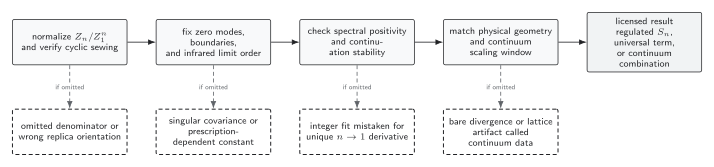
Normalization and sewing establish the intended integer moment; zero-mode and boundary control establish the infrared state; spectral and continuation checks control ; geometry matching and a scaling window establish the continuum target. Omitting any stage licenses only a weaker conclusion. Schematic.
References
Section titled “References”- Mallayya, Krishnanand, Rakesh Tibrewala, S. Shankaranarayanan, and T. Padmanabhan. “Zero Modes and Divergence of Entanglement Entropy.” Physical Review D 90 (2014): 044058. arXiv; DOI.
- Yazdi, Yasaman K. “Zero Modes and Entanglement Entropy.” Journal of High Energy Physics 2017, no. 4 (2017): 140. arXiv; DOI.