

Entropy Counterterms and Renormalization Ambiguities
Replica effective actions admit local counterterms in the bulk and, at a conical defect or physical boundary, local terms supported on the entangling surface. These terms remove divergences but may also shift finite parts. A “renormalized entanglement entropy” is therefore unique only after the allowed counterterms and renormalization conditions have been declared.
Required background. Begin with ultraviolet divergences and the area law. Helpful background. Replica branched geometries explains how the conical surface enters the partition function.
Entropy from the effective action
Section titled “Entropy from the effective action”Let be the Euclidean effective action on the -fold geometry. This replica-effective-action formulation is used in Callan and Wilczek 1994, pp. 55–61. With the vacuum normalization included,
Bulk divergences in are canceled by the same local couplings needed on smooth backgrounds. Because the replica geometry has curvature concentrated near , those counterterms contribute surface terms after the replica derivative; Fursaev and Solodukhin 1996, pp. 51–55 demonstrate this mechanism for one-loop black-hole entropy. Physical boundaries, nonminimal curvature couplings, and the prescription used to smooth the cone can require additional contact or boundary terms.
Schematically, an allowed local change of scheme has
The replica derivative turns this into a shift of entropy by local integrals on . If a finite coefficient is allowed by the symmetries and dimensions, the corresponding finite entropy term is scheme dependent unless a physical matching condition fixes it.
The structural map places Entropy Counterterms and Renormalization Ambiguities on the route from a regulated subsystem to integer moments, spectral checks, analytic continuation, and a continuum claim.
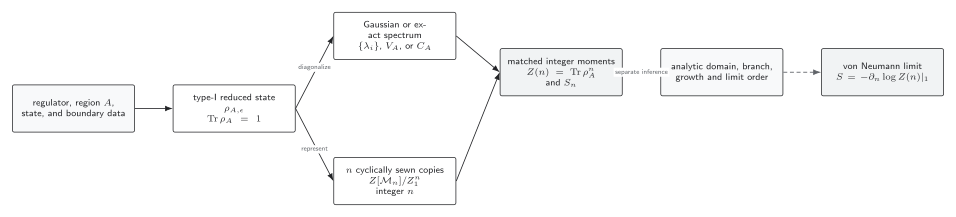
The spectral and replica routes must agree on matched integer moments at fixed regulator. Continuation from those moments to is logically separate and must state its analytic domain, branch, growth conditions, and order of limits. Schematic.
What can remain meaningful
Section titled “What can remain meaningful”Several kinds of information can survive local shifts, but each has hypotheses:
- an anomaly-related logarithmic coefficient can be invariant after the theory and surface class are fixed;
- mutual information for disjoint separated regions cancels local terms when every entropy uses the same regulator and convention;
- derivatives with respect to a separation or shape parameter can remove constants that are independent of that parameter;
- differences between states can cancel state-independent ultraviolet terms when the states share the same short-distance structure.
None of these cancellations should be assumed for unrelated regions, unmatched regulators, or different boundary algebras. A finite result obtained by subtraction is a property of the stated subtraction.
Matching heat-kernel and lattice schemes
Section titled “Matching heat-kernel and lattice schemes”Compute a free-field entropy for the same smooth physical surface with a heat-kernel cutoff and a lattice cutoff. Expand both results in local surface invariants. First match the physical mass, field normalization, surface geometry, and outer boundary. Then determine which divergent and finite local terms must be adjusted to compare the remainders.
The comparison should produce a relation of the form
within the scaling window. The coefficients specify the scheme matching; they are not universal predictions. A nonlocal residual that persists under refinement indicates unmatched physics, an omitted invariant, or a numerical error.
Finite-counterterm challenge
Section titled “Finite-counterterm challenge”Add one symmetry-allowed finite surface counterterm and recompute the claimed quantity. If it shifts, label that quantity scheme dependent and state the renormalization condition used to quote it. If a combination remains invariant, show the cancellation term by term. This test is stronger than observing that two regulators happened to give similar numbers.
Before exporting this calculation, use the validity map to check normalization, infrared data, spectral or continuation control, and matched continuum scaling independently.
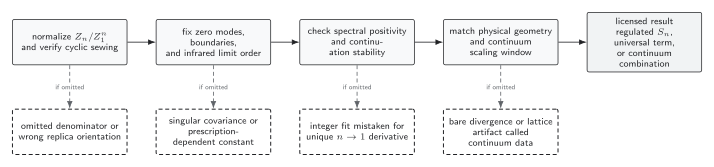
Normalization and sewing establish the intended integer moment; zero-mode and boundary control establish the infrared state; spectral and continuation checks control ; geometry matching and a scaling window establish the continuum target. Omitting any stage licenses only a weaker conclusion. Schematic.