

The Split Property and Approximate Tensor Products
The split property supplies a controlled tensor-product realization for two regions separated by a nonzero collar. For , it asks for a type-I factor between the corresponding type-III algebras. This permits normal product states and independent operations while retaining the fact that the sharp continuum boundary does not factorize.
Required background. Review vacuum clustering and type-III local algebras. Helpful background. Spectral decompositions and the factorization diagnosis clarify what the interpolating factor does and does not supply.
Split inclusions
Section titled “Split inclusions”Write when the closure of lies inside with positive separation. The inclusion is split if a type-I factor exists such that
Equivalently, under standard hypotheses, the multiplication map on the commuting pair extends to a spatial tensor-product isomorphism
The collar is not empty bookkeeping. It is where arbitrarily short-distance correlations across a sharp cut are excluded from the claimed subsystem separation. The interpolating is generally not unique, so quantities defined using it must state that choice or prove independence from it.
Doplicher and Longo developed the standard structure of split inclusions Doplicher and Longo 1984, pp. 493–536. Phase-space nuclearity gives physically useful sufficient conditions rather than making the property automatic.
The structural map places The Split Property and Approximate Tensor Products among sharp local algebras, split inclusions, and regulated or operational substitutes.
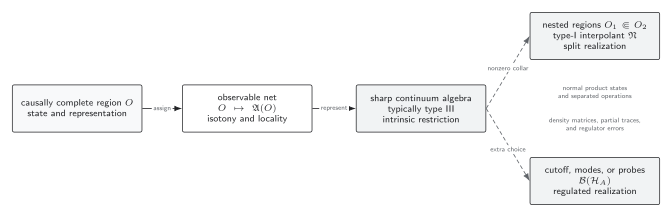
A causally complete region determines a sharp local algebra, usually type III. A nonzero split collar or an explicit cutoff, mode selection, or probe model can instead supply a type-I realization; these alternatives enable ordinary density matrices but retain different physical approximations. Schematic, not to scale.
Statistical independence
Section titled “Statistical independence”For commuting algebras and , the split property permits independently chosen normal states and to extend to a normal product state:
It also permits local normal completely positive maps to be combined consistently. This is stronger than commutativity: commuting observables can still be constrained by global state structure, centers, or a failure of normal product extensions.
The property does not say that the vacuum itself is a product state. It says that the algebraic pair has a type-I bridge through which product preparations can be represented.
Massive free-field example
Section titled “Massive free-field example”Consider nested intervals or double cones with collar width in a massive free field. Energy-damped phase-space bounds imply the split property for every fixed in standard models Buchholz and Wichmann 1986, pp. 321–344. A regulated Gaussian construction can compare the vacuum covariance with a product covariance across the split. As grows, clustering suppresses cross-correlations; as , the required type-I interpolation becomes increasingly ultraviolet-sensitive.
There is no universal scalar “split error.” One must choose an operational metric—an expectation-value bound on a specified observable class, a channel norm with an energy constraint, or a relative-information quantity—and prove its dependence on , , and the state.
Failure at zero collar
Section titled “Failure at zero collar”Taking before controlling phase-space growth restores the sharp type-III boundary. Product-state extensions may cease to be normal and energy costs may diverge. Thus the split result licenses finite-separation statistical independence, not exact geometric factorization at coincident boundaries.
Before applying this result, use the validity map to keep the algebra, state, operation class, resources, and approximation fixed.
For a side-by-side statement of the chapter’s subsystem choices, use the subsystem comparison table.
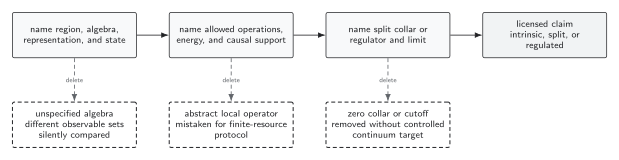
Every local-information claim must specify the represented algebra and state, the allowed operations and resource support, and any split collar or regulator. The dashed lower boxes show what fails when the algebra, protocol, or limiting prescription is left implicit. Schematic.
References
Section titled “References”- Buchholz, Detlev, and Eyvind H. Wichmann. “Causal Independence and the Energy-Level Density of States in Local Quantum Field Theory.” Communications in Mathematical Physics 106 (1986): 321–344. DOI.
- Doplicher, Sergio, and Roberto Longo. “Standard and Split Inclusions of von Neumann Algebras.” Inventiones Mathematicae 75 (1984): 493–536. DOI.