

Reconstruction from Redundant Encodings
Redundant reconstruction means that different physical regions contain operators with the same action on the code’s logical algebra. The representatives need not be equal on the full Hilbert space, and their equivalence does not create independent copies of quantum information. Consistency requires agreement of projected actions, products, commutators, and approximation errors on the declared code domain.
Required background. Operator-Algebra Quantum Error Correction supplies logical equivalence.
Helpful background. Complementary Recovery and Cleaning Relations constructs regional representatives, and Tensor Networks as Encoding Maps: Scope and Limits supplies a regulated example.
Equivalence classes of physical representatives
Section titled “Equivalence classes of physical representatives”With code isometry and projector , two physical operators and represent the same logical operator when
or equivalently . Their difference lies in the code-null ideal. This Heisenberg equivalence is the core of operator-algebra QEC Bény, Kempf, and Kribs 2007, pp. 1–3. It can act nontrivially after leakage or on high-energy states outside the code, so the equality must not be used there. Under approximation, continuity of channel dilations supplies useful recovery-error controls Kretschmann, Schlingemann, and Werner 2008, Theorem 3.
Approximate equivalence on an energy domain can be stated as
with stronger completely bounded formulations when ancillas and products are relevant. Separate errors for generators do not automatically control long products; give a stability bound or test the generated algebra.
Why no cloning is violated
Section titled “Why no cloning is violated”Suppose regions and each admit a representative. Acting with both does not yield two tensor-independent logical systems; both actions are constrained by the same encoded subspace. If and are spacelike separated, their physical operators commute, so only logical observables whose represented commutator vanishes on the code can be simultaneously assigned in that way. A full noncommuting algebra cannot be duplicated into two independent commuting factors.
Classical center observables are an exception in the expected sense: they can have redundant commuting records. State whether the reconstructed object is a center label, an Abelian algebra, or a full matrix algebra.
Constructive finite-code test
Section titled “Constructive finite-code test”Choose a basis of the logical algebra and solve separately for representatives supported in candidate regions. Validate:
- and likewise for ;
- adjoint, product, and commutator relations after projection;
- error on reference-entangled logical states;
- operator norms and energy-domain stability;
- behavior under small leakage outside the code;
- overlap consistency when regions are not disjoint.
If the two constructions use different gauge or center conventions, translate them before comparing. Equality of a few expectation values is not logical equivalence.
Continuum interpretation
Section titled “Continuum interpretation”In QFT, representatives belong to regional von Neumann algebras or controlled split factors. Exact sharp localization can be replaced by convergence on a smeared low-energy algebra with tails. Record the buffer size, energy cap, and topology. A sequence of representatives whose norms diverge may converge weakly on selected states but fail as a robust reconstruction channel.
As of 10 August 2026, redundant reconstruction is well defined in specific regulated and algebraic code models. Claims exported to generic continuum fields require the same uniform algebra, energy, and locality controls as any continuum code.
Exercises
Section titled “Exercises”Code-null difference. Let with . Must ?
Solution
No. can map code states out of the code while having vanishing projected action. For repeated operations or leakage-sensitive tasks, one needs the stronger condition or explicit control of the leakage component.
Commuting regions. Why can two disjoint regions redundantly reconstruct logical but not independently reconstruct the entire qubit algebra?
Solution
Logical generates an Abelian algebra and can be redundantly recorded. Independent full-qubit reconstructions would place logical and in both commuting regions, contradicting their noncommuting action on the code and enabling broadcasting.
Recovery and continuum maps
Section titled “Recovery and continuum maps”The first diagram follows the task from logical algebra through noise, environmental leakage, and constrained recovery; inspect which metric and recovery family support the guarantee. The second identifies the additional uniformity tests required before finite-regulator correctability becomes a continuum field-code statement.
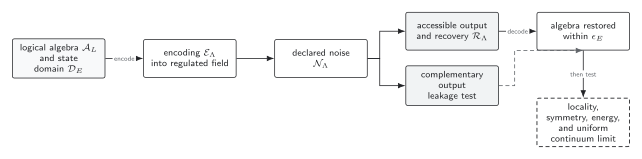
Correctability relates one logical algebra, one noise channel and complement, one state or energy domain, and one recovery class. Environmental forgetting supports recovery only in the matching metric; locality, symmetry, and continuum convergence are additional tests. The diagram is schematic and not to scale.
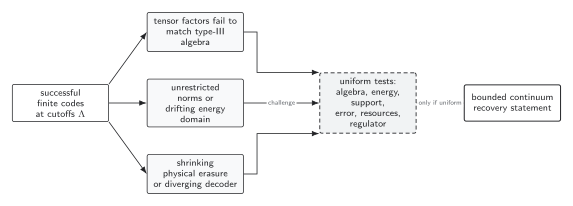
A sequence of successful finite codes does not establish a continuum code unless its logical algebra, physical erasure region, energy domain, recovery error, and locality bounds converge uniformly. Type-III structure and regulator-dependent tensor factors require an algebraic target. The diagram is schematic.
References
Section titled “References”- Bény, Cédric, Achim Kempf, and David W. Kribs. “Generalization of Quantum Error Correction via the Heisenberg Picture.” Physical Review Letters 98 (2007): 100502. DOI. Open PDF.
- Kretschmann, Dennis, Dirk Schlingemann, and Reinhard F. Werner. “The Information-Disturbance Tradeoff and the Continuity of Stinespring’s Representation.” IEEE Transactions on Information Theory 54 (2008): 1708–1717. DOI. Open PDF.