

Symmetry, Covariance, and QEC Constraints
Exact covariance under a continuous symmetry can obstruct exact finite-resource quantum error correction: a code cannot both protect arbitrary logical charge coherence from sufficiently local erasures and implement the logical symmetry through a strictly transversal or otherwise factorized physical action under the theorem’s hypotheses. Approximate codes evade the contradiction only by paying in recovery error, physical charge spread, subsystem size, or an external asymmetry resource.
Required background. Covariant Channels and Symmetry-Restricted Recovery supplies covariant channel notation. Higher-Form Currents, Charges, Backgrounds, and Ward Identities supplies field-theory charge structure. Error Models, Codes, and Recovery Conditions supplies exact QEC. Symmetry-Constrained Operations in QFT supplies resource restrictions.
Covariant encoding and recovery
Section titled “Covariant encoding and recovery”Let act on the logical system and on the physical system. An encoding channel is covariant when
If physical degrees factor into shares and , the logical transformation is transversal. The Eastin–Knill theorem rules out a universal set of transversal logical gates for finite-dimensional exact codes Eastin and Knill 2009, pp. 1–3. Related covariant-code tradeoffs focus specifically on continuous symmetry, exact erasure correction, and bounded physical charge resources.
The hypotheses travel with the conclusion. Discrete groups, approximate recovery, subsystem actions, infinite-dimensional shares, nontransversal finite-depth circuits, or externally supplied reference frames change the problem. They do not refute the exact theorem.
Charge leakage intuition
Section titled “Charge leakage intuition”For a continuous symmetry, differentiate covariance at the identity. A factorized physical charge represents logical on the code. If erasure of any one share is exactly correctable, that share cannot contain logical-state information. But exact covariance forces local charge responses to reproduce the logical generator. Under bounded local charges these requirements conflict for a nontrivial logical continuous action.
Approximate codes distribute a small amount of charge information into each share. Information–disturbance then turns local charge distinguishability into a lower bound on recovery error. The bound depends on the physical charge range or variance and the chosen error metric.
Finite-energy oscillator example
Section titled “Finite-energy oscillator example”Encode logical charge eigenstates into several oscillator modes with total number charge. Impose covariant encoding and recovery, a mean-energy cap, and single-mode erasure. Measure:
- worst-case energy-constrained recovery error;
- physical charge variance and maximum occupied level;
- covariance defect of the encoder and decoder;
- performance after adding a phase-reference ancilla.
As the reference becomes more asymmetric, recovery can improve because the effective allowed operations enlarge. Charge the reference energy, size, and degradation. A sequence whose reference energy diverges has not produced a finite-resource covariant code.
Faist and collaborators quantify how continuous covariance enforces approximate-QEC tradeoffs and how increasing physical resources relaxes them Faist et al. 2020, §§II–V.
Field-theory qualifications
Section titled “Field-theory qualifications”QFT charges can be unbounded, surface-supported, anomalous, or absent as globally well-defined operators in a chosen representation. Higher-form symmetries act on extended operators rather than pointlike tensor shares. Before applying a finite-dimensional bound, identify the physical charge generators, their domains, the erasure algebra, and the regulator scaling of their range or variance.
Exercises
Section titled “Exercises”Asymmetry loophole. Why does a phase reference relax a -covariant restriction?
Solution
Relative to the reference, operations can create apparent charge coherence while the joint operation remains symmetric. The asymmetry has moved into a consumable resource. The original no-reference task is not solved unless that resource is charged and returned as required.
Discrete symmetry. Does the continuous-generator argument apply unchanged to a finite group?
Solution
No. Differentiation at the identity and bounded-charge tradeoffs rely on a continuous generator. Finite groups have different covariant-code possibilities and require their own exact conditions.
Recovery and continuum maps
Section titled “Recovery and continuum maps”The first diagram follows the task from logical algebra through noise, environmental leakage, and constrained recovery; inspect which metric and recovery family support the guarantee. The second identifies the additional uniformity tests required before finite-regulator correctability becomes a continuum field-code statement.
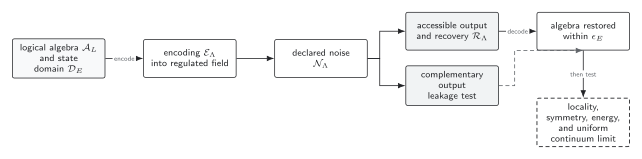
Correctability relates one logical algebra, one noise channel and complement, one state or energy domain, and one recovery class. Environmental forgetting supports recovery only in the matching metric; locality, symmetry, and continuum convergence are additional tests. The diagram is schematic and not to scale.
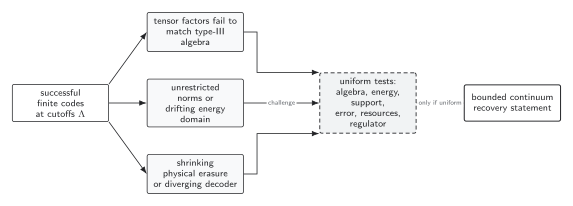
A sequence of successful finite codes does not establish a continuum code unless its logical algebra, physical erasure region, energy domain, recovery error, and locality bounds converge uniformly. Type-III structure and regulator-dependent tensor factors require an algebraic target. The diagram is schematic.
References
Section titled “References”- Eastin, Bryan, and Emanuel Knill. “Restrictions on Transversal Encoded Quantum Gate Sets.” Physical Review Letters 102 (2009): 110502. DOI. Open PDF.
- Faist, Philippe, Sepehr Nezami, Victor V. Albert, Grant Salton, Fernando Pastawski, Patrick Hayden, and John Preskill. “Continuous Symmetries and Approximate Quantum Error Correction.” Physical Review X 10 (2020): 041018. DOI. Open PDF.