

Nuclearity, Phase-Space Bounds, and Split Distance
Nuclearity turns the intuitive statement “a bounded region contains only finitely many states below a fixed energy resolution” into an operator-theoretic phase-space condition. Suitable nuclearity bounds imply the split property, but the numerical strength of the conclusion depends on the chosen map, region, energy damping, mass spectrum, and separation.
Required background. Review the split property. Helpful background. Type-III structure explains why nuclearity controls a type-I interpolation rather than changing the local factor type.
The energy-damped local map
Section titled “The energy-damped local map”Let generate time translations, let be the vacuum, and let be bounded. The Buchholz–Wichmann map is
It is nuclear if it admits a decomposition
The infimum of the sum is the nuclear norm . The parameter is an energy-resolution scale, not automatically a physical inverse temperature. Growth bounds on this norm prevent the local phase space from becoming too large and yield statistical independence for suitably separated regions Buchholz and Wichmann 1986, pp. 321–344.
Other nuclearity maps use modular operators or energy projections. Their indices cannot be compared without translating definitions and domains.
The structural map places Nuclearity, Phase-Space Bounds, and Split Distance among sharp local algebras, split inclusions, and regulated or operational substitutes.
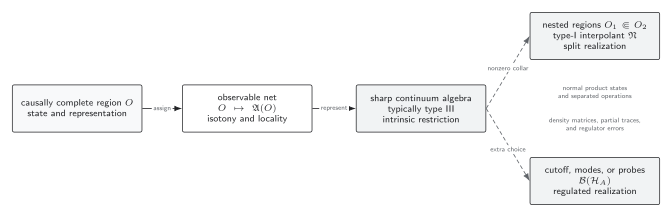
A causally complete region determines a sharp local algebra, usually type III. A nonzero split collar or an explicit cutoff, mode selection, or probe model can instead supply a type-I realization; these alternatives enable ordinary density matrices but retain different physical approximations. Schematic, not to scale.
From nuclearity to splitting
Section titled “From nuclearity to splitting”For an inclusion , a nuclearity estimate with energy resolution tied to the collar width can establish an intermediate type-I factor. Schematically,
for small is the expected extensive phase-space behavior in spacetime dimensions. The constants and exponents are model-dependent; this display is a scaling guide, not a universal theorem.
“Split distance” may denote the infimum collar width for which splitting is known in a given family of regions and states. A qualitative proof of nuclearity can show that this distance vanishes without supplying a useful error bound for a finite experiment. Conversely, a nonzero bound in one criterion may reflect the weakness of the estimate rather than a physical minimum length.
Free massive-field estimate
Section titled “Free massive-field estimate”For a free massive field, one-particle modes contribute Boltzmann weights roughly . The logarithm of a bosonic phase-space determinant is controlled by
times a localization factor set by . The mass suppresses long-wavelength contributions for , while the high-momentum density produces the small- growth. A rigorous proof also controls localization and multiplicities; the thermodynamic-looking integral is only the transparent free-field guide.
Increasing the number of independent species multiplies the logarithm of the index by . An infinite tower with insufficiently sparse masses can destroy the bound. This is the adversarial test: phase-space overpopulation removes the inference to a split inclusion even though locality itself remains intact.
What a reported bound must contain
Section titled “What a reported bound must contain”A quantitative claim must name the nuclearity map, domain, region family, , mass spectrum, species multiplicities, norm, and theorem translating the bound into splitting. Without these data, “the theory is nuclear” cannot be converted into a numerical split error or preparation cost.
Before applying this result, use the validity map to keep the algebra, state, operation class, resources, and approximation fixed.
For a side-by-side statement of the chapter’s subsystem choices, use the subsystem comparison table.
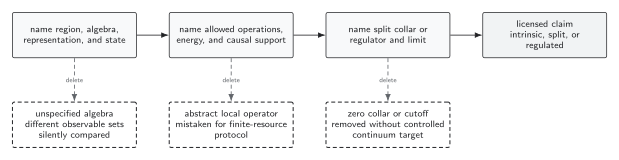
Every local-information claim must specify the represented algebra and state, the allowed operations and resource support, and any split collar or regulator. The dashed lower boxes show what fails when the algebra, protocol, or limiting prescription is left implicit. Schematic.
References
Section titled “References”- Buchholz, Detlev, and Eyvind H. Wichmann. “Causal Independence and the Energy-Level Density of States in Local Quantum Field Theory.” Communications in Mathematical Physics 106 (1986): 321–344. DOI.
Further reading
Section titled “Further reading”- Buchholz, Detlev, Claudio D’Antoni, and Roberto Longo. “Nuclear Maps and Modular Structures. I. General Properties.” Journal of Functional Analysis 88 (1990): 223–250. DOI.