

Numerical Replica and Thermodynamic-Integration Estimators
Numerical replica methods estimate partition-function ratios rather than a density matrix. Swap estimators, incremental ratios, and thermodynamic integration can make those ratios accessible, but their reliability depends on replica sewing, ensemble overlap, autocorrelation, quadrature, normalization, and sign control. A smooth integration curve is not, by itself, evidence that these conditions hold.
Required background. Use the replica construction and branched geometries. Helpful background. Regulated subregion entropy fixes the target and its regulator dependence.
Swap and ratio estimators
Section titled “Swap and ratio estimators”The swap estimator was introduced for quantum Monte Carlo entanglement measurements in Hastings et al. 2010, pp. 157201-1–157201-4. For two copies of a pure state, the swap operator on subsystem satisfies
In a path integral, the swap changes the temporal boundary condition so fields in close on the other replica while fields in close on the same replica. For a large region the swapped and unswapped ensembles can have poor overlap. One can factor the ratio through a sequence of nested regions or intermediate actions, but the product then inherits correlations and normalization factors from every stage. A generic path-integral and stochastic-series implementation is given in Humeniuk and Roscilde 2012, §§ II–III.
The structural map places Numerical Replica and Thermodynamic-Integration Estimators on the route from a regulated subsystem to integer moments, spectral checks, analytic continuation, and a continuum claim.
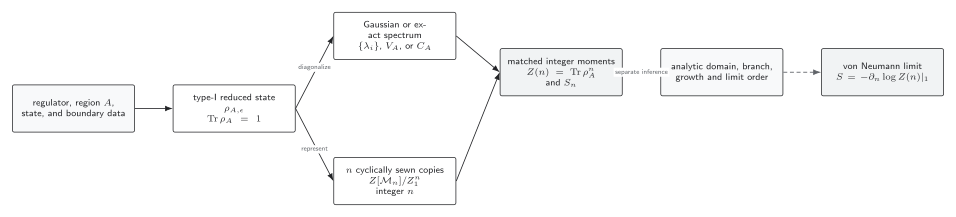
The spectral and replica routes must agree on matched integer moments at fixed regulator. Continuation from those moments to is logically separate and must state its analytic domain, branch, growth conditions, and order of limits. Schematic.
Thermodynamic integration
Section titled “Thermodynamic integration”Let interpolate between ensembles with partition functions and . Then
The path is exact if its endpoints implement the intended replica boundary conditions and the measure is normalized consistently. Numerically, it should be chosen so adjacent ensembles overlap and no hidden phase transition is crossed. Adaptive quadrature addresses curvature in but not biased sampling. Replica-sector tunneling, a sign problem, or long autocorrelation times require separate diagnostics.
For correlated measurements at quadrature nodes, propagate the full covariance rather than adding errors in quadrature as if the samples were independent. Estimate integrated autocorrelation times after equilibration, block the data at scales longer than them, and repeat with independent chains. If reweighting is used, report effective sample size and the tails of the weight distribution.
A scalar-lattice benchmark
Section titled “A scalar-lattice benchmark”Estimate the second Rényi entropy of a small scalar region in three ways:
- exact diagonalization or a covariance-matrix calculation;
- a direct swap estimator;
- thermodynamic integration between unswapped and swapped boundary conditions.
Freeze and archive a set of configurations for a deterministic estimator check, then run independent production chains. Match the lattice action, region, state-preparation extent, and outer boundary. Verify when the region is empty and complement symmetry for a pure state.
Next, deliberately shorten runs until adjacent replica sectors have poor overlap or compute standard errors without autocorrelation correction. The resulting estimate may look stable while disagreeing with the exact answer. A valid workflow detects the bias through overlap diagnostics, chain-to-chain inconsistency, and the independent spectral benchmark.
Error budget
Section titled “Error budget”Separate statistical variance, thermalization bias, autocorrelation, quadrature error, interpolation-path dependence, finite Euclidean-time error, finite volume, and lattice-spacing effects. The first five concern the estimator at fixed regulator; the last three concern the physical target. Combining them into one undifferentiated error bar hides which improvement is needed.
Generic Monte Carlo algorithms are outside this page. The entropy-specific requirements are exact replica endpoints, verified normalization, measurable overlap, covariance-aware integration, and an independent small-system or free-field check.
Before exporting this calculation, use the validity map to check normalization, infrared data, spectral or continuation control, and matched continuum scaling independently.
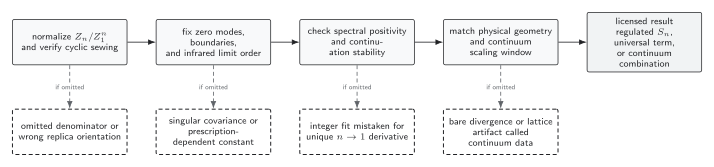
Normalization and sewing establish the intended integer moment; zero-mode and boundary control establish the infrared state; spectral and continuation checks control ; geometry matching and a scaling window establish the continuum target. Omitting any stage licenses only a weaker conclusion. Schematic.
References
Section titled “References”- Hastings, Matthew B., Iván González, Ann B. Kallin, and Roger G. Melko. “Measuring Rényi Entanglement Entropy in Quantum Monte Carlo Simulations.” Physical Review Letters 104 (2010): 157201. arXiv; DOI.
- Humeniuk, Stephan, and Tommaso Roscilde. “Quantum Monte Carlo Calculation of Entanglement Rényi Entropies for Generic Quantum Systems.” Physical Review B 86 (2012): 235116. arXiv; DOI.