

Decoupling and Subsystem Information Loss
A subsystem is decoupled from a reference when its joint state is close to a product state in a declared norm; this means that the subsystem has nearly forgotten the encoded input. In a QFT the statement is meaningful only after fixing the output algebra or regulator, the energy domain, the ensemble or channel being averaged, and the side information. A small expectation value or two-point signal is not decoupling.
Required background. Information Scrambling and Recovery Diagnostics fixes the reference-system and access tuple. Helpful background. Infinite-Dimensional and Energy-Constrained Channel Distances supplies norms that remain informative for field systems.
Product-state criterion
Section titled “Product-state criterion”Let purify the logical input and let be an inaccessible output. A state-level decoupling error is
When the marginal is used, quantum Pinsker gives
for natural logarithms. Thus small mutual information is a sufficient trace-distance certificate. The converse direction has different constants and must not be inferred by reversing Pinsker.
For a channel claim, optimize over all allowed reference-assisted inputs rather than a single state. In an infinite-dimensional system the optimization is normally restricted by
with the reference energy accounted for through the input marginal. The Hamiltonian, vacuum subtraction, and whether is total or excess energy are part of the definition.
What the decoupling theorem averages
Section titled “What the decoupling theorem averages”Finite-dimensional decoupling theorems consider an encoding or unitary drawn from an ensemble and bound the expected distance between and a discarded subsystem. In one-shot form the balance is governed by conditional Rényi or smooth min-entropies: the input must contain enough effective randomness relative to the size of the discarded output and any side information. The exact constants depend on the norm, entropy convention, and design order Dupuis et al. 2014, §§3–4.
The constructive role of decoupling in quantum capacity is shown by Hayden et al. 2008, §§II–IV: an environment that forgets the reference permits a recovery on the receiver. The statement does not say that a fixed Hamiltonian time evolution is Haar random. Applying it to dynamics requires either a proven design property, a model-specific average, or a direct measured decoupling bound.
Finite-energy effective dimension
Section titled “Finite-energy effective dimension”A cutoff gives an effective finite subspace, but two errors must be reported:
The first term is the finite-subspace decoupling error and the second is a typical gentle-truncation bound on the high-energy tail. Uniform continuum control requires the tail bound to hold over the entire declared code family, not only the state used in one plot.
Side information changes the question
Section titled “Side information changes the question”Suppose an observer holds and pre-shared side information . The relevant inaccessible system is not simply the geometric complement : one asks whether is decoupled from conditioned on the resources supplied to the decoder. Classical charge labels, a reference frame, a purification, or an early-radiation register can change the access structure. A result without this resource list is under-specified.
Worked contrast
Section titled “Worked contrast”Take a Bell pair and encode by a two-qubit repetition isometry , . Each single output retains the classical label, so it is not decoupled from ; however, neither single output can recover the phase. This distinguishes quantum decoupling from the disappearance of a chosen local expectation value. A complete quantum-information test must probe a basis sufficient to protect both logical quadratures.
Common pitfalls
Section titled “Common pitfalls”A small correlator is not a product-state bound. It tests one observable pair. Decoupling controls all observables in the declared norm and domain.
Typical is not uniform. An ensemble-average theorem can allow rare unitaries or inputs with large error. State the probability tail or worst-case conversion used for the claim.
Large Hilbert-space dimension is not an energy estimate. In QFT, mode count and accessible energy are different resources; both may diverge under regulator removal.
Exercises
Section titled “Exercises”Show that implies .
Solution
Mutual information is the relative entropy . Positivity of relative entropy is saturated only when its two arguments agree on their common support, giving the product state. The statement assumes the relative entropy is well defined; its algebraic counterpart uses the same equality condition.
Continue to Tripartite Information and Multipartite Scrambling when pairwise decoupling coexists with joint encoding, or to Channel Capacities During Scrambling when the question is an asymptotic communication rate.
Diagnostic and failure maps
Section titled “Diagnostic and failure maps”The first diagram separates influence diagnostics from the decoupling and recovery test; inspect the declared output access, norm, and decoder class. The second collects mechanisms that can imitate scrambling and the controls that distinguish them.
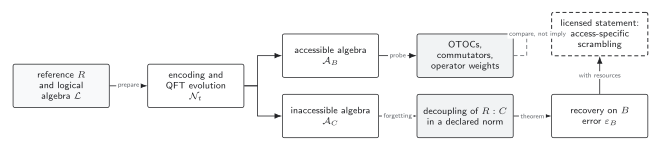
Scrambling becomes operational only after the input algebra, output access structure, side information, norm, energy restriction, and decoder class are declared. OTOCs and operator weights diagnose influence; decoupling and a recovery theorem license a statement about information access. The diagram is schematic and not to scale.
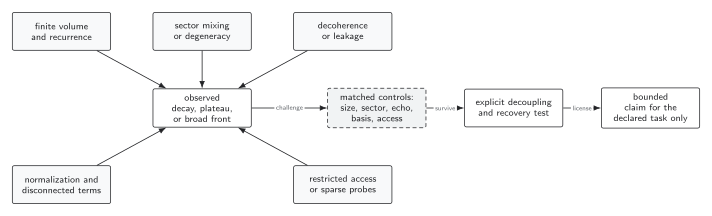
Several mechanisms can suppress a correlator or produce an entropy plateau without delocalizing recoverable quantum information. Sector resolution, recurrence windows, normalization checks, access variation, and an explicit recovery test distinguish these alternatives. The diagram is schematic.
References
Section titled “References”- Dupuis, Frédéric, Mario Berta, Jürg Wullschleger, and Renato Renner. “One-Shot Decoupling.” Communications in Mathematical Physics 328 (2014): 251–284. DOI. Open PDF.
- Hayden, Patrick, Michał Horodecki, Andreas Winter, and Jon Yard. “A Decoupling Approach to the Quantum Capacity.” Open Systems & Information Dynamics 15 (2008): 7–19. DOI. Open PDF.