

Twist Operators, Replica Defects, and Sewing Data
Twist operators and replica defects are local encodings of the cyclic sewing used to compute . In two dimensions the endpoints of an interval support local twist fields. In higher dimensions the entangling surface supports a codimension-two defect. In both cases the permutation, orientation, normalization, and defect operator content are part of the observable.
Required background. Begin with replica sewing and branched geometries. Helpful background. Rényi continuation explains which extra step is needed after the integer- defect correlator is known.
Permutation monodromy
Section titled “Permutation monodromy”Work in the replicated theory and let . Transporting a field counterclockwise around a twist defect implements
The oppositely oriented antitwist implements . A twist–antitwist pair therefore creates the same cyclic cover as cutting along an interval and sewing adjacent sheets. Changing the cycle structure changes the cover and, in general, the moment being computed. Orientation is not a pictorial convention: replacing one endpoint by a twist of the same orientation leaves uncompensated monodromy at infinity.
In a two-dimensional CFT of central charge , the branch-point twist construction in Calabrese and Cardy 2004, § 3 gives the full--cycle weights
Consequently, for an interval on the line,
with the cutoff factors restored so the result is dimensionless. This reproduces the exponent in the replica partition-function ratio. The coefficient depends on field normalization and the endpoint regulator; conformal symmetry does not determine it.
The structural map places Twist Operators, Replica Defects, and Sewing Data on the route from a regulated subsystem to integer moments, spectral checks, analytic continuation, and a continuum claim.
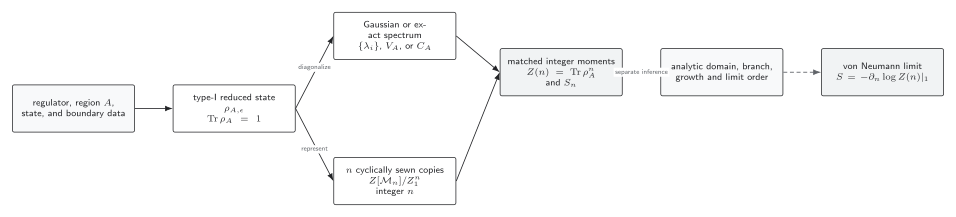
The spectral and replica routes must agree on matched integer moments at fixed regulator. Continuation from those moments to is logically separate and must state its analytic domain, branch, growth conditions, and order of limits. Schematic.
Codimension-two replica defects
Section titled “Codimension-two replica defects”In , a smooth entangling surface supports a codimension-two replica defect. A small transverse loop links and produces the replica permutation. Defect-local operators can be organized by their transverse spin and scaling dimension when the replicated theory is conformal. Their one-point and defect-expansion coefficients encode shape response and correlations with bulk operators. The two-dimensional form-factor realization in Cardy, Castro-Alvaredo, and Doyon 2008, pp. 129–168 provides a concrete nontrivial example.
This language must not be overextended. A generic entangling surface is not a pointlike primary, and defect-CFT formulae require the stated dimension, symmetry, state, and geometry. Corners, physical boundaries, gauge constraints, and singular surfaces add data not contained in the smooth planar defect.
Interval check and failure test
Section titled “Interval check and failure test”Insert a twist–antitwist pair in a vacuum two-dimensional CFT and verify three facts independently: the total monodromy is trivial far from the interval, the exponent equals , and a pure global state gives the same Rényi entropy for the interval and its complement. At , and the normalized correlator reduces to one.
Now replace the full cycle by two shorter cycles or reverse neither endpoint. The resulting correlator may remain a valid replicated-theory correlator, but it no longer represents the original single-interval moment. This controlled change is an effective way to detect a hidden permutation or orientation error before analytic continuation.
Before exporting this calculation, use the validity map to check normalization, infrared data, spectral or continuation control, and matched continuum scaling independently.
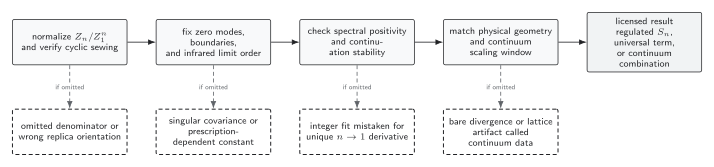
Normalization and sewing establish the intended integer moment; zero-mode and boundary control establish the infrared state; spectral and continuation checks control ; geometry matching and a scaling window establish the continuum target. Omitting any stage licenses only a weaker conclusion. Schematic.
References
Section titled “References”- Calabrese, Pasquale, and John Cardy. “Entanglement Entropy and Quantum Field Theory.” Journal of Statistical Mechanics: Theory and Experiment 2004 (2004): P06002. arXiv; DOI.
- Cardy, John, Olalla A. Castro-Alvaredo, and Benjamin Doyon. “Form Factors of Branch-Point Twist Fields in Quantum Integrable Models and Entanglement Entropy.” Journal of Statistical Physics 130 (2008): 129–168. arXiv; DOI.