

OTOCs, Commutators, and Information Measures
A regulated out-of-time-order correlator (OTOC) or squared commutator measures whether one localized perturbation can influence another observable after time evolution. It becomes an information statement only after a complete operator average, a channel-state identity, or an independent decoupling and recovery comparison supplies the missing access question. OTOC decay by itself does not establish entanglement growth, chaos, information loss, or failed recovery.
Required background. Information Scrambling and Recovery Diagnostics supplies the operational target. Helpful background. Entanglement, Correlation, and Hydrodynamic Fronts supplies the distinct propagation fronts used for comparison.
Regulated operator influence
Section titled “Regulated operator influence”For bounded operators and and a thermal state , one useful regulated correlator is
Other placements of define different analytic boundary values. They cannot be mixed without a contour translation. For unitary Hermitian , the unregulated squared commutator obeys
only with compatible normalization and ordering. For general operators, disconnected terms and two-point functions remain.
Microcausality gives at spacelike separation for local observables, so an exact continuum commutator front cannot outrun the light cone. A lattice regulator may instead have exponentially small Lieb–Robinson tails; the continuum claim must track their scaling.
From an operator basis to a channel statement
Section titled “From an operator basis to a channel statement”In a finite-dimensional bipartite system, average the OTOC over complete orthonormal operator bases on an input subsystem and output subsystem . In the Choi state of the unitary channel, the resulting averaged correlator can be expressed through a second-Rényi mutual information between the reference of and . This identity is the reason some OTOC averages diagnose information delocalization Hosur et al. 2016, §3.
Every qualifier matters:
- the operator family must be complete in the regulated space;
- the averaging measure and normalization must match the channel-state identity;
- second-Rényi information is not automatically von Neumann mutual information;
- conserved sectors require a blockwise average;
- the identity concerns a chosen output partition, not all possible decoders.
A single local pair tests influence along one direction in operator space. It cannot certify decoupling of a reference from an entire algebra.
Three nonconverses
Section titled “Three nonconverses”Decay from noise. A depolarizing or dephasing environment can reduce an OTOC while destroying information into an uncontrolled bath. This is not internal scrambling; the complementary channel identifies the leak.
Growth without loss. A known unitary circuit can produce a large commutator and high operator weight while remaining exactly invertible to an observer with full access.
No decay despite distributed information. Symmetry-protected components can leave a plateau even when the neutral part is strongly delocalized. The plateau is a conserved projection, not necessarily a failure to scramble everything else.
Thermal growth bounds do not define a velocity
Section titled “Thermal growth bounds do not define a velocity”In regimes satisfying analyticity and factorization hypotheses, an early-time connected OTOC may behave schematically as
The Lyapunov rate controls temporal growth and locates a chosen front. They have different dimensions and neither equals a recovery velocity by definition. The bound is conditional on the analytic and boundedness assumptions stated by Maldacena, Shenker, and Stanford 2016, §§2–4; it is not a universal statement about every QFT OTOC or an information-speed limit.
Checks for a usable OTOC
Section titled “Checks for a usable OTOC”- Verify and the disconnected normalization.
- Check the contour by an explicit Euclidean-to-Lorentzian continuation or spectral representation.
- Resolve conserved sectors and subtract only terms justified by the same ensemble.
- Compare forward and echo protocols to expose decoherence.
- Vary operator families, support, regulator, and system size.
- Compare with decoupling or recovery on the same channel and output partition.
Exercises
Section titled “Exercises”For unitary Hermitian and in a normalized trace state, derive .
Solution
Expand . Using and cyclicity of the trace, the middle terms each give , while the first and last are complex conjugates. Hence .
Continue to Operator Growth versus Recoverability for the missing decoder comparison and to Finite Size, Symmetry Sectors, and Scrambling False Positives for adversarial controls.
Diagnostic and failure maps
Section titled “Diagnostic and failure maps”The first diagram separates influence diagnostics from the decoupling and recovery test; inspect the declared output access, norm, and decoder class. The second collects mechanisms that can imitate scrambling and the controls that distinguish them.
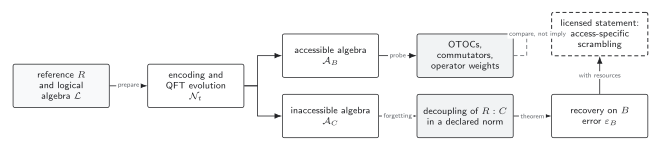
Scrambling becomes operational only after the input algebra, output access structure, side information, norm, energy restriction, and decoder class are declared. OTOCs and operator weights diagnose influence; decoupling and a recovery theorem license a statement about information access. The diagram is schematic and not to scale.
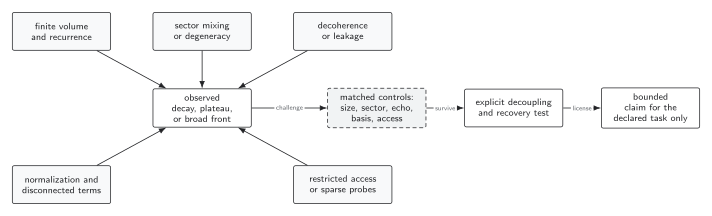
Several mechanisms can suppress a correlator or produce an entropy plateau without delocalizing recoverable quantum information. Sector resolution, recurrence windows, normalization checks, access variation, and an explicit recovery test distinguish these alternatives. The diagram is schematic.