

Approximate Recovery and Information–Disturbance
Approximate QEC is controlled by an information–disturbance principle: a logical algebra is recoverable from the system precisely to the extent that the complementary output forgets the protected information, with quantitative constants that depend on the chosen channel metric and domain. In a field system, the theorem becomes useful only after an energy restriction or algebraic topology prevents arbitrarily energetic witnesses from making every small difference maximal.
Required background. Error Models, Codes, and Recovery Conditions supplies the code and complementary channel.
Helpful background. Petz, Rotated, and Universal Recovery Maps supplies constructive recovery families.
Information–disturbance for a code channel
Section titled “Information–disturbance for a code channel”Let encode the logical system, and let have complement . Exact correction is equivalent to the existence of a constant channel such that
The environment then contains no logical-state dependence. In finite dimensions, continuity of Stinespring dilations yields quantitative comparisons between optimal recovery error and optimal complementary-channel forgetting Kretschmann, Schlingemann, and Werner 2008, Theorem 3 and §IV.
For finite-dimensional input and output spaces, use the unhalved diamond norm in Schrödinger picture and define
The information–disturbance theorem then gives
Equivalently, . The constants change if one inserts a factor in the channel distance or uses infidelity or Bures distance, so conventions cannot be mixed. In particular, if and only if ; saturation at nonzero error is not generic.
For an operator algebra, the comparison channel retains only information in the commutant that the environment is allowed to learn. “Environment becomes constant” is too strong when classical center or gauge information is not protected. Bény and Oreshkov formulate the corresponding approximate-correction problem and near-optimal recovery in channel-fidelity language Bény and Oreshkov 2010, Theorems 1–2.
Weak bosonic noise example
Section titled “Weak bosonic noise example”Encode a finite-energy logical qubit into oscillator modes and let a weak attenuation or erasure channel act. Compute two quantities on the same logical-reference input set:
- environmental distinguishability from the best allowed comparison channel;
- error of an explicit or numerically optimized recovery.
For pure-loss attenuation, the environment receives a fraction of the field amplitude. A code that makes low-energy environment outputs nearly independent of the logical state should admit recovery with a related energy-constrained error. Verify coherences by including a maximally entangled logical reference; comparing only the environment states of and misses phase leakage.
The recovery optimization should be independent of the diagnostic used to select the code. Report Choi or reference-state residuals within the energy-truncated problem, then enlarge the truncation and energy window separately.
Why the energy domain travels with the bound
Section titled “Why the energy domain travels with the bound”An energy-constrained diamond distance may be written
The reference system is retained so entangled logical inputs are tested. The constraint Hamiltonian , ground-energy convention, and whether reference energy is also bounded must be declared. A bound at energy says nothing uniform about inputs whose energy grows with the regulator.
Removing the constraint can make nearby bosonic channels distance two. Switching from average fidelity to a worst-case energy-constrained channel norm can also weaken a result. That is not a contradiction: it is a stronger task.
Equality, achievability, and locality
Section titled “Equality, achievability, and locality”The displayed KSW bound assumes finite-dimensional Hilbert spaces and the full stabilized norm. It does not automatically remain valid with the same constants after replacing that norm by an energy-constrained one or passing to a type-III algebra; an infinite-dimensional application must prove the required continuity and domain statement. Information–disturbance theorems guarantee existence of a recovery in the mathematical channel class. They do not guarantee that it is spatially local, causal within a desired time, energy efficient, or computationally constructible. A QFT application reports these as separate requirements. Petz-type maps can be constructive under suitable states and domains, but their physical implementation and conditioning must be checked.
Exercises
Section titled “Exercises”Classical leakage. The environment learns the code-sector label but no operator inside each matrix block. Which algebra can remain correctable?
Solution
The direct sum of quantum matrix algebras within fixed sectors can remain correctable if the center label is not required to be private. The comparison channel may depend on the center while forgetting noncommuting logical information.
Metric change. Why can small average infidelity coexist with large worst-case error?
Solution
Average fidelity can hide a small subset of badly corrupted states, while the worst-case norm selects them and may entangle them with a reference. A recovery guarantee must use the metric appropriate to the intended code task.
Recovery and continuum maps
Section titled “Recovery and continuum maps”The first diagram follows the task from logical algebra through noise, environmental leakage, and constrained recovery; inspect which metric and recovery family support the guarantee. The second identifies the additional uniformity tests required before finite-regulator correctability becomes a continuum field-code statement.
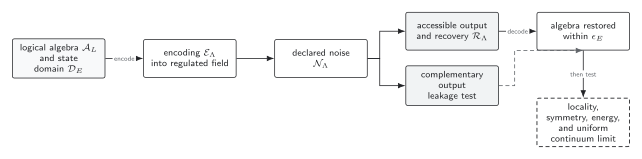
Correctability relates one logical algebra, one noise channel and complement, one state or energy domain, and one recovery class. Environmental forgetting supports recovery only in the matching metric; locality, symmetry, and continuum convergence are additional tests. The diagram is schematic and not to scale.
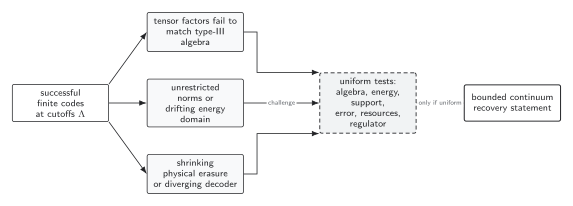
A sequence of successful finite codes does not establish a continuum code unless its logical algebra, physical erasure region, energy domain, recovery error, and locality bounds converge uniformly. Type-III structure and regulator-dependent tensor factors require an algebraic target. The diagram is schematic.
References
Section titled “References”- Bény, Cédric, and Ognyan Oreshkov. “General Conditions for Approximate Quantum Error Correction and Near-Optimal Recovery Channels.” Physical Review Letters 104 (2010): 120501. DOI. Open PDF.
- Kretschmann, Dennis, Dirk Schlingemann, and Reinhard F. Werner. “The Information-Disturbance Tradeoff and the Continuity of Stinespring’s Representation.” IEEE Transactions on Information Theory 54 (2008): 1708–1717. DOI. Open PDF.