

Complexity with Symmetry, Gauge, and Locality Constraints
Symmetry, gauge constraints, superselection sectors, and spatial locality restrict which transformations count as admissible gates. Complexity must be minimized after these restrictions are imposed. Comparing a constrained result with an unconstrained one measures an overhead only when the reference, target, tolerance, and charged ancillary resources are otherwise matched.
Required background. Circuit Complexity in Quantum Field Theory supplies the regulated gate task. Symmetry-Constrained Operations in QFT supplies the operational meaning of symmetric transformations.
Helpful background. Gauge Constraints, Centers, and Edge Data supplies the algebraic alternatives to naive spatial factorization.
Symmetric gates and sector preservation
Section titled “Symmetric gates and sector preservation”Let a group act by and let the physical task forbid an external reference frame. An admissible unitary satisfies
or, for a channel,
Generators then lie in the commutant of the symmetry action. A conserved charge decomposes the regulated Hilbert space into sectors, and symmetric gates cannot create coherence between them without an asymmetry resource. If the target and reference have incompatible charge distributions, the admissible set may be empty rather than merely expensive.
Supplying a charged ancilla or phase reference enlarges the task. Its state, size, degradation, and return condition must be charged. Calling it “free” converts a constrained complexity into an unconstrained one.
This dependence on a reference-frame resource is an operational consequence of symmetry-restricted state transformations, not merely a choice of basis Bartlett, Rudolph, and Spekkens 2007, §§II–IV.
Gauge constraints are not optional symmetries
Section titled “Gauge constraints are not optional symmetries”In a lattice gauge regulator, physical states satisfy Gauss constraints and physical gates preserve the constraint subspace or implement a controlled gauge-covariant dilation. Gauge fixing can simplify coordinates but does not license gates that move between gauge copies as if they were distinct physical states.
For spatial subregions, the physical algebra can have a center and need not come from a tensor factor. A circuit task must choose an algebraic, extended-Hilbert-space, or edge-mode prescription. Complexity differences between prescriptions are definition differences unless a mapping charges the added boundary degrees of freedom.
In lattice gauge theory, even the distillable entanglement depends on the operationally accessible gauge-invariant algebra and sector information Van Acoleyen et al. 2016, pp. 1–4; a complexity comparison must declare the analogous access convention.
A small gauge-system comparison should therefore use three columns:
| Model | Admissible gates | Resource that changes |
|---|---|---|
| unconstrained link Hilbert space | arbitrary local link unitaries | solves an enlarged, generally unphysical task |
| gauge-invariant circuit | plaquette, electric, and matter-gauge generators preserving Gauss law | may need greater depth or become unreachable |
| extended space with charged ancillas | invariant joint gates plus declared edge resources | overhead depends on ancilla accounting |
Locality and causal implementation
Section titled “Locality and causal implementation”A gate may respect global symmetry yet be spatially nonlocal. Fix a range , arity, parallelization rule, and norm or amplitude bound. Under finite-range bounded controls, information propagates within an effective light cone, producing depth lower bounds for long-range correlations. In relativistic QFT, a physical protocol must also respect spacetime support and causal ordering; an abstract momentum-mode gate is not local merely because it is quadratic.
Penalty metrics can approximate locality by assigning large costs to nonlocal generators, but a finite penalty still allows them. A hard constraint and a soft penalty are different tasks. Demonstrate robustness by increasing the penalty and checking whether the optimizer converges to an admissible local path.
Matched overhead calculation
Section titled “Matched overhead calculation”To compare unconstrained and constrained preparation for a regulated gauge-field state:
- project both reference and target into the same physical charge sector;
- fix the same fidelity or observable tolerance;
- synthesize an explicit gauge-invariant circuit for an upper bound;
- prove a lower bound from charge transport, locality, or missing reference-frame resource;
- add a charged ancilla and charge its preparation to test whether the overhead moves;
- vary gauge fixing and confirm physical predictions agree.
The ratio of two costs is meaningful only within this matched construction. A divergent overhead can indicate an impossible target, an improperly chosen reference, or a genuine resource restriction; the checks distinguish them.
Exercises
Section titled “Exercises”Unreachable target. A -symmetric circuit starts in a charge eigenstate and the target is a coherent superposition of two total charges. What is the constrained complexity?
Solution
No admissible symmetric unitary prepares the target, so the feasible set is empty. One may call the cost infinite by convention, but the informative statement is unreachability. Adding a phase reference defines a new task whose resource must be counted.
Gauge fixing. Why is a shorter path in one gauge not automatically a physical improvement?
Solution
The coordinate path may move along gauge redundancy or use gates that do not preserve the physical constraint. Translate it to gauge-invariant operations and compare on the physical algebra; only that charged implementation has operational meaning.
Task and validity maps
Section titled “Task and validity maps”The first diagram distinguishes target objects and their admissible resource models; inspect which equivalence class is being minimized over. The second shows the definition changes and physical controls that must be held fixed before two complexity values or growth laws are compared.
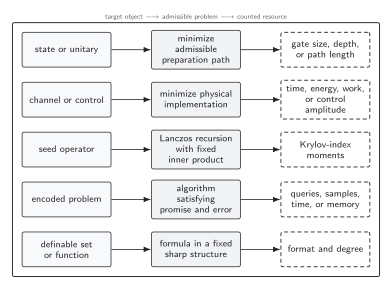
A complexity value is defined only after the target object selects an admissible family of paths or descriptions. Circuit length, physical control cost, Krylov spread, algorithmic resources, and sharp o-minimal format or degree answer different questions. The diagram is schematic and not to scale.
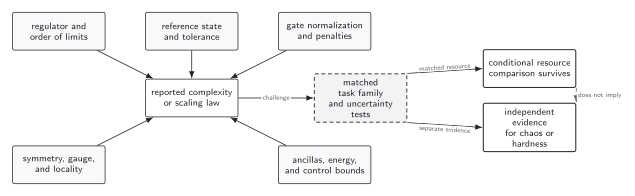
Reference sensitivity, gate nonuniqueness, regulator dependence, symmetry constraints, and unbounded controls are distinct failure modes. A link from complexity growth to chaos or computational hardness requires separate evidence after those controls. The diagram is schematic.
References
Section titled “References”- Bartlett, Stephen D., Terry Rudolph, and Robert W. Spekkens. “Reference Frames, Superselection Rules, and Quantum Information.” Reviews of Modern Physics 79 (2007): 555–609. DOI. Open PDF.
- Van Acoleyen, Karel, Nick Bultinck, Jutho Haegeman, Michael Mariën, Volkher B. Scholz, and Frank Verstraete. “Entanglement of Distillation for Lattice Gauge Theories.” Physical Review Letters 117 (2016): 131602. DOI. Open PDF.