

Gaussian States and Correlation-Matrix Entropy
For a Gaussian state, all reduced-state entropies are determined by two-point functions on the declared regulated subsystem. Bosons require the symplectic spectrum of the restricted covariance matrix; fermions require the occupation spectrum of the restricted correlation matrix. The formulas are powerful precisely because Gaussianity, canonical normalization, positivity, and constraint handling are explicit hypotheses.
Required background. Start with entropy of a regulated subregion. Helpful background. Restricted states and subregion observables clarifies what the matrix restriction represents.
Bosonic covariance data
Section titled “Bosonic covariance data”Collect canonical coordinates into with
Physicality requires . Restrict and to the chosen canonical modes in . The eigenvalues of occur in real pairs ; their positive moduli are the symplectic eigenvalues , and
If , one may equivalently diagonalize . That shortcut fails for a general squeezed state with position–momentum correlations; the full symplectic calculation is then required. Very small violations of usually indicate numerical loss of positivity or inconsistent canonical scaling, not negative entropy physics.
The structural map places Gaussian States and Correlation-Matrix Entropy on the route from a regulated subsystem to integer moments, spectral checks, analytic continuation, and a continuum claim.
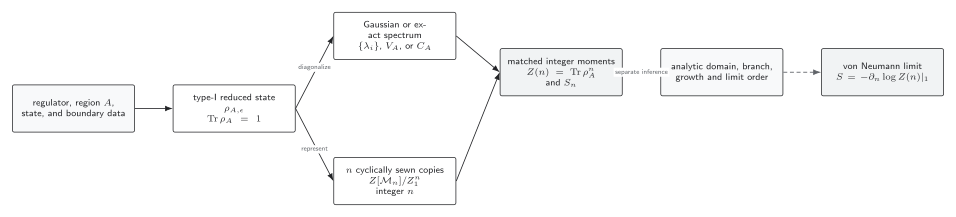
The spectral and replica routes must agree on matched integer moments at fixed regulator. Continuation from those moments to is logically separate and must state its analytic domain, branch, growth conditions, and order of limits. Schematic.
Fermionic correlation data
Section titled “Fermionic correlation data”The correlation-matrix reduction is derived explicitly in Peschel 2003, pp. L205–L208. For a number-conserving fermionic Gaussian state, restrict
to modes in . Its eigenvalues satisfy , and
Pairing states require a Nambu or Majorana covariance matrix rather than the number-conserving formula. Gauge constraints or a nonorthonormal mode basis likewise require a prior reduction to independent canonical degrees of freedom. Simply extracting a coordinate subblock need not define a subsystem.
Matched interval calculation
Section titled “Matched interval calculation”For bosonic and fermionic lattice vacua, choose intervals of the same physical length and evaluate the relevant restricted spectra; Srednicki 1993, pp. 666–669 is a canonical bosonic area-law benchmark. Check the following before comparing entropies:
- the bosonic uncertainty matrix is positive and every ;
- the fermionic is Hermitian with spectrum in ;
- a pure global state has matching nontrivial spectra for and ;
- exact diagonalization agrees for a small system;
- increasing numerical precision stabilizes eigenvalues near , , or .
Perturbing outside the uncertainty cone can leave a visually plausible matrix while making the entropy formula complex or negative. Adding a connected four-point cumulant provides a different failure: the covariance remains physical, but it no longer determines the entropy because the state is non-Gaussian. Both tests expose the hypothesis on which the method depends.
Numerical conditioning
Section titled “Numerical conditioning”Avoid forming products whose nonnormality magnifies roundoff when a symplectic eigensolver is available. Symmetrize only within an error budget; do not project a badly inconsistent covariance to the nearest physical matrix and then report the projected entropy as raw data. Record canonical normalization, subsystem basis, precision, eigenvalue clipping policy, and the change induced by any repair.
Before exporting this calculation, use the validity map to check normalization, infrared data, spectral or continuation control, and matched continuum scaling independently.
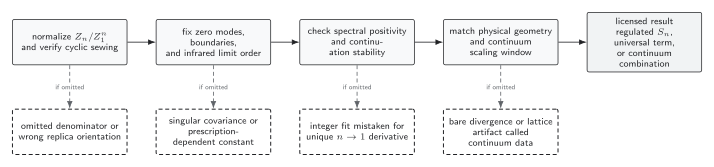
Normalization and sewing establish the intended integer moment; zero-mode and boundary control establish the infrared state; spectral and continuation checks control ; geometry matching and a scaling window establish the continuum target. Omitting any stage licenses only a weaker conclusion. Schematic.