

Reeh–Schlieder Property and Limits of Localization
The Reeh–Schlieder theorem says that the vacuum is cyclic for every suitable nonempty local algebra. Local operators can therefore approximate any global vector arbitrarily well. This is a statement about density in Hilbert space; it does not give a bounded-norm, bounded-energy, deterministic remote-control protocol and does not permit superluminal signaling.
Required background. Review vacuum representations, relativistic causality, local nets, and type-III structure. Helpful background. The spectrum condition supplies the analytic input, and cyclic and separating vectors gives the modular interpretation.
The theorem and its hypotheses
Section titled “The theorem and its hypotheses”For a relativistic QFT satisfying the spectrum condition and standard locality/analyticity assumptions, the vacuum is cyclic for the algebra of any nonempty open region :
Locality then makes separating for when the causal complement has nonempty interior. The original result was proved by Reeh and Schlieder Reeh and Schlieder 1961, pp. 1051–1068.
The analytic mechanism is important. Positive energy makes vacuum correlation functions boundary values of analytic functions. If a vector is orthogonal to all local excitations in an open region, analyticity and locality force it to be orthogonal to a much larger set, ultimately to the whole vacuum sector.
The structural map places Reeh–Schlieder Property and Limits of Localization among sharp local algebras, split inclusions, and regulated or operational substitutes.
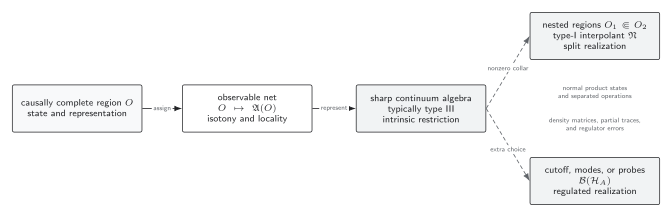
A causally complete region determines a sharp local algebra, usually type III. A nonzero split collar or an explicit cutoff, mode selection, or probe model can instead supply a type-I realization; these alternatives enable ordinary density matrices but retain different physical approximations. Schematic, not to scale.
Why density is not cheap preparation
Section titled “Why density is not cheap preparation”For a target vector and any , cyclicity ensures some with
It supplies no bound on , the energy of , the success probability of an associated selective operation, or how these scale as . Approximating a distant, sharply localized excitation normally requires increasingly singular high-energy components.
Moreover, a nonunitary operator applied and renormalized as represents a postselected branch, not a deterministic channel. The normalization probability and the physical measurement that realizes the branch must be included.
Free-field wavepacket check
Section titled “Free-field wavepacket check”Let be a one-particle wavepacket concentrated far from . Reeh–Schlieder implies a sequence with . A meaningful check records simultaneously
Holding or fixed while forcing is the adversarial test. The theorem does not promise that all three remain controlled.
No superluminal signal
Section titled “No superluminal signal”For a trace-preserving operation localized in , expectation values in a spacelike algebra remain unchanged when causal factorization holds. A remote observer cannot condition on an uncommunicated local outcome. Selective branches may display changed conditional correlations, but using them requires classical information and therefore cannot signal outside the light cone.
Common pitfalls
Section titled “Common pitfalls”Dense is not equal. A local orbit is norm-dense; a target vector need not be created exactly by a bounded local operator.
Cyclicity is not a protocol. It omits energy, norm, probability, switching, and disturbance until those are supplied by an operational model.
Before applying this result, use the validity map to keep the algebra, state, operation class, resources, and approximation fixed.
For a side-by-side statement of the chapter’s subsystem choices, use the subsystem comparison table.
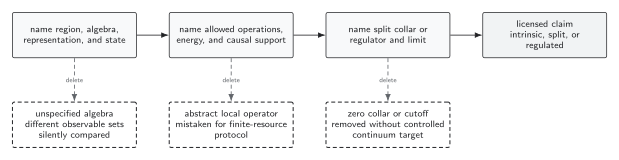
Every local-information claim must specify the represented algebra and state, the allowed operations and resource support, and any split collar or regulator. The dashed lower boxes show what fails when the algebra, protocol, or limiting prescription is left implicit. Schematic.
References
Section titled “References”- Reeh, Helmut, and Siegfried Schlieder. “Bemerkungen zur Unitäräquivalenz von Lorentzinvarianten Feldern.” Il Nuovo Cimento 22 (1961): 1051–1068. DOI.